Showing posts with label physics. Show all posts

Friday, June 18, 2021

Historical physics and astronomy as .gifs


Galilei, Galileo, 1564-1642. Istoria e dimostrazioni intorno alle macchie solari e loro accidenti, 1613.

Put Galileo's 1612 drawings of sunspots together and what do you get (via Houghton Library, Harvard University)? 


Gifs taken from a 1929 film by Nobel laureate William Lawrence Bragg demonstrating his research into surface tension and spectroscopic analysis of light reflected from a soap film. (via the Royal Institution tumblr)

NASA imagery of Pioneer via the US National Archives on GIPHY

This work from the Dibner Library of the History of Science and Technology,  Celestial scenery, or, The Wonders of the planetary system displayed (1845) was written by Thomas Dick, a Scottish minister and science educator.
This work from the Dibner Library of the History of Science and Technology,  Celestial scenery, or, The Wonders of the planetary system displayed (1845) was written by Thomas Dick, a Scottish minister and science educator. (via the Smithsonian)


And of course Eadweard Muybridge:


Wednesday, February 20, 2019

Sol-Monath is for Science Cakes

Celestial Cephalopod Created by Corinna Maguire for the Threadcakes Competition

I learned from the Wellcome Collection (a museum which aims to share "science, medicine, life and art") that February was once the month of cakes.


so let's talk about cakes as science-art and science communication shall we?

ATLAS detector cake (credit: Katharine Leney via Symmetry)

Universe cake (credit: David Morse and Katharine Leney via Symmetry)

Particle physicists Katy Grimm and Katharine Leney who work on the ATLAS collaboration at CERN, discovered they also share a mutual love of baking. Symmetry magazine covers their delightful cakes (and other baked goods) which do everything from directly illustrating the ATLAS particle detector, to equations, diagrams and other data visualizations to metaphorically communicating the structure of protons according to the Standard Model or communicating through the medium of the cosmos cake, the proportions of regular matter, dark matter and dark energy. You'll find more via PhysicsCakes on Twitter.

In the wonderful world of science cakes, Earth and planetary science and amazingly well represented. Australian zoologist Rhiannon has posted several wonderful examples, including tutorials for nested spherical cakes on her blog Cakecrumbs.

This wonder Earth cake shows oceans and continents on the blue icing layer, orange mantle and yellow inner and outer core layers. (via Cakecrumbs)

The beautiful Jupiter cake likewise has three concentric layers to represent rocky and icy core, a middle liquid metal hydrogen layer and an outer molecular hydrogen layer. She says the famous giant anticyclone storm, the Great Red Spot was what attracted her. She recreated the patterns in the atmosphere with "ivory marshmallow fondant, then dry brushing a combination of ivory, brown and maroon edible ink." (via Cakecrumbs)

You can find space cakes bedecked or embedded with the planets of the solar system! Consider this tutorial for Mirror Glaze Galaxy Cake from the Also the Crumbs Please blog, the Astronomy themed groom's cake or the award-winning portrait of Galileo Galilei!

Astronomy-themed groom's cake shot by Laurel McConnell


Mirror Glaze Galaxy Cake from the Also the Crumbs Please

Galileo cake, winner of the Birmingham’s Cake International gold medal in the international class.

The mirror glaze is also just the thing for anyone creating cakes representing marble, many minerals or geode cakes. Geodes in fact, have been a real trend in wedding cakes and there is an astonishing array of geode inspired cakes in every imaginable colours.

Mirror glaze cake with recipe from Musely
Boho geode wedding cake by Cake Life Bake Shop | Photo by Hope Helmuth
Geode cake via You and Your Wedding

Natural history cakes don't stop with mineral specimens! Flora and fauna are popular too. There's a long history of using actual edible flowers, or sculpting flowers or leaves, often cast directly from actual plants - but those that convincingly recreate lifeforms with cake, icing, chocolate, fondant and other edibles are my favourites.

Lifelike deer cake by legendary Grand Dame of the cake decorating world, Sylvia Weinstock
This beauty hits on both natural history and the history of science as it's inspired by the hyper-realistic botanical still-life paintings of Dutch artist Rachel Ruysch (1685 to 1750). This cake is deocrated with custom-made sugar flowers, created by Amy DeGiulio of Sugar Flower Cake Shop in New York City, and placed in a gold urn to complete the look. (via Martha Stewart Weddings)

Tasmanian Masked Owl cake from Cakecrumbs
Albino Burmese Python Snake cake by by Francesca Pitcher from North Star Cakes


Jakarta-based pastry chef Iven Kawi who runs the Iven Oven where she makes these wonderful terrarium inspired cakes which hit the succulent trend (via Colossal)


My son requested a dinosaur-shaped cake, capped with a Cretaceous scene with volcano and smaller dinosaurs for his 5th birthday, so I assure you, this is but a tiny peek at what is out there. I haven't even touched on paleontological cakes, or the gothic world of anatomy cakes. There's a whole world of yummy cake-based science art/communication out there for you to explore and, better yet, eat.

(Hat-tip to my friend Faunalia, who has been sharing images of amazing cakes with me for years! You can find some of our favourite images here.).

Tuesday, October 11, 2016

Ursula Franklin for Ada Lovelace Day #ALD16

Ursula Franklin, linocut, 11" x 14" by Ele Willoughby, 2016
Cross-posted from the minouette blog 

This year, to celebrate the international celebration of the achievements of women in science, technology, engineering and math, Ada Lovelace Day (ALD16), I am returning again to my first subject: Ursula Franklin (16 September 1921 – 22 July 2016). Every year since 2009, people have devoted the 2nd Tuesday in October to blogging about (and otherwise celebrating) the under-recognized and under-appreciated women who have made pivotal contributions to STEM throughout history, in the name of Countess Ada Lovelace. (I hope you'll all recall, Ada, brilliant proto-software engineer, daughter of absentee father, the mad, bad, and dangerous to know, Lord Byron, she was able to describe and conceptualize software for Charles Babbage's computing engine, before the concepts of software, hardware, or even Babbage's own machine existed! She foresaw that computers would be useful for more than mere number-crunching. For this she is rightly recognized as visionary - at least by those of us who know who she was. She figured out how to compute Bernouilli numbers with a Babbage analytical engine. Tragically, she died at only 36.)

A preliminary mock-up of one of the Phylo cards
in this new Women in Science and Engineering set
featuring my portrait of today's namesake: Ada Lovelace
I began participating in Ada Lovelace Day in 2010, and I knew immediately I should write about Ursula Franklin. For me she really personifies the goals of ALD; not only did she represent excellence in science and engineering, but she was a great, perhaps even visionary, thinker on the very role of technology in our society, as well as a fearless and tireless advocate for women in STEM, peace and social justice. Her research interests and achievements were clearly guided by her principles, including gathering evidence of the harmful health effects of radiation from atmospheric testing of nuclear weapons to or her work on the political and societal impacts of support of the technologies and their use. When she died earlier this year, I wrote about her life, work and how she has been one of my heroes since I was too young to fully appreciate the importance of role models in my scientific career. Her influence as a roll model of women in physics and engineering here cannot be overstated. She was one of the most impressive people I have ever met. I got some encouragement from friends to do something I had long contemplated: add her portrait to my growing collection of scientists. When I finally sat down to do so this September, I was really tickled to open my email and receive a commission to do precisely that! I'm really pleased to say I'm going to be contributing some artwork to latest edition of the Phylo Project from Dave Ng and the Advanced Molecular Biology Laboratory (the science education facility within the Michael Smith Laboratories, UBC): a trading card game about Women in Science and Engineering! Sometimes you get several hints of what work you should do next; this portrait's time clearly had arrived.

Franklin was born in Munich in 1921 and survived being interned by the Nazis. She received her PhD in physics from the Technical University of Berlin in 1948 and immigrated to Canada, where after a post-doc at U of T, she joined the faculty. She pioneered archeometry - the use of modern materials analysis in archeology, dating prehistoric artifacts made of metals and ceramics. In my portrait I include an image of an ancient Chinese ding vessel to represent both her metallurgical research and archeometry and her writing about "prescriptive" versus "holistic" technologies used in mass production versus technologies used by craft workers and artisans. Her science was always engaged with societal concerns. During the 60s she advocated for the atmospheric nuclear test ban treaty, citing her studies of strontium-90 radioactive fallout found in children's teeth. Strontium-90 (90Sr) is called a "bone-seeker" because biochemically it behaves like calcium and when absorb it in our bodies what isn't excreted finds its way to our bones. Thus, this radioactive product of nuclear fission (for instance, in atmospheric tests of nuclear weapons) is particularly dangerous and can cause cancers. It decays by beta decay, giving off electrons, as shown by the child's tooth in my portrait. During the 70s she was part of the Science Council of Canada investigation of how we could better conserve resources and protect nature. She began to develop her ideas about complexities of modern technological society.

She consistently has stood up for her beliefs in peace and social justice. As a member of the Voice of Women (now called Canadian Voice of Women for Peace), she tried to persuade Parliament to disengage Canada from supplying any weapons to the US during the Vietnam war, to shift funding from weapons research to preventative medicine, to withdraw from NATO and disarm. She later fought to allow conscientious objectors to redirect part of their income taxes from military uses to peaceful purposes (though the Supreme Court declined to hear the associated case). She joined other retired female faculty in a class action law suit against the University of Toronto for claiming it had been unjustly enriched by paying women faculty less than comparably qualified men. The University settled in 2002 and acknowledged that there had been gender barriers and pay discrimination.

As an applied scientist, her writings on technology benefit from the insight of an insider, but her priorities are justice and peace and she critiques and analyses technology in this light. She does not view technology as neutral; it is a comprehensive system that includes methods, procedures, organization, "and most of all, a mindset". It can be work-related or control-related, holistic and prescriptive. Franklin argues that the dominance of prescriptive technologies in modern society discourages critical thinking and promotes "a culture of compliance". She investigated the relationship between technology and power. She investigated how we interact with communication technologies and advocated for the right to silence - long before our contemporary concern with these issues.

Many of her articles and speeches on pacifism, feminism, technology and teaching are collected in The Ursula Franklin Reader (2006). A nod to her pacifism and feminism is built into the structure of her portrait which encompasses the symbols for peach and women in the negative space. Franklin is one of many respected scholars and thinkers to have delivered a series of Massey Lectures, in 1989. Hers were gathered and published as The Real World of Technology. She has been recognized for her work in many ways, including receiving the Order of Canada, Governor General's Award in Commemoration of the Persons Case for promoting the equality of girls and women in Canada and the Pearson Medal of Peace for her work in advancing human rights. She was inducted into the Canadian Science and Engineering Hall of Fame in 2012. Locals may know the Ursula Franklin Academy, a Toronto high school, named in her honour. I think this University, city, country and in fact, society at large were made a better place because Ursula Franklin was a part of it. So, though she has received this recognition, I think she should be a household name, so that's why I am happy to add her to my portrait pantheon of scientists and write about her again this Ada Lovelace Day 2016. I also think that it is very apt to combine making her portrait using holistic technologies of the artisan and sharing it through more prescriptive digital technologies with the world.

(NB: much of the biographical information is recycled from my own previous post about Franklin) .

Wednesday, February 22, 2012

Science Nation Army

Today, instead of 'art about science' I bring you 'science about art', if you will.
"Using real footage and sounds from a working science lab, the Inside Knowledge team have reconstructed the White Stripes song Seven Nation Army from scratch."


The equipment is from Imperial College's BLAST lab; like its name suggest, the scientists at the lab study the effects of explosions, specifically "the behaviour of the human skeleton under high impulse loading" from an inter-disciplinary perspective involving medicine, physics, bioengineering, and military research. You can imagine how the machinery might inspire a percussionist. The Inside Knowledge team consists of four science communication students who are interested in the scientific process, not just the sort of headline-grabbing results released at press conferences. They say they want to produce a unique multimedia diary of their time 'embedded' at the BLAST lab. I'm really impressed; this may not be what we think of as 'science communication' but the video did effectively give me a glimpse of what they actually do in the lab, piqued my interest and entertained me - all of which is far to rare in much of the scientific journalism out there.

(via Toronto Standard)

Monday, June 28, 2010

Stats, Lines and Stars

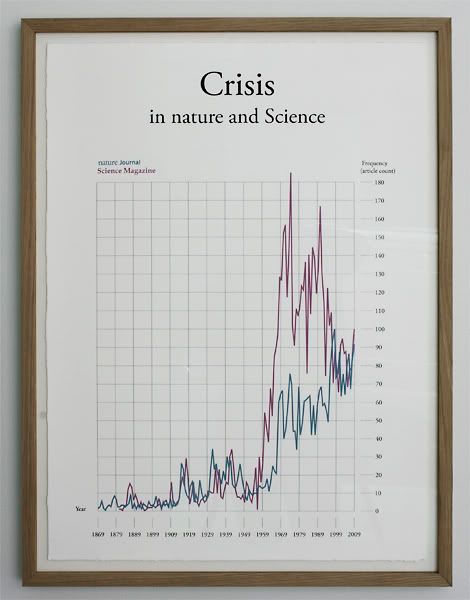
I came across Norwegian artist Toril Johannessen via I'M REVOLTING. She's made some interesting pieces in Words and Years by simply making elegant plots (even Tufte would approve) of the yearly occurances of certain words in certain journals, such as 'Crisis' in nature and Science:


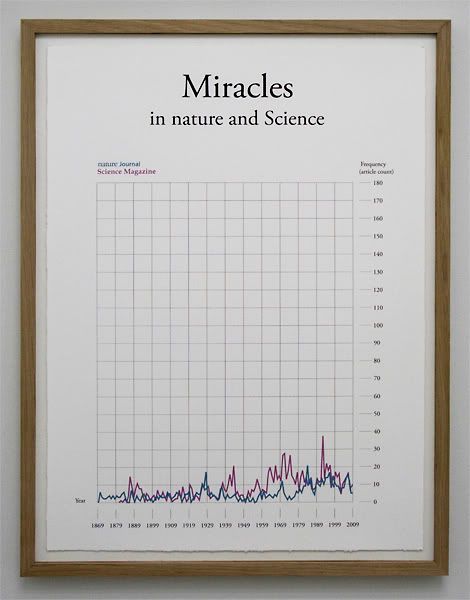
or as 'Miracles' in nature and Science:


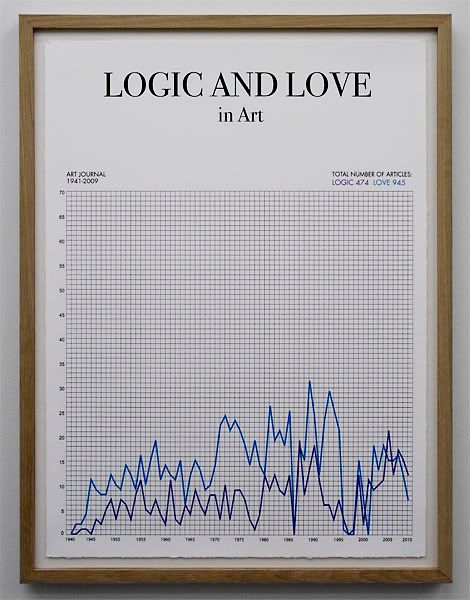
which we can contrast with 'Logic" and 'Love" in Art


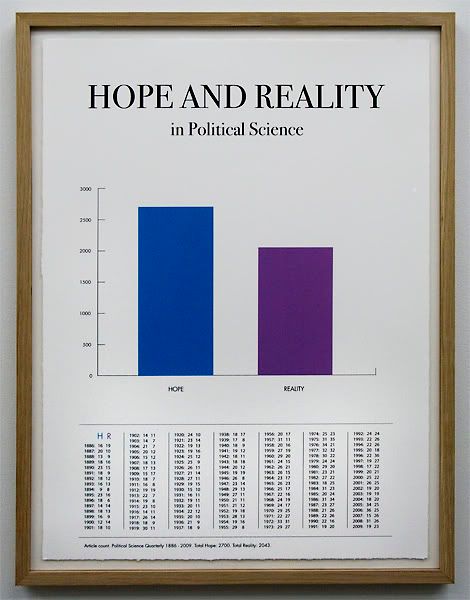
or 'Hope" and 'Reality' in Politcal Science


I love the simplicity of these pieces. These are real data and really say something, but, like in science (and other scholarship) itself, the interpretation of the data is left to the viewer. There is both insight and humour in the data she chooses to present.

She's previously tackled science and that inspiring place where art and science intersect. In Transcendental Physics she imagined the intersection of German astrophysicist Johann Zöllner (1834-1882), who studied optical illusions, and the Canadian/US visual artist Agnes Martin (1912-2004), an abstract expressionist who employed lines and grids. Zöllner discovered that parallel lines appear like they will intersect if cross-hatched with shorter lines at an angle - this is known as Zöllner's illusion as shown to the left. She drew her imagined Agnes Martin interpretation of this effect:
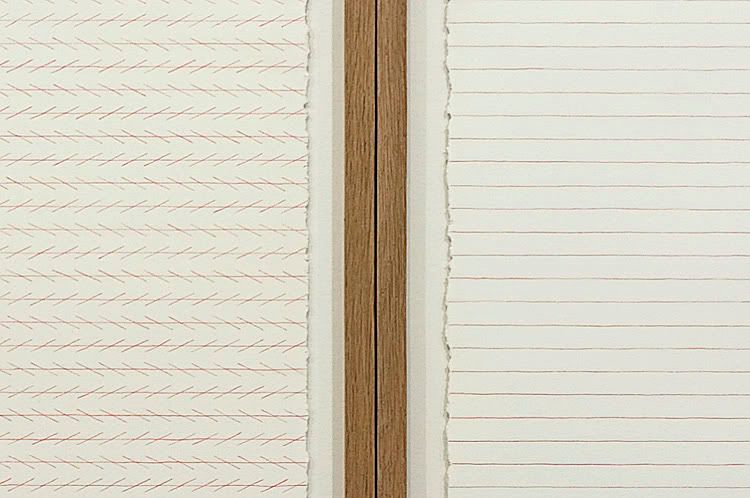

Zöllner's illusion and Agnes Martin's lines
Color pencil drawing (diptych). 46 x 101 cm.
Detail.


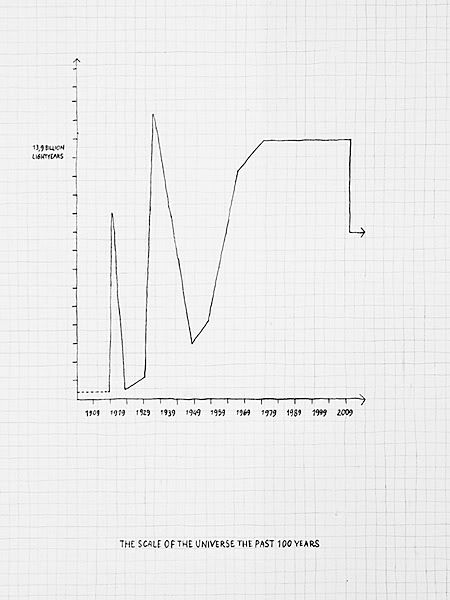
The Scale of The Universe The Past 100 Years.
Drawing. Pencil on paper. 29,7 x 42 cm.

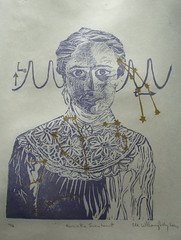
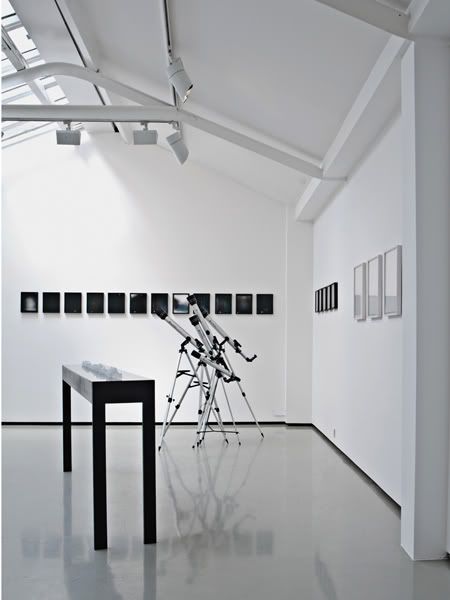
Henrietta Swan Leavitt In 2009, she tackled a topic I've also depicted, in Variable Stars. She points out that at the beginning of the 20th century our estimated scale for the Universe increased radically, and she describes how the project of mapping and photographing the entire sky at the Harvard College Observatory, Cambridge, MA, employed cheap yet conveniently accurate female labour, with all the work done by 'The Havard Computers'. These women were literally treated as automatons and had no status as scientific staff. Nonetheless, as several 'Computers' were outstanding astronomers, they also developped theories about the immense dataset they painstakingly gathered. Henrietta Swan Levitt (shown in my lino block print portrait at left) made a discovery which forever changed our understanding of the scale of the Universe, allowed Hubble's later insight about the age and expansion of the universe and gave us 'Standard Candles' as a metre-stick for the Universe at large. She found a correlation between brightness and period of a particular type of variable stars, the Cepheid Variable stars. I tackled this subject by printing a portrait of Swan Leavitt with how luminosity varies with time and the constellations around and including Cepheus, where she made her discovery. Johannessen travelled to the Harvard College Observatory and dug through the archives, selecting plates showing any stars which would be visible from her location in Norway. She made copies of the photographs, she cut out the cepheid or RR Lyrae star (those used as 'Standard Candles') and them as seeds for growing crystals of alum, a substance that is used as a component in photographic paper. Her installation also included the plot above, photographs and the telescopes below.


Variable Stars
Installation view. Photographs, crystals on table, drawings, telescopes. Oslo Kunstforening, January 2009.

Her work also alludes to geology, orienteering, engineering and technology. It's fascinating. Go check out her portfolio! I really enjoy the artwork and her sophisticated understanding of science, the propagation and dissemination of scientific ideas, and the interplay between science and society.

Wednesday, June 16, 2010

promise & uncertainty of science


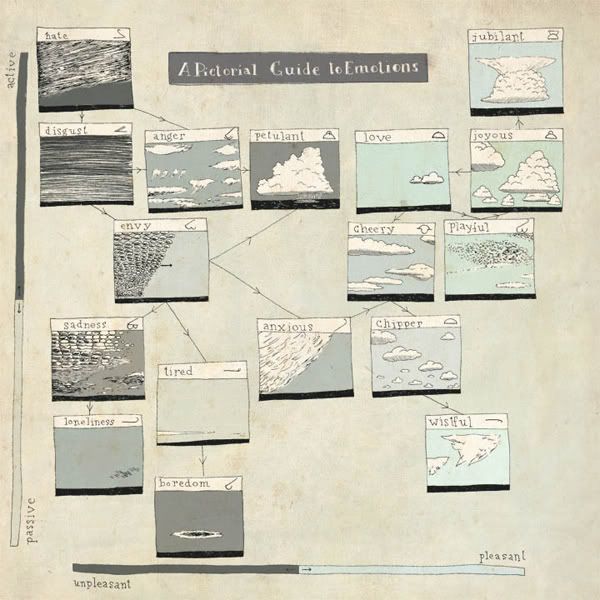
A Pictorial Guide to the correlation between emotions and cloud formations

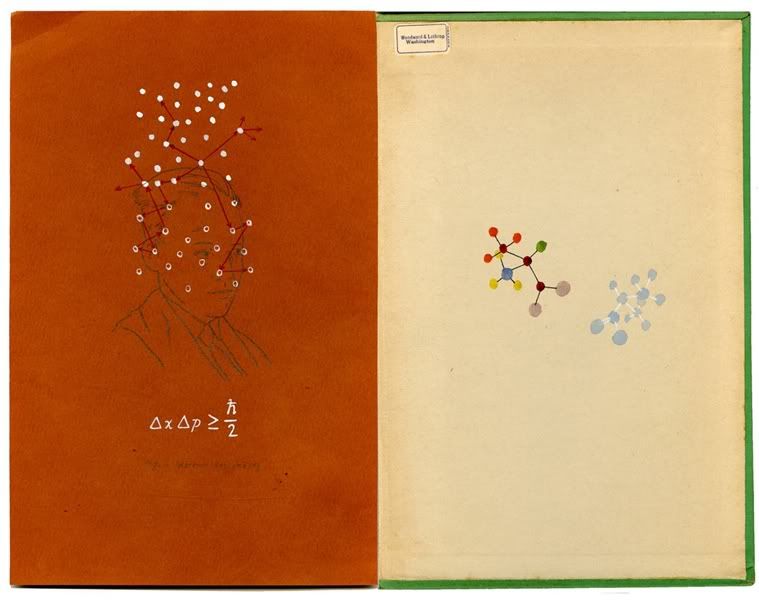
Shannon May is an illustrator living in Baltimore, MD. She writes that she is "fascinated by the promise and aesthetics of science and loves exploring, being uncomfortable, books, clouds, and geometry." Her intersection of art and science is up my alley. In fact, her portrait of Heisenberg reminds me of my own approach to portraits of scientists: combining their face with their work. At first I thought this was not that literal, that the dots were merely molecules. But, if you look closely, you can see that she is specifically trying to illustrate the nature of the Heisenberg Uncertainty Principle (no mean feet). One formulation,
Δx Δp ≥ ħ/2

appears at the bottom. This inequality means that the product of the uncertainty in the position of ANYTHING and the uncertainty in its momentum is greater or equal to a half h-bar (Planck's constant divided by 2π, or ħ=h/2π). This means we can never know the position and momentum (mass times velocity, or basically, the motion) of ANYTHING with absolute precision. It turns out that Planck's constant is very small, so this limit on the knowability of both location and motion is largely irrelevant to everyday life of things we can see (people, trees, planets, cars, mice, or even bacteria). But, in the quantum world of the very small, this limit has profound implications. The only way we can 'see' the very small, for instance, an electron (we'll call him Bob), involves hitting Bob with at least a single quantum of light (a photon). But if you hit Bob with a photon he'll go off running in all directions, since the photon will transfer some momentum to Bob - so, we might know exactly where Bob was, when he was hit with the photon, but we don't know his momentum at all. Conversely, we could measure Bob's collision with another particle or photon and know his momentum but we could no longer know where he was. Also we can know both position and momentum, but only with a certain fuzziness or lack of precision (dictated precisely by the inequality above). Thus, we can precisely describe behaviours of groups of small things in a statistical way, but it is inherently impossible to precisely predict the behaviour of individual quanta like Bob.


I think in this illusration, Shannon May is trying to show this with her filled and hollow circles, to denote positions (filled) and posible positions (hollow) of particles and their interactions shown by little red arrows.

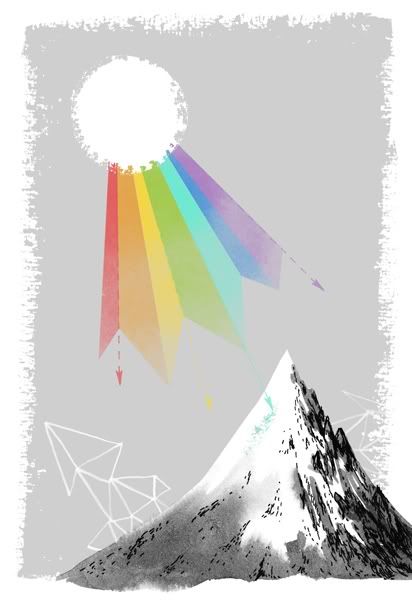
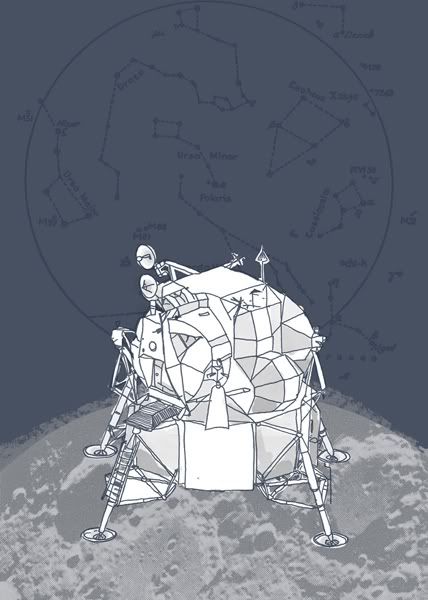
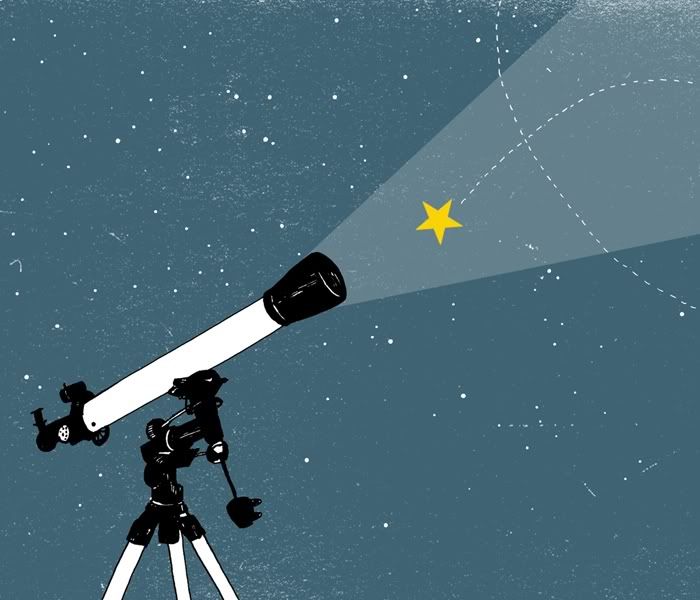
Other illustrations like A Pictorial Guide to the correlation between emotions and cloud formations seem both humourous metaphor, with a wink and a tip of the hat to the science of cloud physics. Some are straightforward wonder at astronomy.


illustration for Italo Calvino's 'Cosmicomics'


Lunar Park, personal work


Illustration for article Contrarian Investor Sees Economic Crash in China


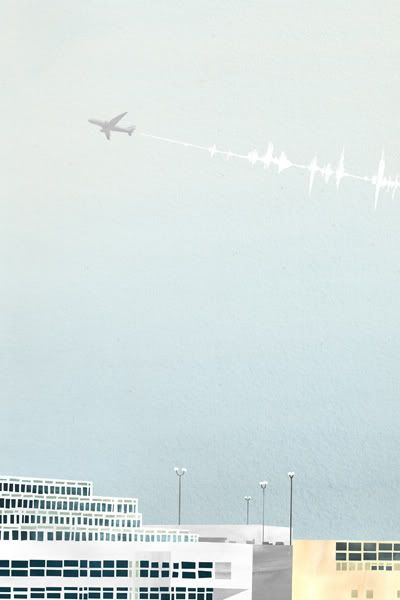
Music for Airports, illustration for article about the history of rock music

I love how that last one combines the sound waveform and airplane steam trail.

You can find her site, her blog and an etsy shop for craftier endeavours and check out the rest of her work.

{via both design sponge and the shallow end}

Monday, April 5, 2010

Beauty and Mathematics

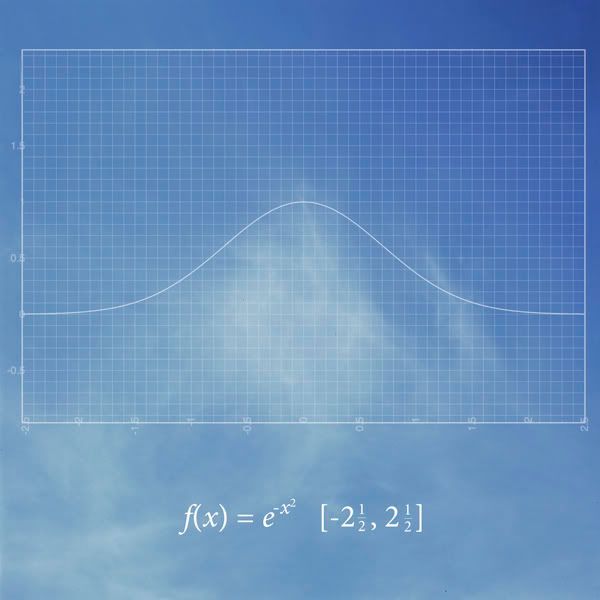
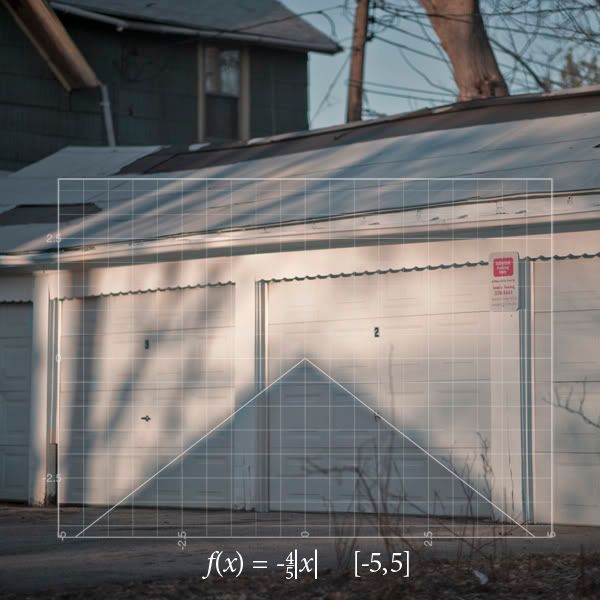
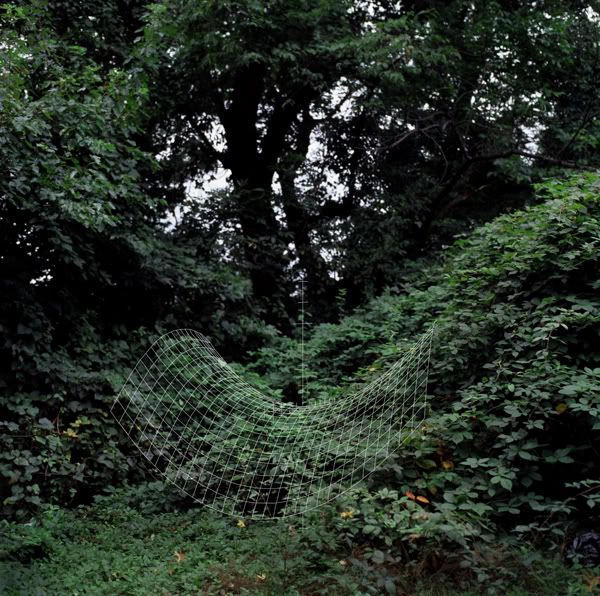
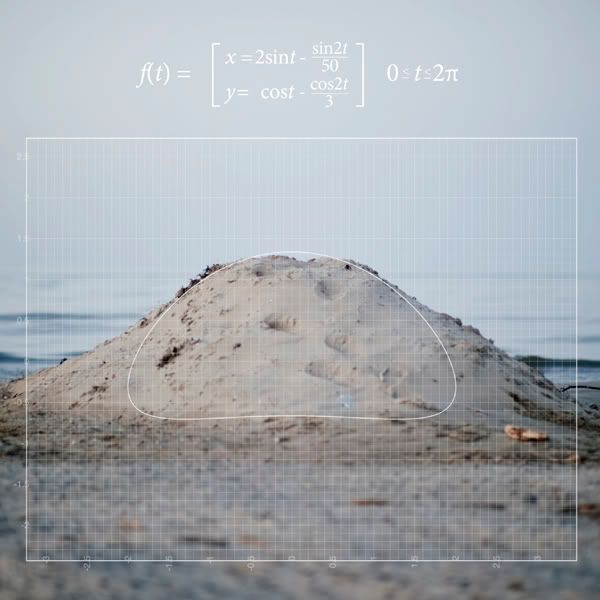
Mathematician and photographer Nikki Gaziano is a sort of natural historian or archivist of mathematical functions found in the wild. Check out her Found Functions. Mathematicians know that any shape can be expressed as the sum of sinusoids, accourding to Fourier analysis but some functions are just below the surface, requiring no more than the eye to see them. Such simplicity and beauty!


Ah! It's our old friend, the Gaussian distribution in the sky. This function is in a family with the Normal distribution (commonly known as the bell curve) and useful for thinking about standard deviation.


Now, this, to a physicist accustomed to time series analysis is a Bartlett window. See, if you need to break something into a summed series of sinusoids, it is important to break it into equal bits (windows of data) and taper the ends. So, you multiply the bits by something which is low at either end and high in the middle. This is one of those tools in my signal processing toolbox.


This is a hyperbolic paraboloid, or a saddle surface, something like z=x2−y2. It has negative Gaussian curvature, which is a fancy way of saying that if you draw a triangle on a saddle the sum of the angles will be less than 180o (the sum of the angles if the triangle is drawn on a flat sheet of paper). Physicists know that gravitation is geometry and have to think about this sort of mathematical creature when considering general relativity because mass deforms the curvature of spacetime itself.


This function isn't in my mathematical zoo. I don't know its purpose, though I can see how it works. Pretty, isn't it? The fact that I think of functions in terms of "purpose" as opposed to "beauty" distinguishes me as a physicist, rather than a mathematician. But, I really appreciate seeing these Found Functions.

{via today and tomorrow}

LinkWithin

Related Posts with Thumbnails