Showing posts with label natural history. Show all posts

Wednesday, February 20, 2019

Sol-Monath is for Science Cakes

Celestial Cephalopod Created by Corinna Maguire for the Threadcakes Competition

I learned from the Wellcome Collection (a museum which aims to share "science, medicine, life and art") that February was once the month of cakes.


so let's talk about cakes as science-art and science communication shall we?

ATLAS detector cake (credit: Katharine Leney via Symmetry)

Universe cake (credit: David Morse and Katharine Leney via Symmetry)

Particle physicists Katy Grimm and Katharine Leney who work on the ATLAS collaboration at CERN, discovered they also share a mutual love of baking. Symmetry magazine covers their delightful cakes (and other baked goods) which do everything from directly illustrating the ATLAS particle detector, to equations, diagrams and other data visualizations to metaphorically communicating the structure of protons according to the Standard Model or communicating through the medium of the cosmos cake, the proportions of regular matter, dark matter and dark energy. You'll find more via PhysicsCakes on Twitter.

In the wonderful world of science cakes, Earth and planetary science and amazingly well represented. Australian zoologist Rhiannon has posted several wonderful examples, including tutorials for nested spherical cakes on her blog Cakecrumbs.

This wonder Earth cake shows oceans and continents on the blue icing layer, orange mantle and yellow inner and outer core layers. (via Cakecrumbs)

The beautiful Jupiter cake likewise has three concentric layers to represent rocky and icy core, a middle liquid metal hydrogen layer and an outer molecular hydrogen layer. She says the famous giant anticyclone storm, the Great Red Spot was what attracted her. She recreated the patterns in the atmosphere with "ivory marshmallow fondant, then dry brushing a combination of ivory, brown and maroon edible ink." (via Cakecrumbs)

You can find space cakes bedecked or embedded with the planets of the solar system! Consider this tutorial for Mirror Glaze Galaxy Cake from the Also the Crumbs Please blog, the Astronomy themed groom's cake or the award-winning portrait of Galileo Galilei!

Astronomy-themed groom's cake shot by Laurel McConnell


Mirror Glaze Galaxy Cake from the Also the Crumbs Please

Galileo cake, winner of the Birmingham’s Cake International gold medal in the international class.

The mirror glaze is also just the thing for anyone creating cakes representing marble, many minerals or geode cakes. Geodes in fact, have been a real trend in wedding cakes and there is an astonishing array of geode inspired cakes in every imaginable colours.

Mirror glaze cake with recipe from Musely
Boho geode wedding cake by Cake Life Bake Shop | Photo by Hope Helmuth
Geode cake via You and Your Wedding

Natural history cakes don't stop with mineral specimens! Flora and fauna are popular too. There's a long history of using actual edible flowers, or sculpting flowers or leaves, often cast directly from actual plants - but those that convincingly recreate lifeforms with cake, icing, chocolate, fondant and other edibles are my favourites.

Lifelike deer cake by legendary Grand Dame of the cake decorating world, Sylvia Weinstock
This beauty hits on both natural history and the history of science as it's inspired by the hyper-realistic botanical still-life paintings of Dutch artist Rachel Ruysch (1685 to 1750). This cake is deocrated with custom-made sugar flowers, created by Amy DeGiulio of Sugar Flower Cake Shop in New York City, and placed in a gold urn to complete the look. (via Martha Stewart Weddings)

Tasmanian Masked Owl cake from Cakecrumbs
Albino Burmese Python Snake cake by by Francesca Pitcher from North Star Cakes


Jakarta-based pastry chef Iven Kawi who runs the Iven Oven where she makes these wonderful terrarium inspired cakes which hit the succulent trend (via Colossal)


My son requested a dinosaur-shaped cake, capped with a Cretaceous scene with volcano and smaller dinosaurs for his 5th birthday, so I assure you, this is but a tiny peek at what is out there. I haven't even touched on paleontological cakes, or the gothic world of anatomy cakes. There's a whole world of yummy cake-based science art/communication out there for you to explore and, better yet, eat.

(Hat-tip to my friend Faunalia, who has been sharing images of amazing cakes with me for years! You can find some of our favourite images here.).

Tuesday, July 10, 2012

Sir David Attenborough

David Attenborough by Elda The


Sir David Attenborough is one of the most popular naturalists and popularizers of natural science, anywhere in the world. His enthusiasm is infectious. He is articulate, mesmerizing and unfailingly fascinating. It's no wonder he's inspired some art about his passion for the animal world.


Father Earth by
Always With Honor


David Attenborough by Damien Weighill


Wait for it... "this is a camera shutter;" it's worth the wait.

Wednesday, June 13, 2012

Ceramic Might-Have-Beens

British ceramicist Sophie Woodrow knows that the Victorian fascination with nature (though it was firmly defined as 'other' than human), collecting and romanticizing nature in a way which was ultimately kitsch is a great place to seek ideas and inspiration. Though most Victorian science was of the 'descriptive' sort, I know I find their romantic and sometimes heroic collecting an inspiration myself; it is definitely a class of activity at the fertile intersection of art and science, like the building of wunderkammers (Cabinets of Curiosity), gathering everything from rocks, to ferns, to fossils, to exotic animal species from around the world. I love how she describes the Victorian "enormous misinterpretations of geological evidence" (particularly of biological evolution) as "a game of Chinese whispers1 played over millennia". She's been inspired by natural history, and our changing ideas about evolution, to create a growing collection of ceramic "might-have-beens". This makes me think of the Rhinogrades, the wonderous "might-have-evolved" creatures of Harald Stümpke [Gerolf Steiner]. Her imaginary-animal pots are likewise truly wonderful.

 
Bear (41 cm height)


Totem (39 cm height)

 
 Little Owl


 Crowd Scene

Here she speaks about her process:
 

 Be sure to check out both her recent work and archive!

Lou Lou & Oscar

 1 "Chinese whispers" is the British name for what North Americans call the game of "broken telephone" where a message passed by whispers from person to person, mutating as it travels along.

Tuesday, December 20, 2011

Maps and UnNatural History


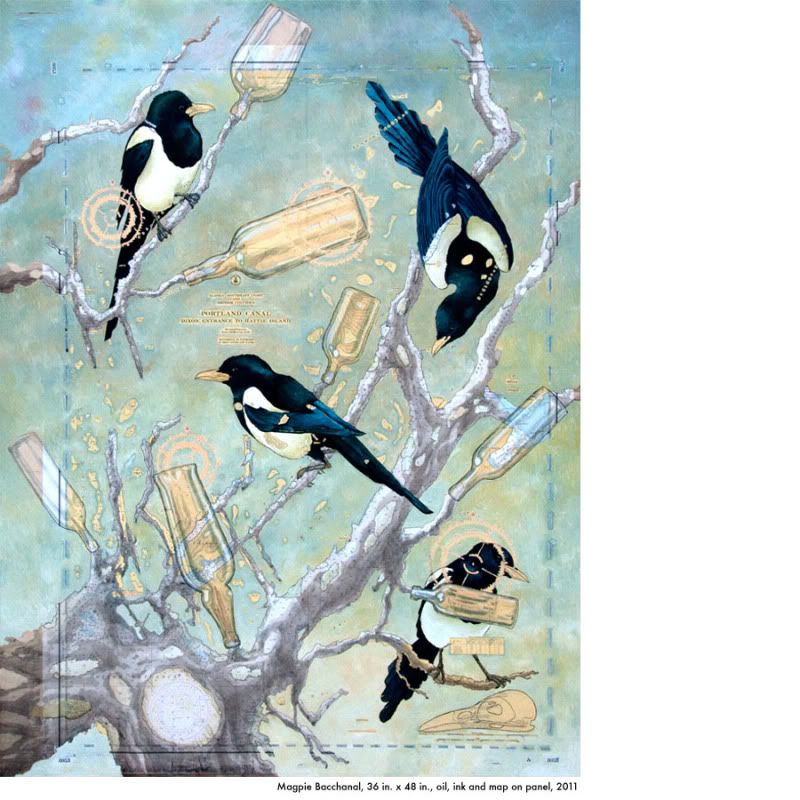
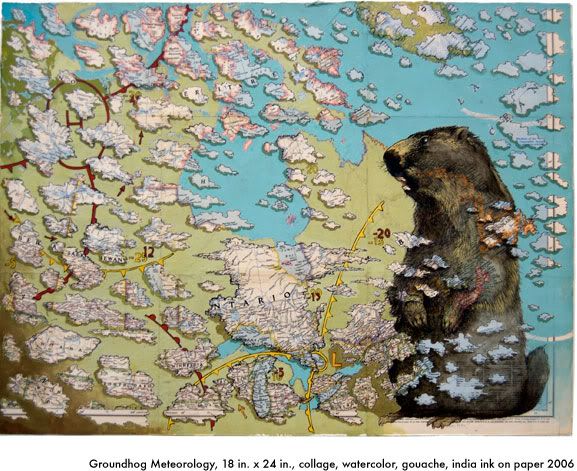
The work of Vancouver-based Paul Morstad involves some of my favorite things, and I don't just mean the magpies (as in Magpie Bacchanal, above). His series of multimedia paintings on nautical charts and maps have a sort of chaotic and romantic welter of natural history (flora, fauna, gems and geology) and subtle, imaginative, visual puns.

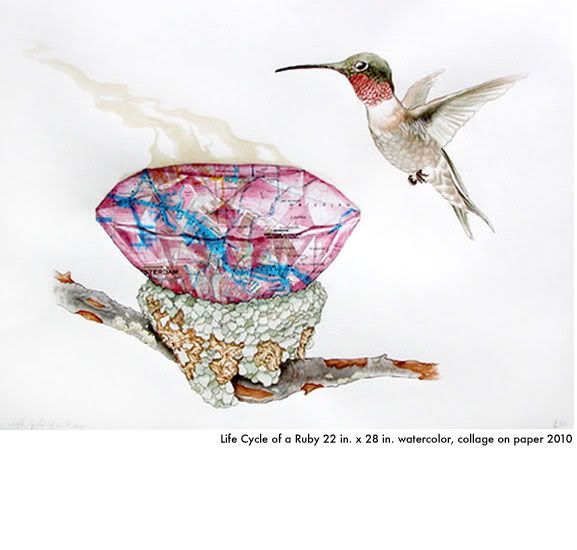
Consider the ruby-throated hummingbird raising a ruby in her nest.


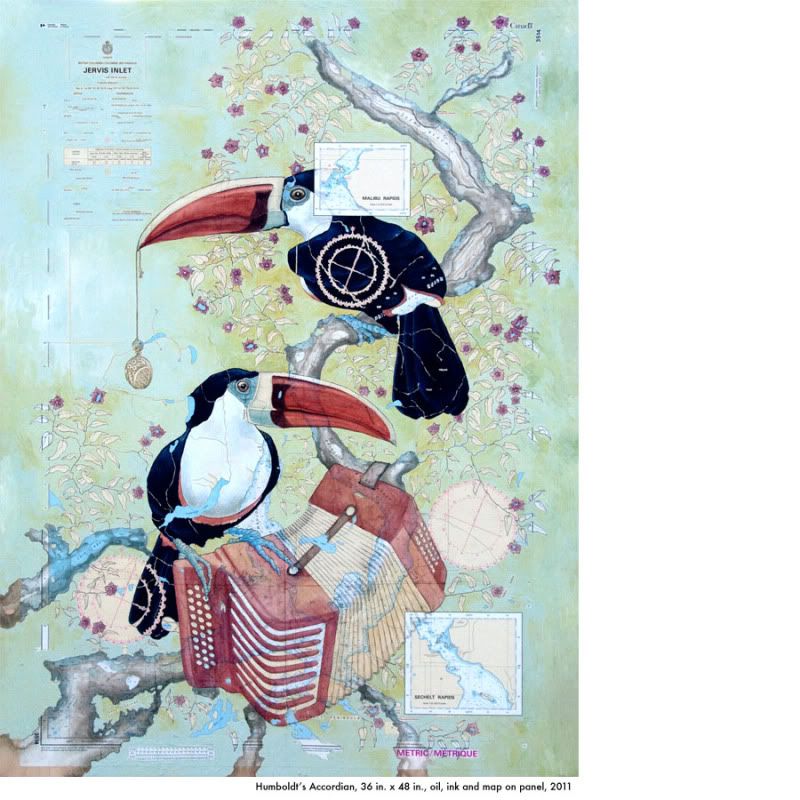
Humbolt's Acordion seems to allude to one of my favorite, heroic nineteenth century naturalist-explorers, the biologist-meterologist-earth scientist-freedom fighter Alexander von Humboldt, who, amongst many adventures, famously learned 40 words of the dead language of the lost Atures tribe of South America, from a parrot, the last surviving speaker. Though, it isn't impossible it may have just been inspired by accordion players in Humboldt, Saskatchewan (or any number of other places of the same name). It makes me imagine tucans passing on the lost accordion music of some imaginary people. I love how the natural lines of inlets and rivers become trees and branches. I wouldn't have thought forks in rivers were isomorphic to branching in trees, (and I happen to be the sort of person who has spent hours looking at the Canadian Hydrographic Service chart for Jervis Inlet) but the organic lines work so well.


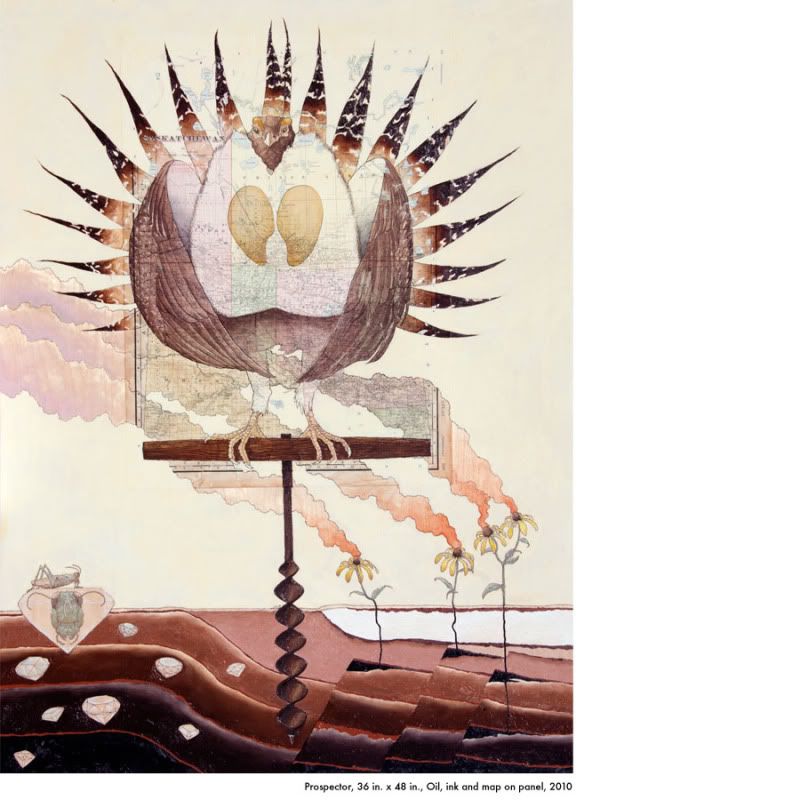
There is something magical and menacing about the regal prairie chicken, over the sedimentary section with cut gem stones, grasshoppers and smoking black-eyed susans in Prospector.


I too am charmed by weather prognosticating rodents.


Paul writes that he is deeply influenced by the "landscapes, people, flora and fauna" of the Western provinces (Saskatchewan, Alberta and British Columbia) where he was raised. Do yourself a favour and check out the rest of his portfolio. I stumbled upon it while looking at some of the animations of his immensely talented sister Julie Morstad; they created the animations together.

Sunday, August 7, 2011

Historia Naturae


Speaking of musical, natural history-themed multimedia, I have to share the somewhat crazed, sliced and diced, musical wunderkammer of the 1967 short film Historia Naturae by Czech animator Jan Švankmajer (via form is void).

Thursday, August 4, 2011

Biophilia


Well, this is garunteed to me my thing: science, technology, nature, art, music, multimedia and Björk. I am, in fact, amazed I did not know sooner, but blame that on actually being offshore when Björk's new Biophilia app was released (thanks to bioephemera for the link). This is an innovative way of releasing music, taking avantage of tablet (iPhone, iPad) technology and the opportunities for interactive audiovisual apps. Though I've been a fan of Björk since her Debut album, and confess both her music and her subject matter are likely to hook me, and further, that I have the sneaking suspicion that Sir David Attenborough could read the phone book in a voice which would still be mesmorizing, full of awe and wonder, but I think she deserves kudos for this project, and for cultural innovation.

Thus far the Cosmogony and Crystalline apps are available. Cosmogony contains an interactive stylized galaxy, like the animation in the video above, which the user can navigate to each of the other songs/apps and can use to play with (almost remix) samples of Björk's music by moving fingers on the touch-screen. The intro above, the song animated as a stylized geometrical score, the actual score and the lyrics are included. The song itself is structured to mimic astronomical cycles and the lyrics allude to origine myths and modern cosmology.


The video (directed by Michael Gondry) above gives you a hint of Crystalline. The app allows users to create their own 'crystals' and associated music. This hits on the crystals in comtemporary art and illustration trend, as well as the harkening back to the Victorian wunkerammer though the "nature, music, technology" formulation feels very modern. Describing humans as the link between the microscopic and the universal, she ties all her science-inspired songs/apps together (ranging from microscopic scales of the virus, through the planetary with moon, mutual core and solstice, and the galactic dark matter to universal cosmogony). Unlike the Victorian approach to natural history, and obsessive collecting of wunderkammer, which was fueled by nostalgia and a morbid fear of death, this project is permeated with wonder and optimism about the future, and the opportunities for technological advancement to lead to a more harmonious relationship with nature. The earth scientist in me can't wait to see what she comes up with for mutual core, which alludes to the structure of the Earth and plate tectonics. The artistic and musical interpretations of the subject matter are (thus far) more metaphorical than literal, but what I've seen is both engaging (mesmerizing, even) and surprisingly educational. I love the way the user is invited to participate, manipulating and creating more music. This is a very refreshing way of viewing fans as participants at minimum and possibly even collaborators rather than mere consumers. I love also the understanding that scientific explanations of the beauty we see around us makes these things more wonderful, not less.

Tuesday, April 5, 2011

The Oddballs, the Endangered, the Invasive & the Poodles

Jenny Pope's website J Pop Studios is a full zoo of exotic (and not so exotic) animal specimens in (colour reduction) woodblock print form. She tackles several topics in contemporary science, from flukes of evolotionary biology, to climate change, ocean acidification, pollution, extinction of the megafauna of Australia, invasive species as well as kitties & poodles.

She has a series investigating the effect of islands on evolution: 'Isolation Produces Oddballs' including the wonderously named, If Pygmy Elephants Climbed Trees (image size 13” x 17”)
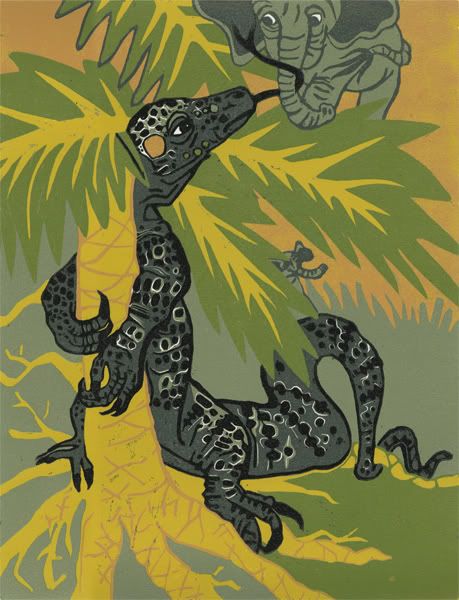


which answers the question how did the 200 pound monitor lizard, the Komodo Dragon get so large? Apparently they were discovered on Flores, along with pygmy elephant bones - and sadly for them, the pachyderms are not known for tree climbing ability. She tackles 'Global Warming Band-aids' in her print 'Ocean Sequestration' (image size 19” x 23.75”) about the perils of simply trying to sequester CO2 in the deep ocean, and the consequent ocean acidification.
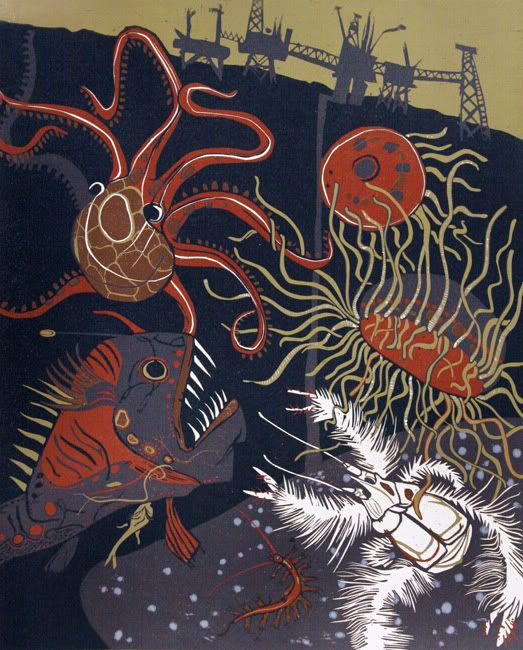


Colleagues of mine are working on the more sophisticated (but as of yet unproven on a large scale) possibility of sequestering CO2 in icelike 'clathrate' cage of hydrogen-bonded water molecules, known as CO2 hydrate - below the seafloor, rather than in the deep sea. So, this print reasonates with me as both a marine scientist and a printmaker.

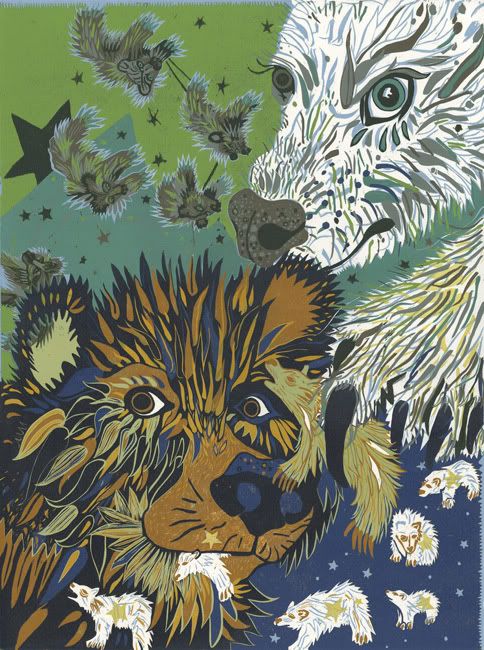
Her South of North---The Lapping Territories of Bears (image size 32” x 24”) is about the strange fate of bears in far north, where the changing climate has lead to the discovery of the hybrid 'pizzly' (polar bear/grizzly cross).


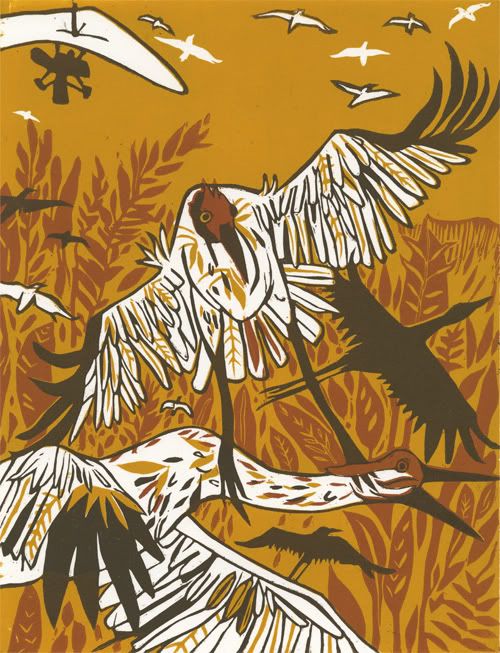
Plane and a crane (image size 15” x 11.5”) in her 'Endangered Animals' series not only highlights the whooping crane, but also "Operation Migration," which uses ultralight planes to teach and re-introduce the migration which was lost when a certain population was destroyed, by having the birds imprint on the plane.


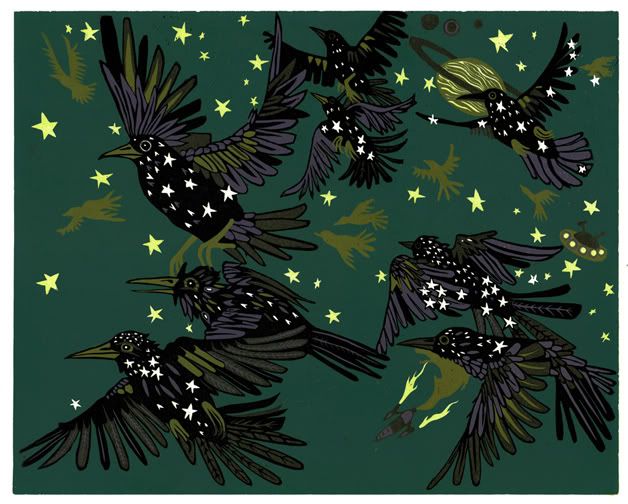
The invasive starlings are a problem where I live, as in many places in North America. They were introduced by Eugene Schieffelin who wanted to release all of the birds mentioned in William Shakespere’s plays. Sometimes romantic ideas and biodiversity are a bad mix. A Starling Guide to Night (image size 19” x 23.75”) is part of her 'Invasive Species' series.


Do yourself a favour and check out her large portfolio. I love the dynamic style and colour pallette of her prints, which combine the whimsy of children's illustration with serious, well-articulated subject matter. Her fascination with ecology, biology and obvious enthusiasm for science in general is infectious. I do love the medium of woodblock prints, and prints created at the art-science interface are likely to delight me, but I'm also very impressed with the background and information she provides with each print. You could learn a lot simply by reading about her subject matter. Despite her dismay at the way we treat our environment, she has a sense of the ridiculous - highlighting the absurdity of using of rubber ducks, turtles, frogs and beavers spilled from a container ship in 1992 to trace currents - or their imagined interaction with real marine animals, or some of our misconceptions about birds, from recent history. This makes her portfolio wonderful to explore, though the topics remain may be dire.

You should also check out her blog and her jpopstudios etsy shop - which also includes etchings.

Wednesday, April 14, 2010

Nature & Un-nature

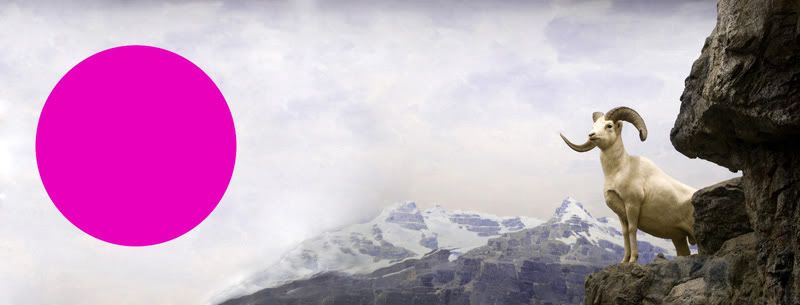
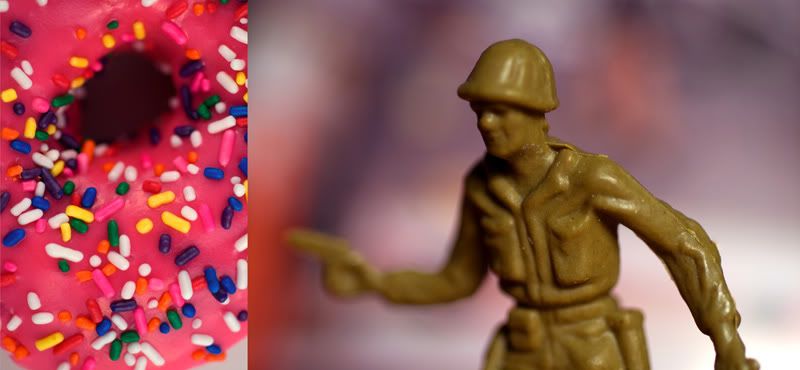
Photographer Jason DeMarte has combined natural history museum dioramas with polkadots and pills, unapetizing food with objects and animals, fabric patterns with nature. Sometimes the elements are combined in one image or in forms common in art history: diptych and triptychs. The contrasts hint at commentary about commodities and nature and how we take nature and make the unnatural. Follow the link to peruse his large portfolio. {via The Jealous Curator}

Sheepish Intimation
2007, 60 x 23


Suspended Splendor
2008, 34x23


Fresh Frozen
2009, 23 x 34


Glazed
2008, 50 x 23

Thursday, February 18, 2010

Beasts


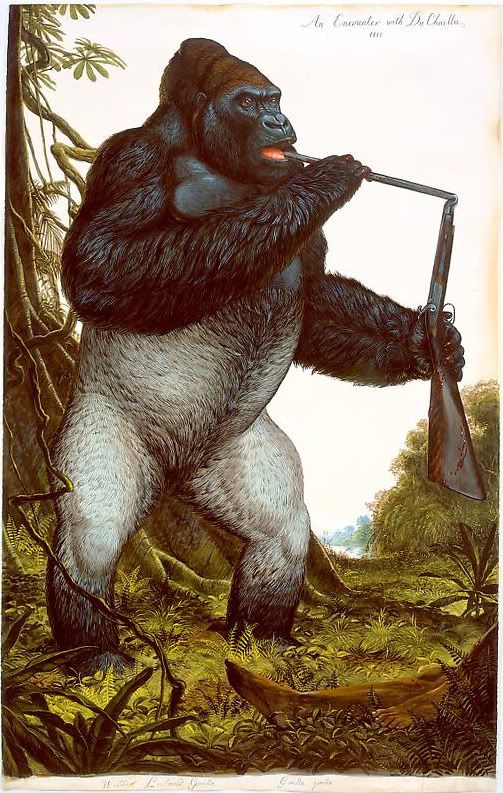
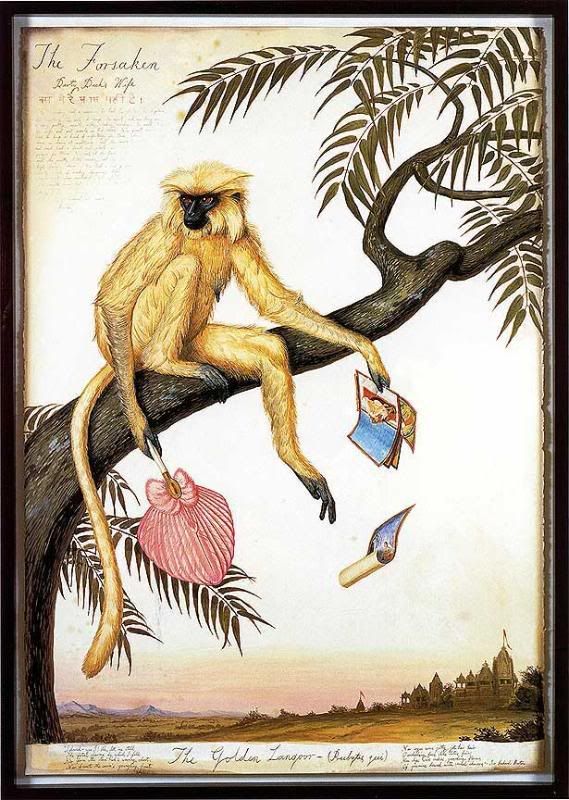
I recently read Lisa Jardine's Ingenious Pursuits, which details, amongst other things, the 17th century so-called scientific revolution, the gathering of many a collection (botanical, zoological, veritable cabinets of curiosity), and the early traveller-adventurer-biologist/artist. There was a time when this sort of science looked like art and art looked like science. To properly do descriptive science one really needed to be an artist.


Not only was Robert Hooke a brilliant engineer/experimentalist in physics, astronomy, chemistry and microscopy, he had training in draughtmanship. This helped him communicate his science and explains the impact of Micrograpia. While he travelled the world only in his imagination, many of his contemporaries of a more zoological bent, travelled the world quite literally. Some gathered all and sundry indiscriminately. Others produced invaluable scientific data, in the form of their illustrated bestiaries. These document ecology, zoology and anatomy, and provide a fascinating glimpse at the early dissemination of scientific information. The European colonists continued to sail the world in search of commercial gain, and with them went many an artist who saw that illustrating exotica was a means of making a living. Collecting prints was cheaper and more practical than gathering cabinets of curiosity, but both practices thrived well into the Victorian age. In The Artificial Kingdom: A Treasury Of The Kitsch Experience, Celeste Olalquiaga traces this tendancy to gather beastiaries and wunderkammer to a morbid fear of death.


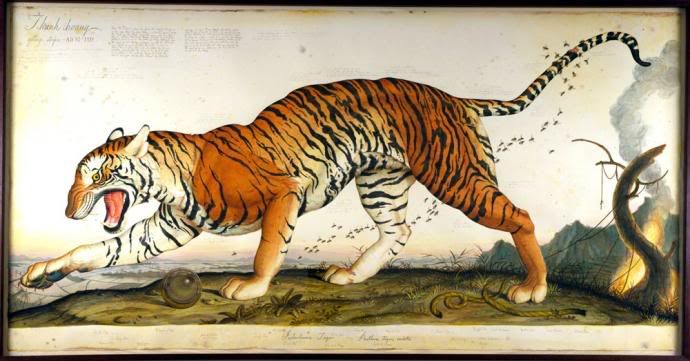
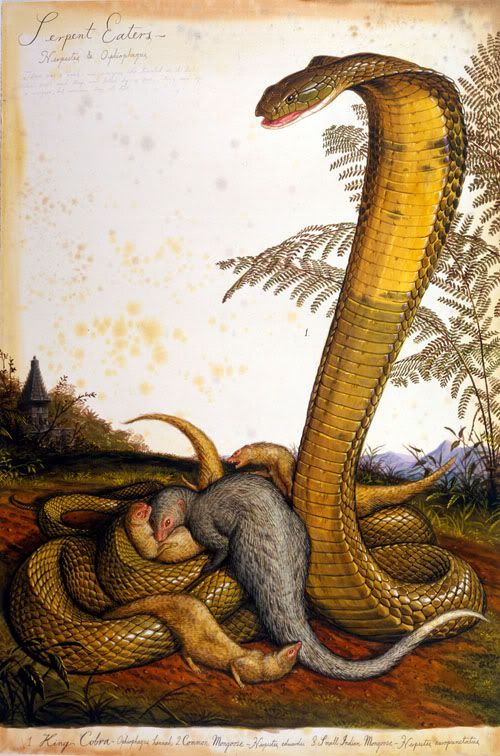
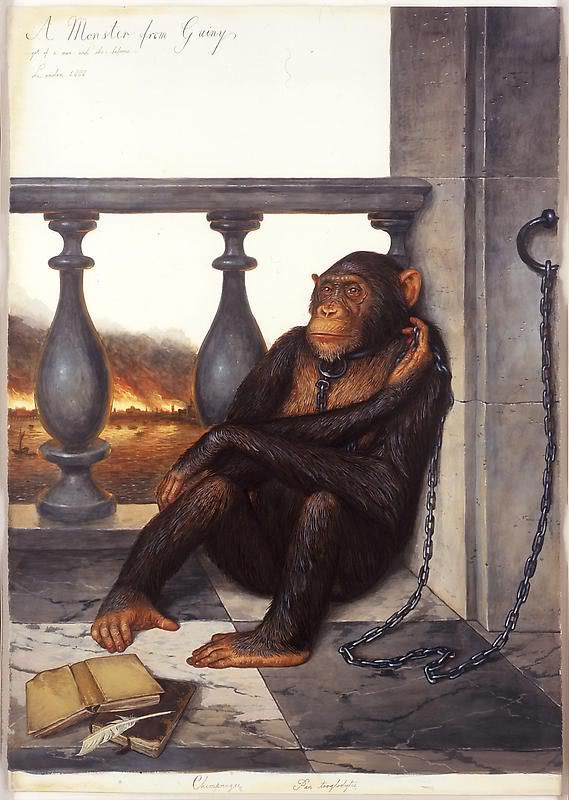
So contemporary artist Walton Ford's images which employ the media of the 17th and 18th century naturalists, in which to make some more provocative statements, with violence, subjugation, suicide and other nasty human habits, ever-so-slightly below the surface, might be heightening tensions already implicit in his sources of visual inspiration. The societal critiques implicit in this art, seem to me to be true of the society which created the original natural histories, as it is of contemporary society.


To modern eyes, calling a chimp a "Monster" and chaining him by the neck is barbaric. But we know all to well, this is something we have a history of doing to our fellow humans.


The dying words of the Parakeet might evoke The Death of General Wolfe (at least, for Canadians), and yet instead of making me see the humanity in the parakeet, it makes me see the absurdity and the animal in us.
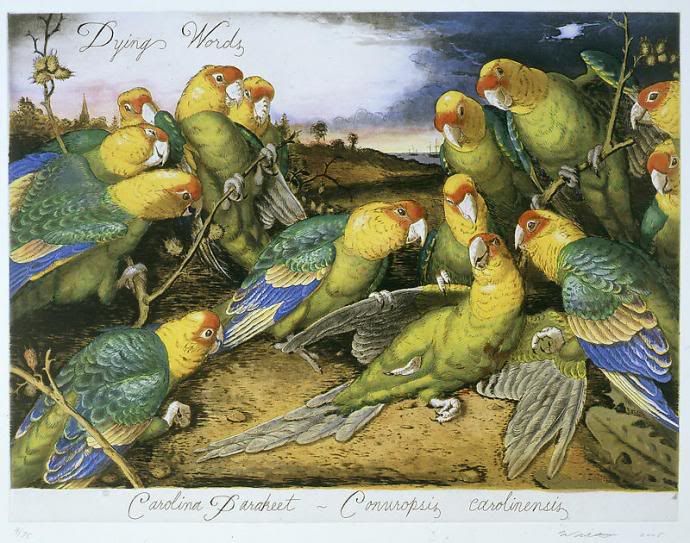


I found Ford's work via News From the Craft + Style Blogosphere {via Trends In Detail} today. I also noticed you can purchase his book, Pancha Tantra via Antropologie.

LinkWithin

Related Posts with Thumbnails