Showing posts with label photography. Show all posts

Tuesday, October 13, 2015

Anna Atkins on Ada Lovelace Day


Ada Lovelace, 3rd edition
Ada, Countess Lovelace, 3rd edition linocut by Ele Willoughby
Today is the 7th annual international day of blogging to celebrate the achievements of women in technology, science and math, Ada Lovelace Day 2015 (ALD15). I'm sure you'll all recall, Ada, brilliant proto-software engineer, daughter of absentee father, the mad, bad, and dangerous to know, Lord Byron, she was able to describe and conceptualize software for Charles Babbage's computing engine, before the concepts of software, hardware, or even Babbage's own machine existed! She foresaw that computers would be useful for more than mere number-crunching. For this she is rightly recognized as visionary - at least by those of us who know who she was. She figured out how to compute Bernouilli numbers with a Babbage analytical engine. Tragically, she died at only 36. Today, in Ada's name, people around the world are blogging.
You can find my previous Ada Lovelace Day posts here. 
This year, I thought I'd take the opposite approach from last year. I wrote about Marie Skłodowska-Curie last year, despite her fame and the risk that she was likely the only women in STEM that many people can name. I chose to write about her because it was artificial to avoid her; she really did make incredible discoveries and lived an extraordinary life. This year, I've selected a scientist who is rather new to me, and who was not an icon of science. She was nonetheless a pioneer. I've selected her because she is precisely the sort of scientist we forget - especially if female. What she did was important, and cutting edge in her time, and while it may not have been epochmaking it was the sort of important, incremental, methodical work which represents much of the scientific entreprise, and most of the advance of science throughout history. I believe the concept of the "paradigm shift" might be useful, but it is often dangerously simplistic and leads to a false narrative of a series of great men (almost invariably it is a man who is selected to represent the bringer of the new idea) revolutionizing science. Science, and its history, is more often much more involved, non-linear, over-lapping and interwoven than this type of narrative presents. Lastly, I love that this particular scientist was working at the intersection of art and science.

This is a portrait of English botanist and photographer Anna Atkins (1799-1871), née Children. It combines both a hand-carved lino block portrait in dark silver ink, and a screenprint of the silhouette of fern leaves in cobalt blue ink, mimicking the cyanotypes she was known for. It is printed by hand on lovely Japanese kozo (or mulberry) paper, 11" x 14" (28 cm x 35.6 cm). (c) Ele Willoughby, 2015

Anna Atkins (1799-1871), née Children, was an English botanist and photographer. She is the first person to have illustrated a book using photographs, Photographs of British Algae: Cyanotype Impressions in October 1843. Note that: not the first woman, the first person. She lived at a time when it was possible to be a self-trained scientist, especially if you were middle or upper class and received an education and the financial freedom to devote your time to pursue your subject. (The Mary Annings of the world, who managed to make a name for themselves in science despite her class, religions and complete lack of financial ressources, are rare indeed). She was raised and instructed by her father, a naturalist, and her social circle included those who were developing (no pun intended) the latest, brand new photographic technology. So, she was at the right place at the right time. But that doesn't take away from the fact that she had the knowledge, skill, insight and ability to immediately see the utility of the method for descriptive science and to document a specific field of sub-field of botany, with her collection of the algae (seaweeds) of Britain. I think this should be understood as equivalent to a modern-day scientist keeping abreast of other fields of study and rapidly mastering a new high-tech tool to apply it to her field. Even William Henry Fox Talbot, who who invented the salted paper and calotype processes, precursors to modern photographic methods, was not able to publish The Pencil of Nature the first commercially printed photographic book, until eight months after she produced Photographs of British Algae: Cyanotype Impressions.

Her mother died when she was still an infant, but she was close with her naturalist father and received a much more scientific education than was common for women in her time. Her 250 detailed engravings of shells were used to illustrate her father's translation of Lamarck's 'Genera of Shells'. This translation was important to the nomenclature of shells, because her illustration allowed readers to properly identify Lamarck's genera. She married John Pelly Atkins in 1825 and devoted herself to botany and collecting specimen, including for Kew Gardens. In 1839, she became a member of the Botanical Society of the British Isles, one of the few scientific organizations open to women. She became interested in algae, after William Henry Harvey published A Manual of the British marine Algae in 1841.

Through her father, she was friends with both William Henry Fox Talbot and Sir John Herschel, who (amongst other things) invented the cyanotype photographic process in 1842. Within a single year of its invention, she self-published the first known book of illustrated with cyanotype photographs and was likely one of the two first women to make a photograph. She recorded her seaweed specimen for posterity by making photograms by placing the unmounted dried-algae original directly on the cyanotype paper. Atkins self-published her photograms in the first installment of Photographs of British Algae: Cyanotype Impressions in October 1843, and two further volumes in the next decade. She collaborated with Anne Dixon (1799–1864) to produce further books of cyanotypes on ferns and flowering plants and also published other non-scientific or photographic books. In 1865, she donated her collections to the British Museum.

I've shown her based on an early photographic portrait, along with some fern leaves which I've worked with directly, much how she illustrated her own specimen.

Have a look at her cyanotypes and a video of one of the surviving copies of her book.


(Cross-posted from the minouette blog)

Sunday, September 29, 2013

paper botanicals

Mary Delany, Crinum Zeylanicum: Asphodil Lilly,
a paper collage, 1778 (via The British Museum)

The lovely and precise paper collage, or as she called them 'mosaicks' depicting various botanical illustrations by Mary Delany were recently brought to people's attention by Molly Peacock's book The Paper Garden: Mrs. Delany Begins Her Life's Work At 72. She wished her work to ressemble dried flowers, and was so successful that some could be mistaken for actual specimen. Peacock describes a woman who in fact invented an entirely new artistic (or scientific illustration) medium, very late in life. Describing her method in a letter to her niece, dated October 4th, 1772, Delany wrote: “I have invented a new way of imitating flowers”.

Mary Delany, Magnolia Grandiflora (Polyandria Polygynia),
the grand Magnolia. 1776
Delany used hand-tinted tissue paper to create 1700 of these paper cuts, working until the age of 88, when her eyesight failed. She worked with plant specimen, and it is believed she dissected them to better observe their detailed anatomy; her works carefully reproduce petals, stamens, calyx, leaves, veins, stalk and other parts of the plant in hundreds of tiny layered pieces of paper, generally against a black background. She lived in a time where there was a revolution in botanical knowledge, a great passion for gardening, and no photography. The intersection of botany and art played an important role in contemporary descriptive science, and Mrs. Delany became a major botanical artist. (via Things that quicken the heart).

Mary Delany, Pancratium Maritinum (Hexandria Monogynia),
Sea Daffodil. 1778
Mary Delany, Vicia Cracca (Diadelphia Decandria),
Tufted vetch

Mary Delany, Iris Susiana, Chalcedonian. 1781
Anandamayi Arnold is a contemporary San Francisco-based artist who makes paper 'surprise balls', a desceptively simple medium: she wraps trinkets and ephemera in layer upon layer of crepe paper, to build up gorgeous, three-dimensional botanical objects. She calls them 'three dimensional trompe l'oeil'. Aya Brackett has photographed Arnold's work in a way which clearly alludes to Mary Delany's work, against a dark background, showing these objects to be more than paper and toys, but a sort of continuation of the paper botanical illustration tradtion, tracing all the way back to the late 18th century and Delany's pioneering work. Further, she's playing with the ideas of the ephemeral and permanance, since these objects are at least nominally built so that someone could unravel them to find the toys inside.

Anandamayi Arnold, Paper Passion Fruit (photograph by Aya Brackett)
Anandamayi Arnold, Paper Pomegranate (photograph by Aya Brackett)
Anandamayi Arnold, (photograph by Aya Brackett)
Anandamayi Arnold, Kumkuat branch, 2012 (photograph by Aya Brackett)


Anandamayi Arnold, paper botanicals photograph by Aya Brackett


Tuesday, June 18, 2013

Scientific Caricatures of the 19th Century


This is a 1882 cartoon of geologist/paleontology/theologian Wiliam Buckland sticking his head into a hyena den, drawn by geologist/paleontologist/clergyman William Conybeare, (via Edible Geography). (I was introduced to both of these characters by a good novel by Joan Thomas called Curiosity, based on the life of Mary Anning). It's surprisingly easy to find 19th century caricatures of scientists; I don't know if this is a function of the medium being more popular, or whether thinkers and scientists were so much more prominent that an educated public could be expected to both recognize them and appreciate the humour. Here we have a few choice selections.


Michael Faraday, FRS (22 September 1791 – 25 August 1867), the great physicist and chemist, meets Father Thames from Punch (21 July 1855). Faraday's many interests included what we would now call environmental science, and his 1855 letter to the Times on the foul state of the River Thames inspired his caricature.


“The great south sea caterpillar, transform’d into a Bath butterfly” (1795) by James Gillray is a caricature of English naturalist and botanist Joseph Banks (who famously sailed with Captain Cook, via Public Domain Review).


This 1863 lithograph shows Félix Nadar (from the Library of Congress Prints and Photographs Division From the Library of Congress Prints and Photographs Division) - pseudonym of Gaspard-Félix Tournachon (6 April 1820 – 23 March 1910), a French photographer, caricaturist, journalist, novelist, and balloonist. I'm including him amongst the scientists for his pioneering work in the development (no pun intended) of photography, and because like Conybeare, he was both producing new science and caricatures. That some scientists and innovators themselves drew caricatures no doubt explains why they are also common subjexts. Though, one publication, Cartoon Portraits and Biographical Sketches of Men of the Day (1873) with drawings by Frederick Watty is a source of a great many (via Public Domain Review) including:

Charles Darwin (by Frederick Watty)

and

Sir Richard Owen, FRS KCB (20 July 1804 – 18 December 1892) was an English biologist, comparative anatomist and paleontologist (by Frederick Watty) who coined the word Dinosauria and opposed Darwin's theory of natural selection.


Tuesday, March 19, 2013

Unexpected Dinosaurs

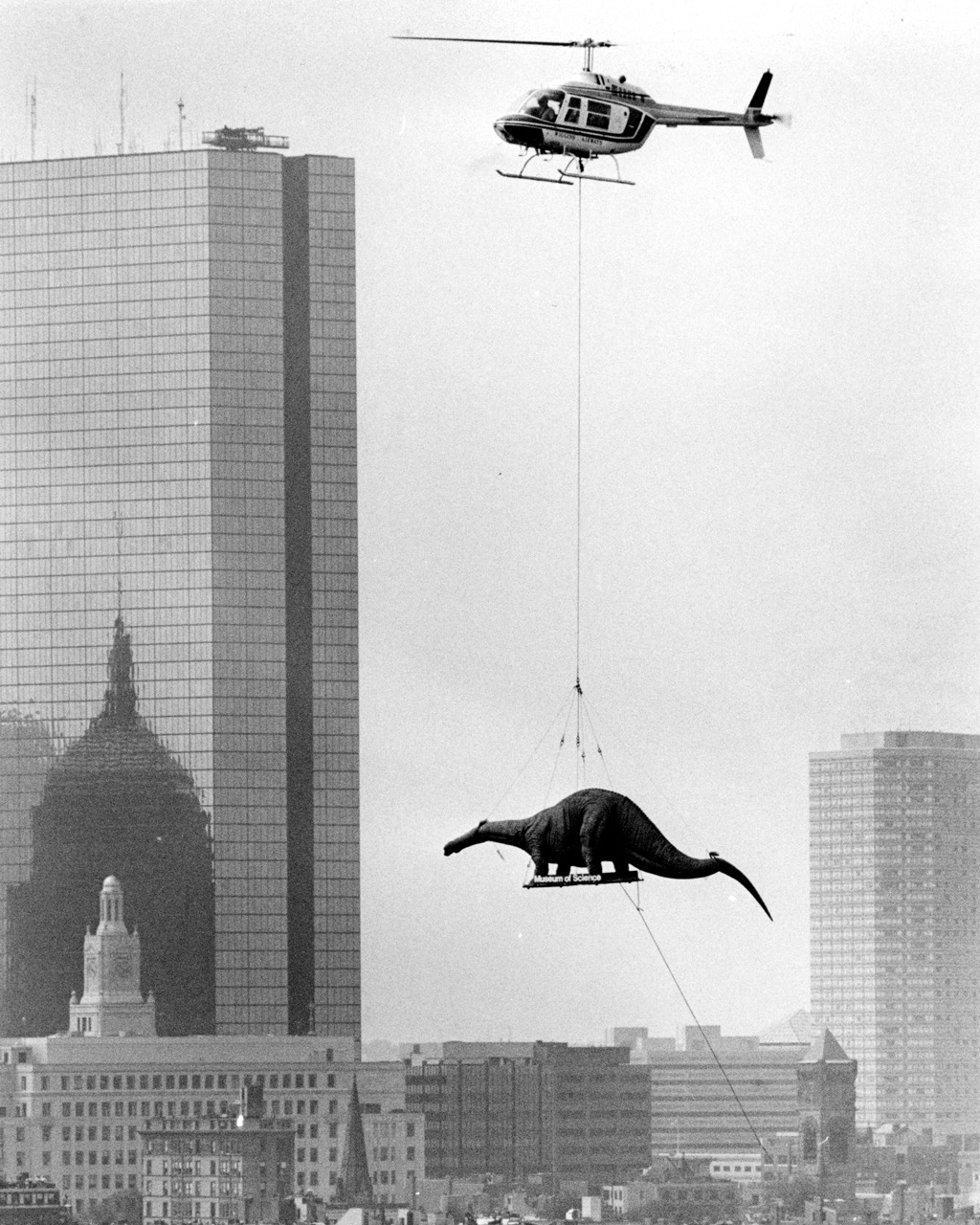
Photos of dinosaurs where one would least expect them make me happy. A simple post.


Delivering dinosaurs for exhibit at the Boston Museum of Science. Arthur Pollock, 1984.


Fiberglass Allosaurus, 'National Geographic', January 1993.


available here


The Dinosaur Museum in Dorchester sends its triceratops away for a makeover.

Dinosaur


T. Rex arriving at the Birmingham Museum and Art Gallery, by Patrick Willcocks/pawprintz on flickr


Tuesday, March 12, 2013

High Voltage Art

Anyone who has watched thunderstorms knows that the form of lightning strikes can be quite beautiful (I almost typed striking...). I know that my scientific work with high voltage transmitters could be dangerous (though I'm proud to state that unlike the majority of my colleagues, I have never electrocuted myself... and while none of my colleagues have seriously injured themselves, they have had some scary experiences). Though with proper care one can safely work with high voltage sources, not only to say, probe the earth as a geophysicist, but to create art with a sort of artificial lightening. This can include making a sort of artificial fulgurite (minerals which are natural hollow glass tubes formed in quartzose sand, silica, or soil by lightning strikes).

Todd Johnson uses electron beams on acrylic slabs to create what he calls “shockfossils”, like 'Fabric of Time' above.

These pieces are created with the help of a particle accelerator. This machine produces up to five million volts and is used to accelerate a beam of electrons. The electrons are fired at pieces of acrylic plastic and penetrate deep within the slabs, resulting in a pool of electrons trapped under tremendous electrical potential within each piece.


He then taps the acryllic, with an electrically insulated tool to make the fractal channels like branching rivers you see.


You can watch the speeded up effect of applying a high voltage (15 kV) to plywood in this video, aptly named '15,000 Volts' by Pratt art student Melanie Hoff. This is like wood burning squared.


Melanie Hoff. Source: melaniehoff.squarespace.com


Japanese artist Hiroshi Sugimoto has created beautiful and fascinating art using effects of electrical discharges on photographic dry plates. He writes about how he is inspired by scientific pioneers of age of discovery, like Benjamin Franklin (with his famous or notorious 1752 kite in a thunderstorm experiment to show that lightening is electricity), Michael Faraday (whose 1831 formulation of the law of electromagnetic induction led to the invention of electric generators and transformers) and his contemporary William Fox Talbot (who discovered the photosensitive properties of silver alloys and was the father of calotype photography).


<


This is a sort amazing, though possibly difficult to watch film by Thosten Fleisch which employs a similar technique. I'll pass on the warnings of TechCrunch, where I found it:
WARNING: Epileptics should not watch this film! It is almost entirely strobing light.
WARNING: Other people, be careful, it will put you in a trance if you put it full screen and turn it up. It takes about a minute to really get started.

Friday, March 8, 2013

Chronophotography


Étienne-Jules Marey. Source: longstreet.typepad.com via minouette on Pinterest


The Victorian photographic method of chronophotography, which captures motion in several photographic frames (both as a sequence or layers one on top of another) is a wonderful means of showing a times series of motion of people and animals. You might be familiar with the examples by Eadweard James Muybridge or Étienne-Jules Marey. The method has been very influential, obviously on animation, but also as a means of diagramming motion for scientific purposes, and even in contemporary art.


Eadweard James Muybridge. Source: en.wikipedia.org


Dan Carr. Source: 500px.com via minouette on Pinterest


A sequence of Sammy Carlson hitting three backcountry jumps in a row during a Poorboyz Productions filming session at Pemberton Icecap,Whistler British Columbia,Canada. March 23, 2011. Photo: Dan Carr.

Gjon Mili photo of drummer Gene Krupa. Source: tsutpen.blogspot.ca via minouette on Pinterest


The National Film Board of Canada's online collection includes the 1968 classic Norman McLaren short film, Pas de Deux. The dancers seem to move forward and backward in time, and are also reflected in several planes, but particularly the second half of this beauty employs a cinegraphic equivalent of chronophotography.


Pas de deux by Norman McLaren, National Film Board of Canada


Consider this experimental short film by Michael Langan & Terah Maher, (perhaps reminiscent of Pas de Deux) Choros: A Transfixing Experimental Dance Film (via this is colossal) to see what else can be done with a contemporary take on this Victorian method.

Michael Langan & Terah Maher. Source: thisiscolossal.com via minouette on Pinterest


Choros from Michael Langan on Vimeo.

If one were to make dancers the subject of a chronophotographic study, with photos taken at such high frequency that the frames blend fluidly, you might be able to create something like New York based photographer Shinichi Maruyama has made with naked dancer looping gracefully through poses (via io9.

Shinichi Maruyama. Source: io9.com via minouette on Pinterest

Shinichi Maruyama. Source: io9.com via minouette on Pinterest


Shinichi Maruyama. Source: io9.com via minouette on Pinterest


This amazing sand sculpture by artist Katie Grinnan captures timelapse of yoga pose, like a 3D chronophotograph.

Katie Grinnan. Source: tumblr.com via minouette on Pinterest


For an interactive take on chronophotography, try this 4-dimensional Webcam app.

Edited March 15th to add 'Pas de Deux' and the '4-dimensional Webcam'. (via being compiled).

Tuesday, September 4, 2012

Where entomology meets fashion

French photographer and graphic artist Laurent Seroussi has created a fascinating series of personal works entitled  Insectes combining photos of women (with a rather high fashion aesthetic) and anthropods, including scarab beetles, a leaf insect, a scolopendra centipede, a member of Heteroptera (the "true bugs"), and more. The melding of the women with the insects (and other anthropods) is quite seemless, creating beautiful, contemporary composite creatures, like a modern twist on images of fairies. I find the beautiful images have the intriguing effect of humanizing the 'bugs' rather than making the women into creatures.

Scarabée Chinois

Punaise

Scarab

Scolopandre

Phasme

He has an extensive portfolio of photographic and video work, including the more editorial place where jewellery design meets botany.

jvdarcy on pinterest
 

Thursday, June 28, 2012

Felt & Food Geology

I love the photos of Vancouver-based Canadian-Hungarian artist Eszter Burghardt, who has used wool and lights to create volcanic environments, fjords, and glaciers or food to make land and seascapes.

WOOLY SAGAS


WOOLY MAGMA, 2010 Inkjet Print 12.25" x 12.25" Edition of 7


FJORD OF WOOL, Archival Print 12.25" x 16.5" Framed, Edition of 7 (limited edition prints available here)


WOOLY ICE, 2010 Inkjet Print 12.25" x 16.5" Edition of 7

EDIBLE VISTAS


SWALLOWED VISTA, 2010 Inkjet Print 12.25" x 16.5" Edition of 7


LAVA CAKE, 2010 Inkjet Print 12.25" x 16.5" Edition of 7


LAVA FOR DESSERT, 2010 Inkjet Print 12.25" x 16.5" Edition of 7

It's not often I see felting or baking about science. She mentions her residency in Iceland. I think you can see the influence of the dramatic landscapes and geology of the world's youngest, growing baby of a continent, on her work. Colossal

LinkWithin

Related Posts with Thumbnails