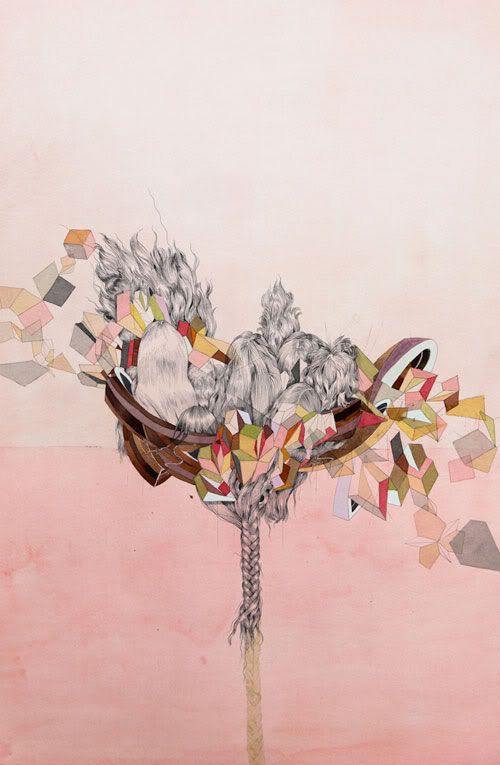
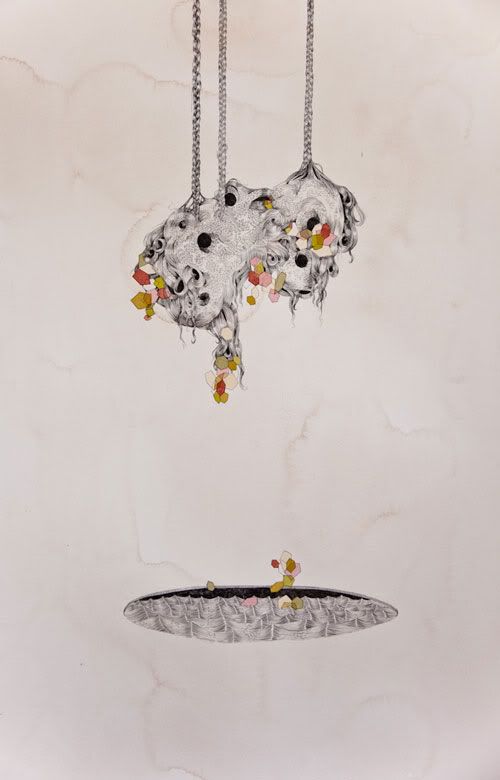
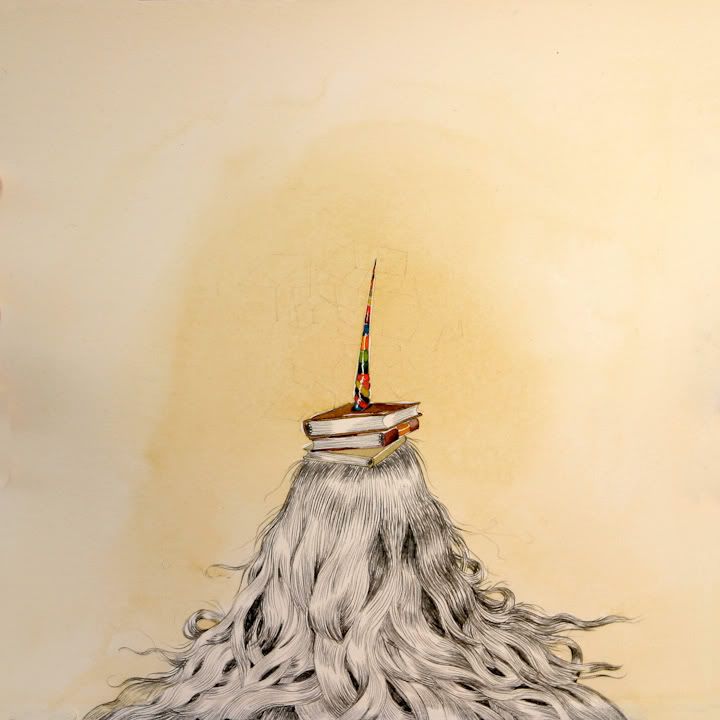
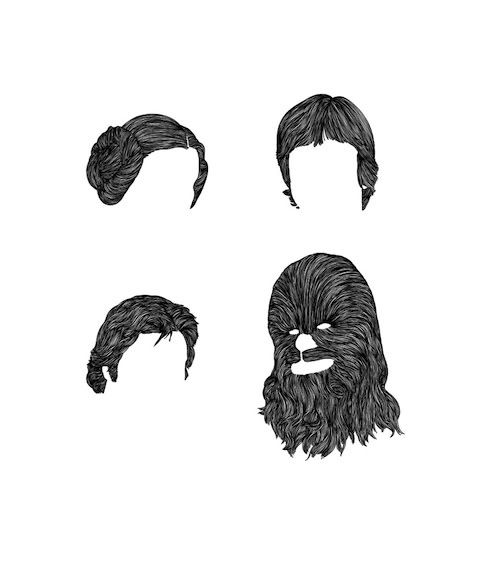
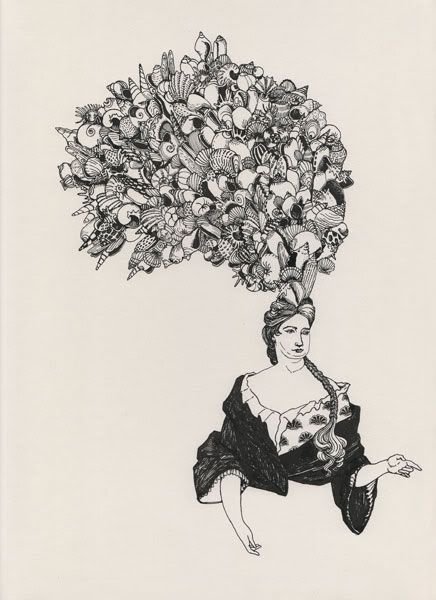
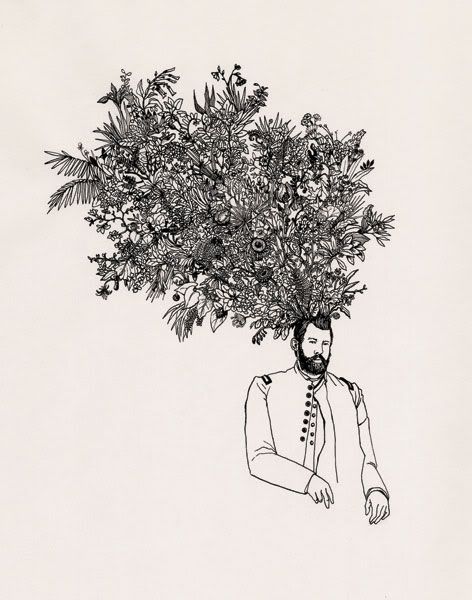
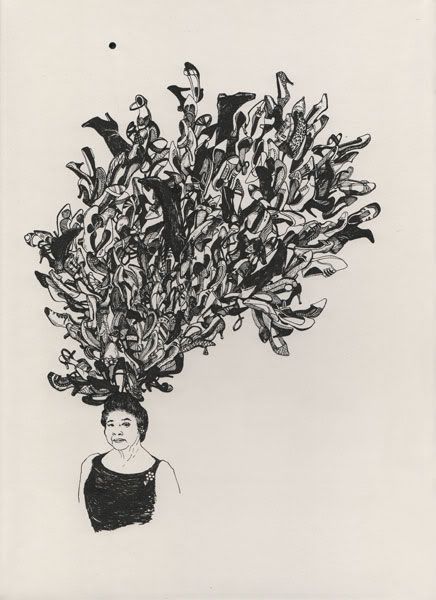
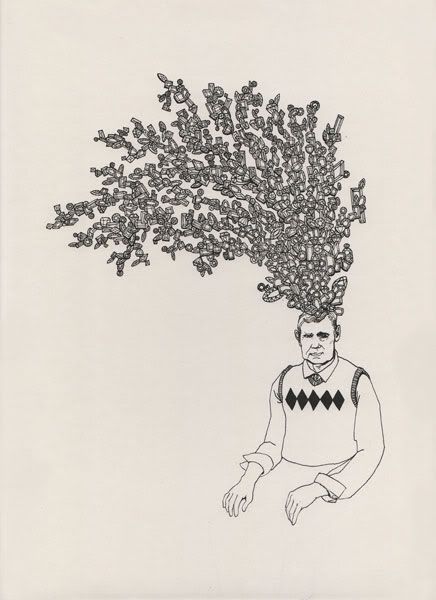
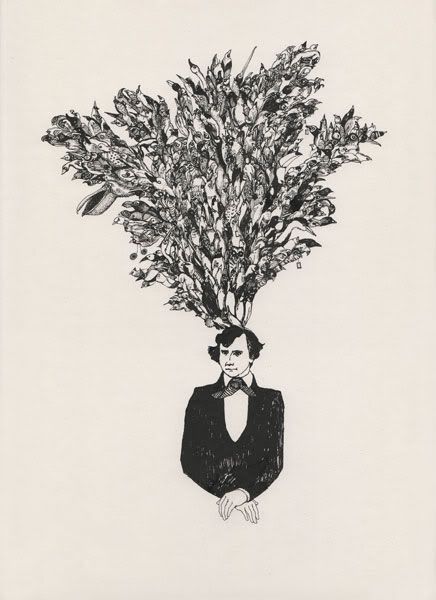
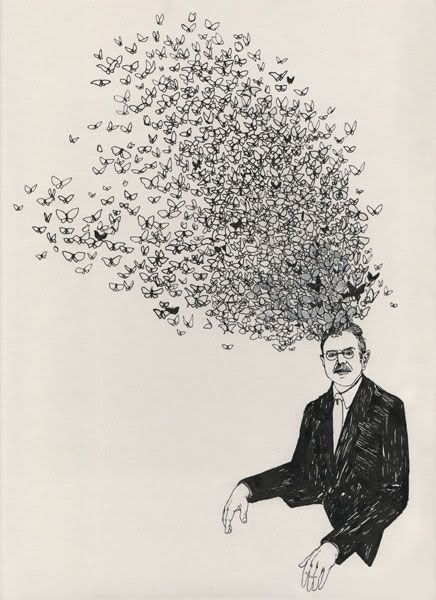
Tiny Showcase brought illustrator Lauren Nassef to my attention this morning. I've been perusing her portforlio (and you should to - you won't be disappointed). The thing which seemed the most magpie-like to share was her collector series. After all, we've had animals, tea sets, and wunderkammers on heads before. This series of illustrations though, is for the specialist collectors:
Duchess, shell collector
Edward Palmer, plant collector
Imelda Marcos, shoe collector
Mr. A.C.D. Pain, mineral and gemstone collector
John Kirk Townsend, bird collector
Andrey Avinoff, butterfly collector
Do look at her site. There is much, much more to see.
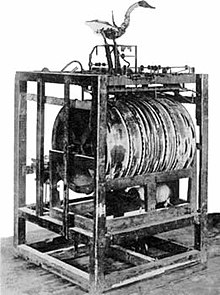
This tiny automaton, presented by German watchmaker, Peter Kintzing to Marie Antoinette in 1784, is central to the Châteu de Verseille's current exhibit of science and curiosities at the Court of Verseille. Hidden beneath her dress is the complex mechanism which allows for her naturalistic movements and musical playing of the dulcimer. The queen immediately presented her delightful toy to the Académie des Sciences, because she recognized this engineering triumph, a marriage of art and science of course, as something which should be commemorated. (via TeenAngster)
It reminded me of the karakuri ningyo, the 200 year old Japanese mechanical dolls, which I saw at the Canadian Museum of Civilization's "Japan: Tradition. Innovation." exhibit. The exhibit traced contemporary Japanese robots and society's fascination with robots back to the tradition of building these automata. The images show a plan from 'Karakuri Zuii' ('Karakuri - An Illustrated Anthology') published in 1796 and Chahakobi Ningyo (Tea Serving Doll) by SHOBEI Tamaya IX (via karakuri.info).
Also, having recently read Thomas Pynchon's Mason & Dixon I can't help but be reminded of Vaucason's mechanical (and digesting) duck. Given a choice I would rather an automaton which did something pleasant, like play music, or useful, like bring me tea, rather than eat and poop, but it is quite amazing to consider the range of movements and achievements of these proto-robots, more than two centuries ago. So much so, that in 1770 by Wolfgang von Kempelen (1734–1804) was able to hoodwink even educated court audiences with the Mechanical Turk, a chess-playing automaton hoax. (To build a chess-playing machine (which not only could move pieces appropriately, but beat highly-skilled human opponents) did take a couple more centuries, because playing chess involves much more than movements, it requires some artificial intelligence.) Vaucanson's more obviously useful output includes the first automated loom - employing punch-cards, foreshadowing 20th century methods for inputting data to computers.
There are also tales of ancient and medieval automata. The Book of Ingenious Devices published in 850 by the three Persian brothers known as the Banu Musa (Ahmad, Muhammad and Hasan bin Musa ibn Shakir) working at the House of Wisdom (Bayt al-Hikma) in Baghdad, Iraq, under the Abbasid Caliphate, includes many machines and automata, including a mechanical flute player described as the first programmable device.
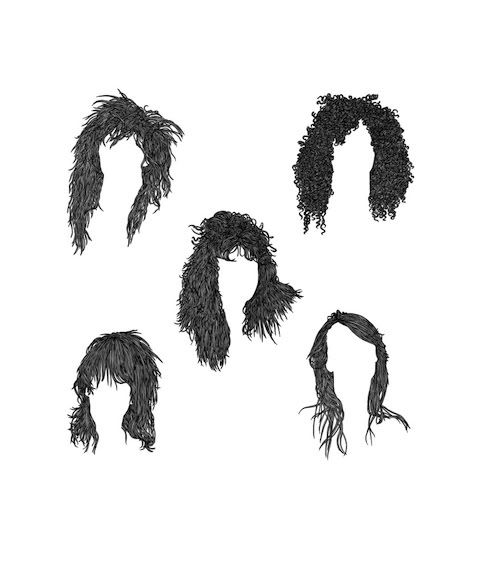
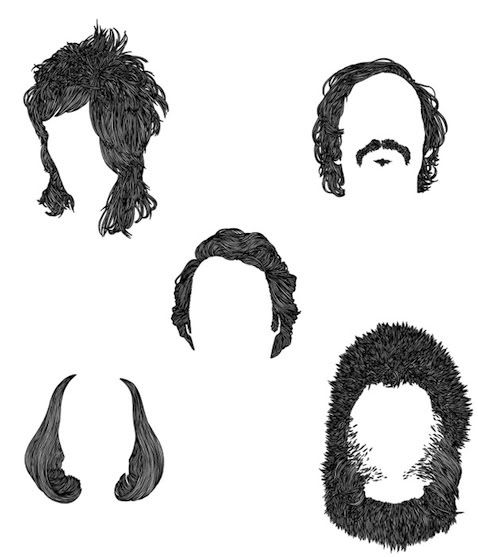
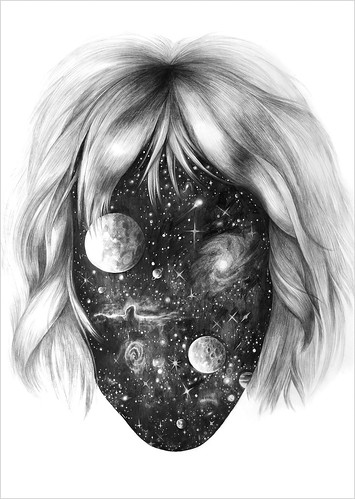
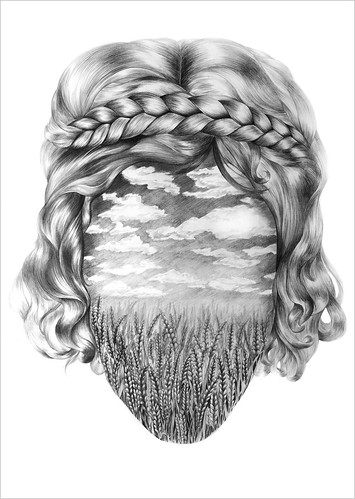
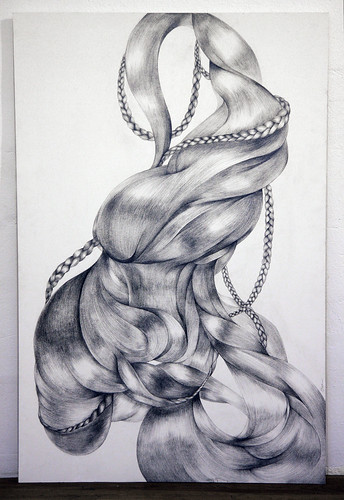
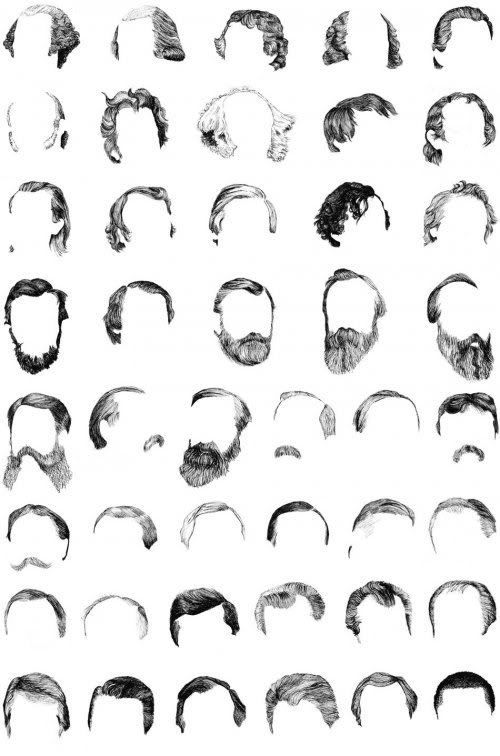
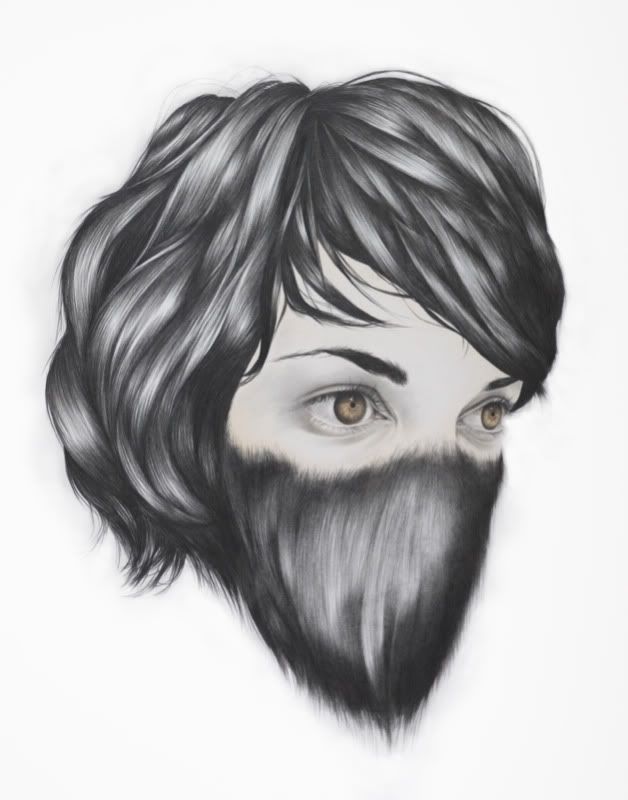
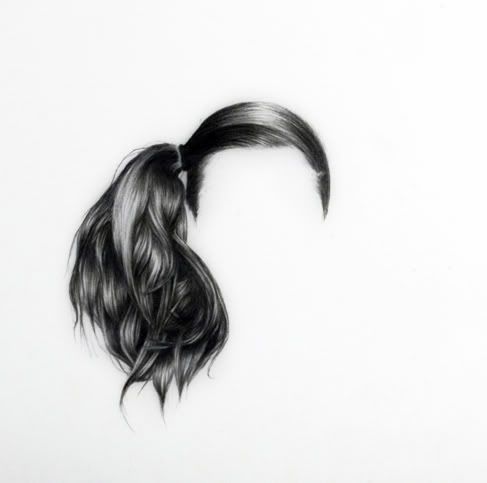
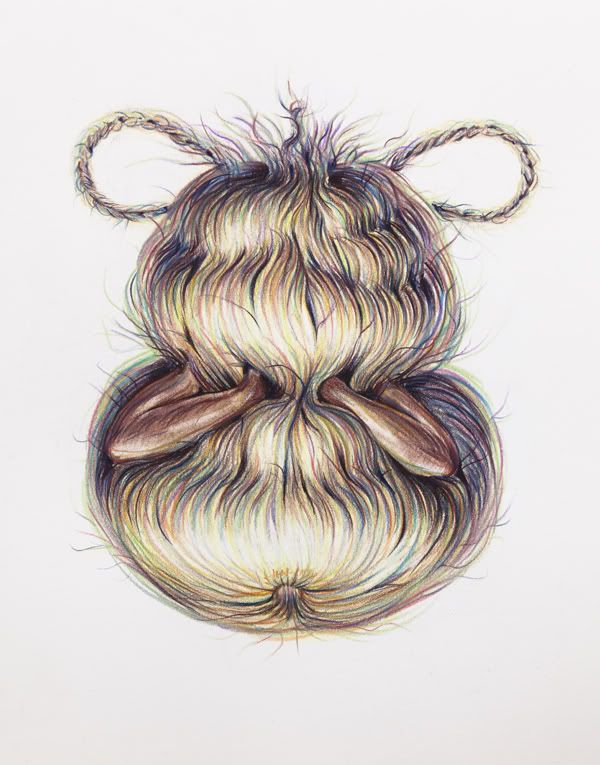
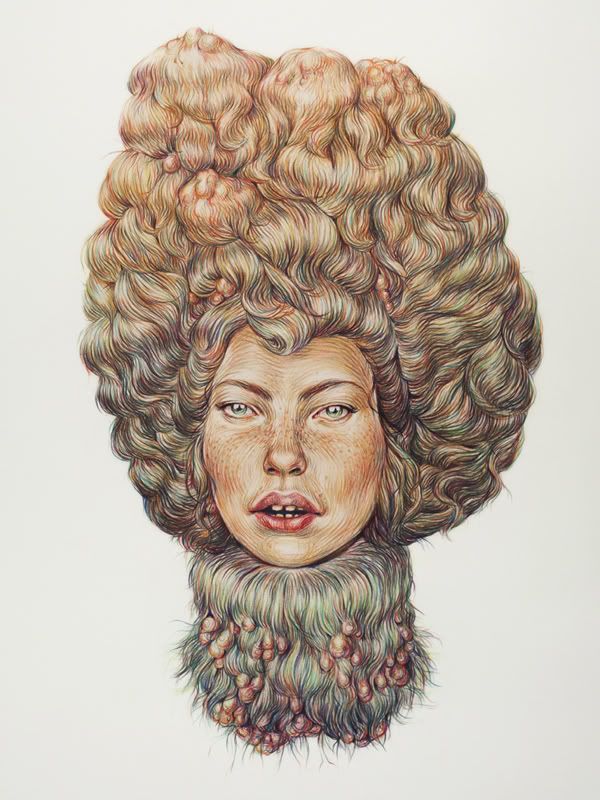
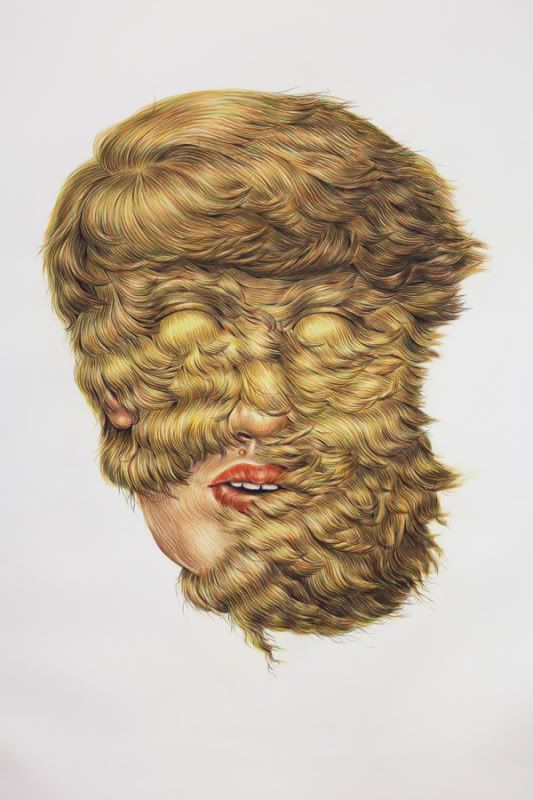
Illustrations of hair seem to be everywhere lately (actually, for a couple of years now). Perhaps it's another Victorian allusion, what with their hair ornaments, jewellery and other (possibly morbid) memorials?
Bear Arms (2011) pencil crayon on paper
14 x 11 in. by Winnie Truong
Glamour and Abscess (2010)pencil crayon on paper 36″ x 48″ by Winnie Truong
Hard To Win Over (2011)pencil crayon on paper 48″ x 72″ by Winnie Truong
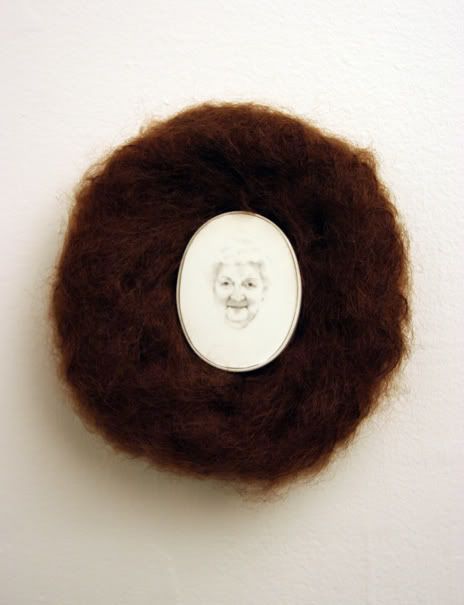
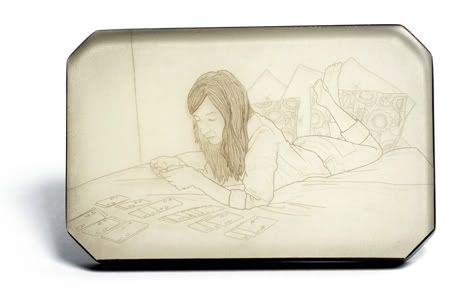
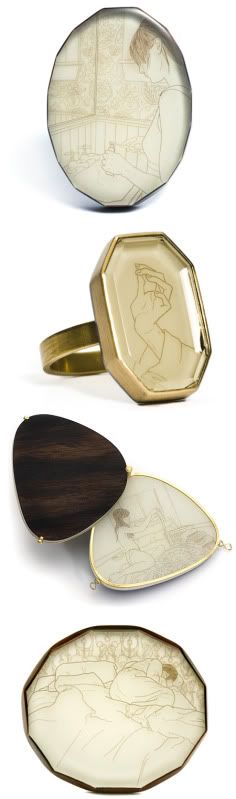
Jeweller Melanie Bilenkar ups the ante by actually using hair as a medium for illustration in her work. (I could do a whole other post on sculpture employing hair as well). She writes, “The Victorians kept lockets of hair and miniature portraits painted with ground hair and pigment to secure the memory of a lost love. In much the same way, I secure my memories through photographic images rendered in lines of my own hair, the physical remnants.”
Solitaire, Brooch (2009)
3 1/4”" x 2" x 1/2"
8 x 5.1 x 1.2 cm
Materials: Gold, ebony, resin, pigment, hair
by Melanie Bilenker
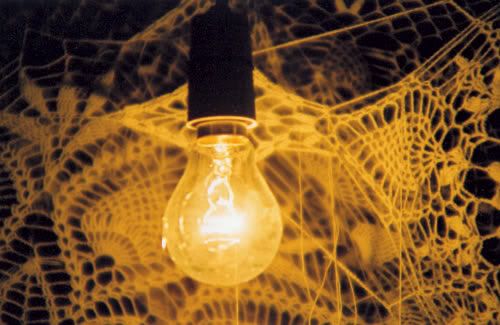
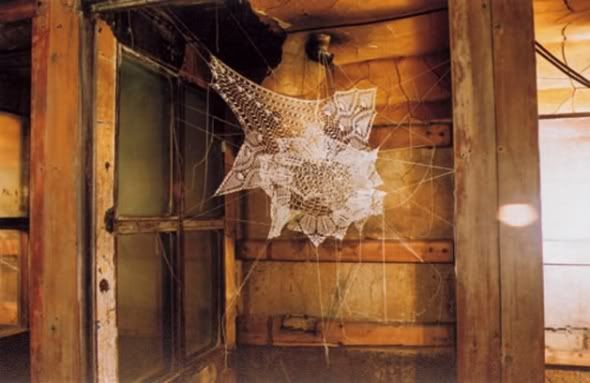
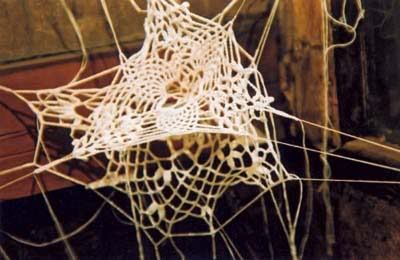
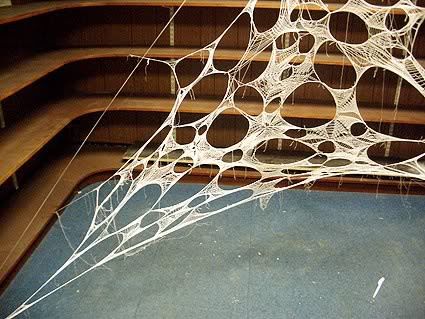
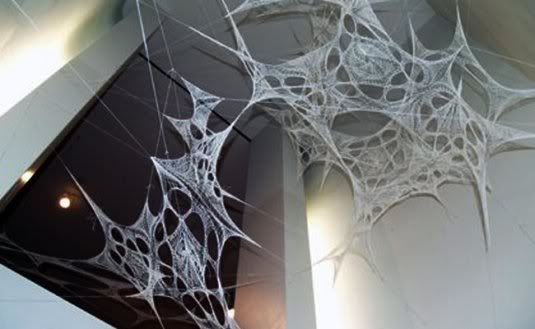
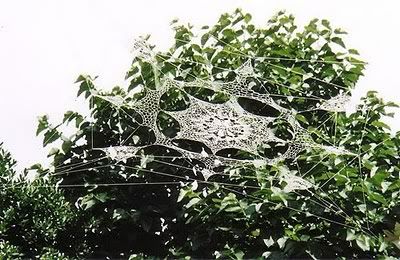
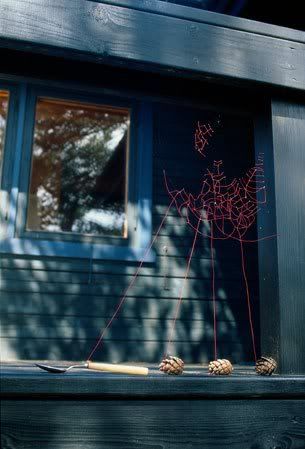
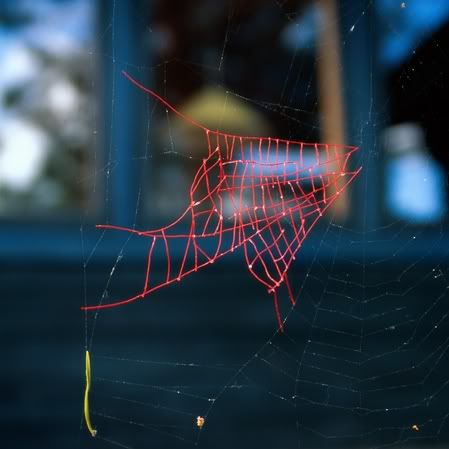
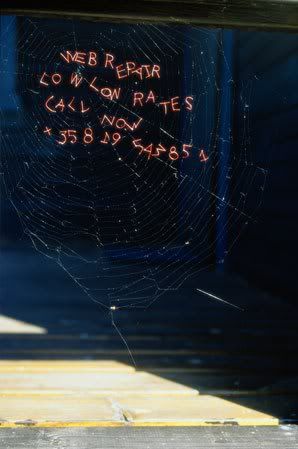
The human-working-in-the-spiderweb-medium reminded me of the 'uninvited collaborations' mended spiderwebs of California and Finland based artist Nina Katchadourian. She searched for broken spider webs and repaired the damage as much as posible with (starched or glued) red thread. Day and day, the spiders rejected her repairs, leaving piles of red thread under their own re-repaired webs. She displayed her photographs of the webs with her repairs alongside the later rejected patches.
A three-dimensional city plan as rotating cylindrical pianola drum in Akko Goldenbeld's 'Stadsmuziek' turns map into music. Building height maps unto note intensity with this scale model of Eindhoven, Netherlands, where model buildings strike hammers which hit piano keys. You can 'hear' the urban plan, the density, distribution and size of buildings make unmelodic, but fascinating music.
Speaking of musical, natural history-themed multimedia, I have to share the somewhat crazed, sliced and diced, musical wunderkammer of the 1967 short film Historia Naturae by Czech animator Jan Švankmajer (via form is void).
Well, this is garunteed to me my thing: science, technology, nature, art, music, multimedia and Björk. I am, in fact, amazed I did not know sooner, but blame that on actually being offshore when Björk's new Biophilia app was released (thanks to bioephemera for the link). This is an innovative way of releasing music, taking avantage of tablet (iPhone, iPad) technology and the opportunities for interactive audiovisual apps. Though I've been a fan of Björk since her Debut album, and confess both her music and her subject matter are likely to hook me, and further, that I have the sneaking suspicion that Sir David Attenborough could read the phone book in a voice which would still be mesmorizing, full of awe and wonder, but I think she deserves kudos for this project, and for cultural innovation.
Thus far the Cosmogony and Crystalline apps are available. Cosmogony contains an interactive stylized galaxy, like the animation in the video above, which the user can navigate to each of the other songs/apps and can use to play with (almost remix) samples of Björk's music by moving fingers on the touch-screen. The intro above, the song animated as a stylized geometrical score, the actual score and the lyrics are included. The song itself is structured to mimic astronomical cycles and the lyrics allude to origine myths and modern cosmology.
The video (directed by Michael Gondry) above gives you a hint of Crystalline. The app allows users to create their own 'crystals' and associated music. This hits on the crystals in comtemporary art and illustration trend, as well as the harkening back to the Victorian wunkerammer though the "nature, music, technology" formulation feels very modern. Describing humans as the link between the microscopic and the universal, she ties all her science-inspired songs/apps together (ranging from microscopic scales of the virus, through the planetary with moon, mutual core and solstice, and the galactic dark matter to universal cosmogony). Unlike the Victorian approach to natural history, and obsessive collecting of wunderkammer, which was fueled by nostalgia and a morbid fear of death, this project is permeated with wonder and optimism about the future, and the opportunities for technological advancement to lead to a more harmonious relationship with nature. The earth scientist in me can't wait to see what she comes up with for mutual core, which alludes to the structure of the Earth and plate tectonics. The artistic and musical interpretations of the subject matter are (thus far) more metaphorical than literal, but what I've seen is both engaging (mesmerizing, even) and surprisingly educational. I love the way the user is invited to participate, manipulating and creating more music. This is a very refreshing way of viewing fans as participants at minimum and possibly even collaborators rather than mere consumers. I love also the understanding that scientific explanations of the beauty we see around us makes these things more wonderful, not less.




 Also, having recently read Thomas Pynchon's