Thursday, August 12, 2010

Friday, August 6, 2010

Tuesday, July 20, 2010

imaging food

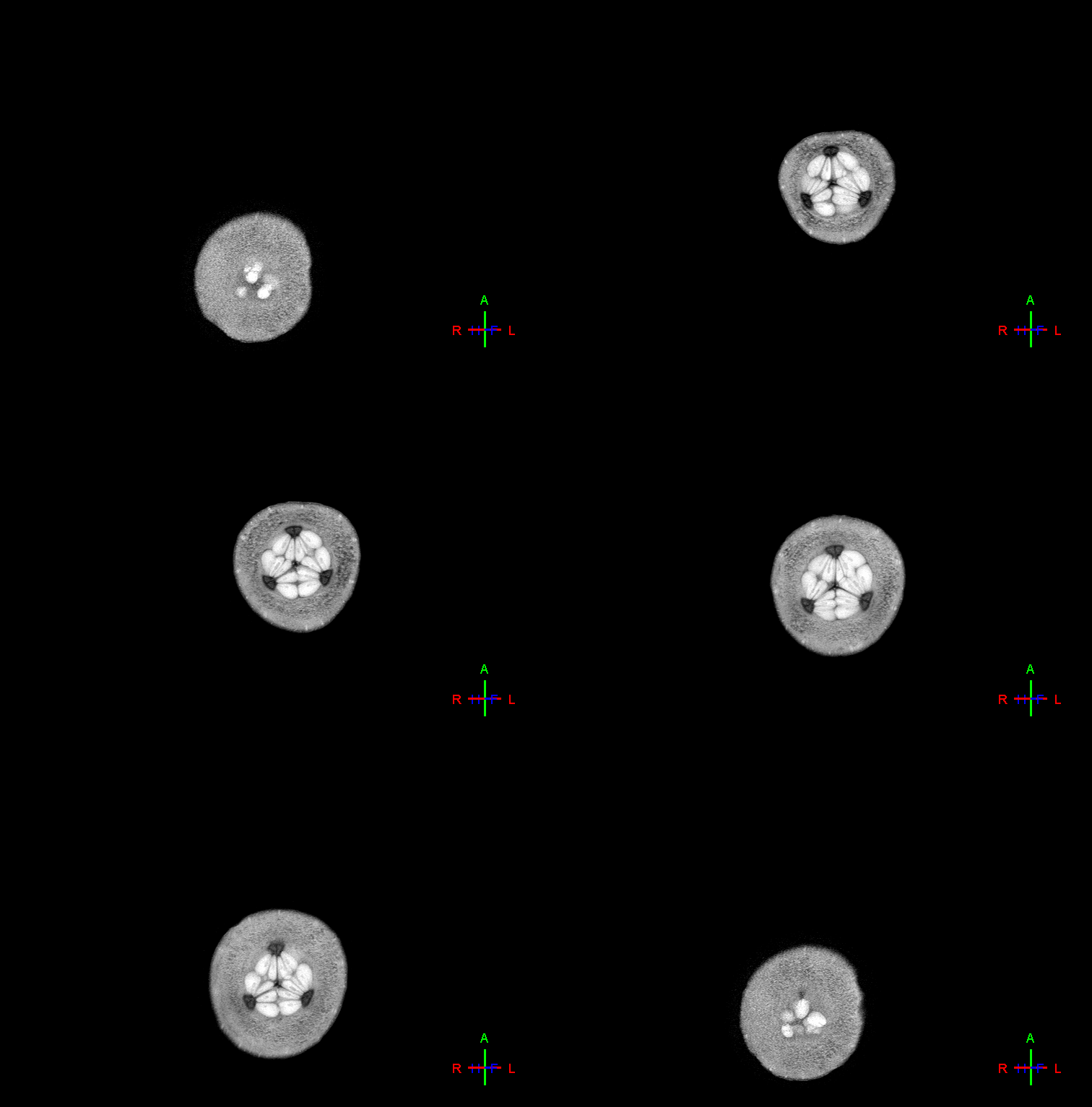
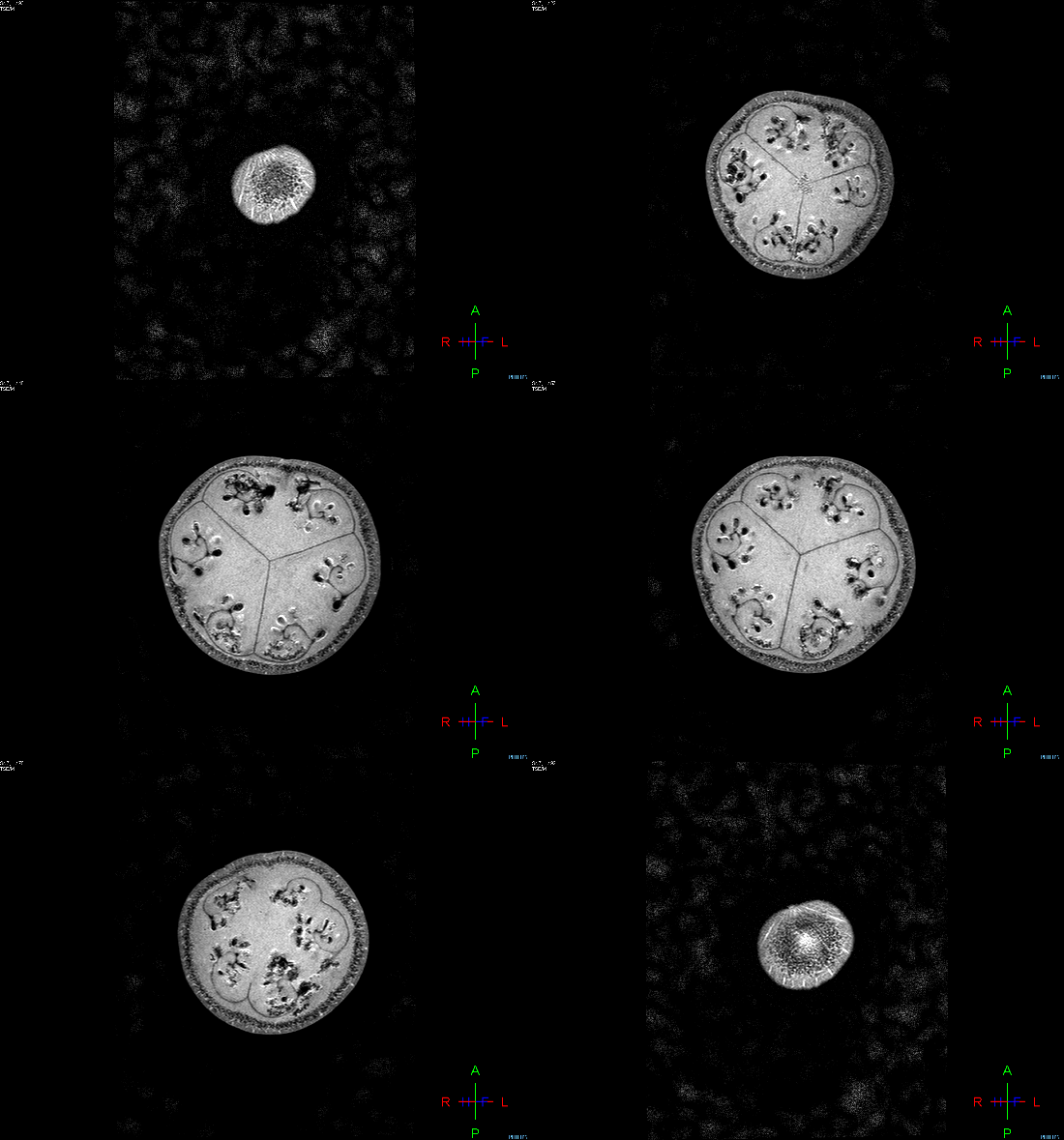
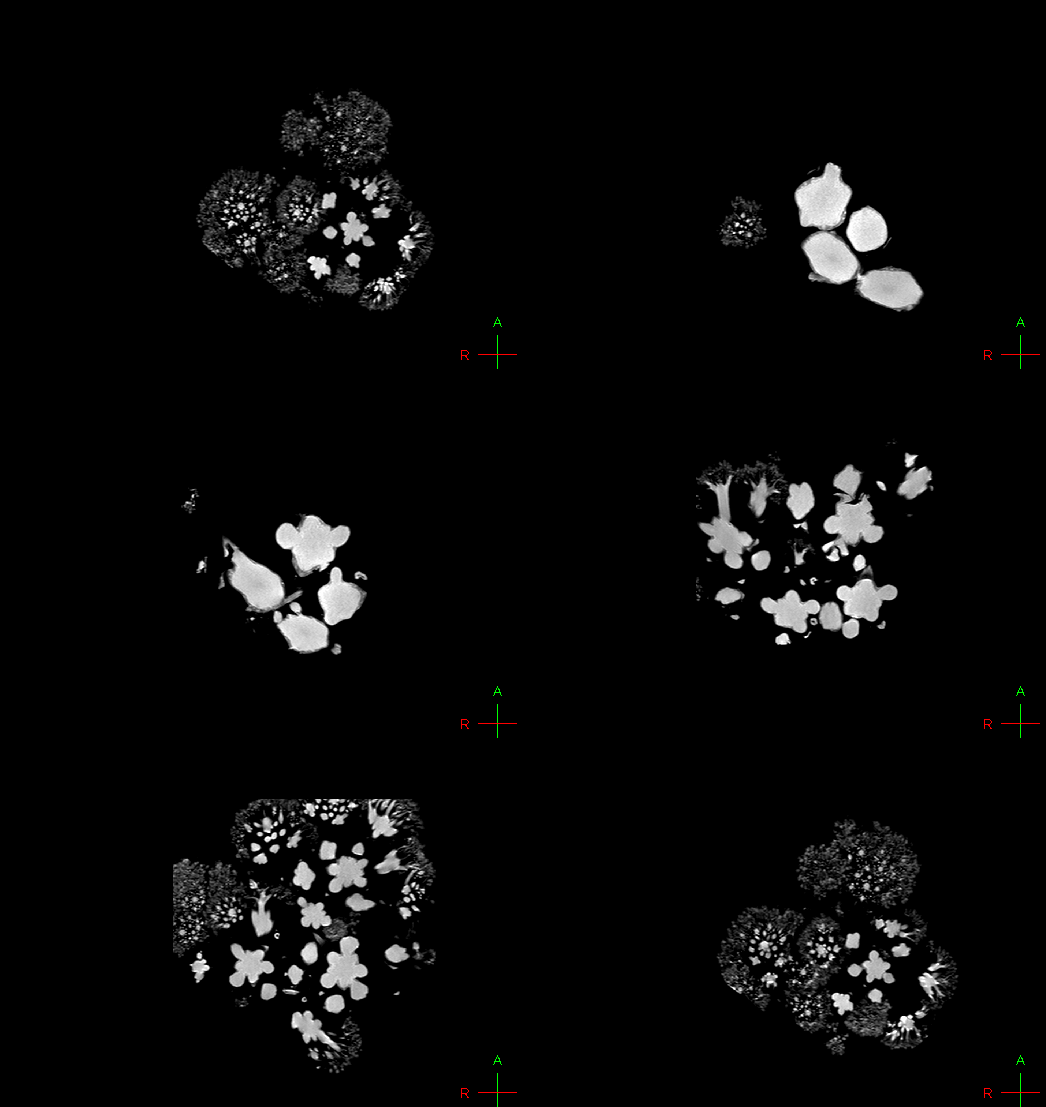
Check out Inside insides and the awe-inspiring gallery of magnetic resonance imaging of food!

The geometry alone is amazing. Look at the bisected equilateral triangle at the heart of the cucumber:


Or the spirals in a watermelon, beyond the neatly trisected centre:


Or the fractal structure of the broccoli:

Friday, July 9, 2010

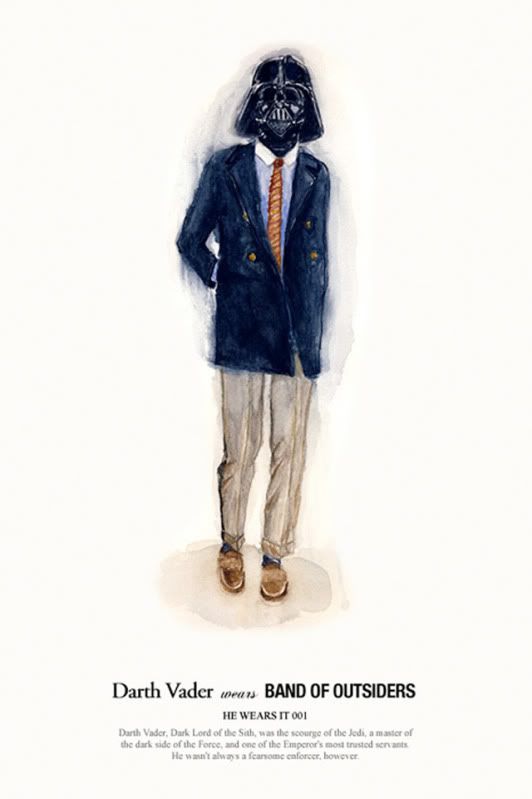
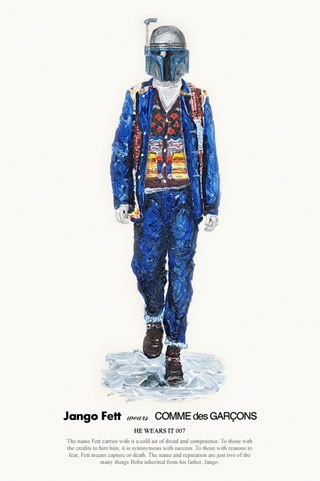
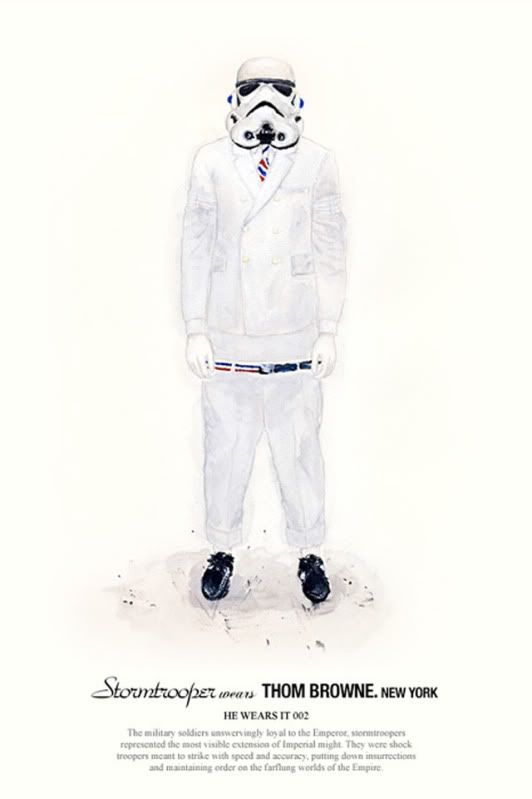
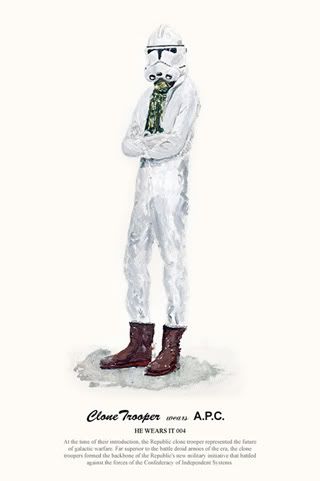
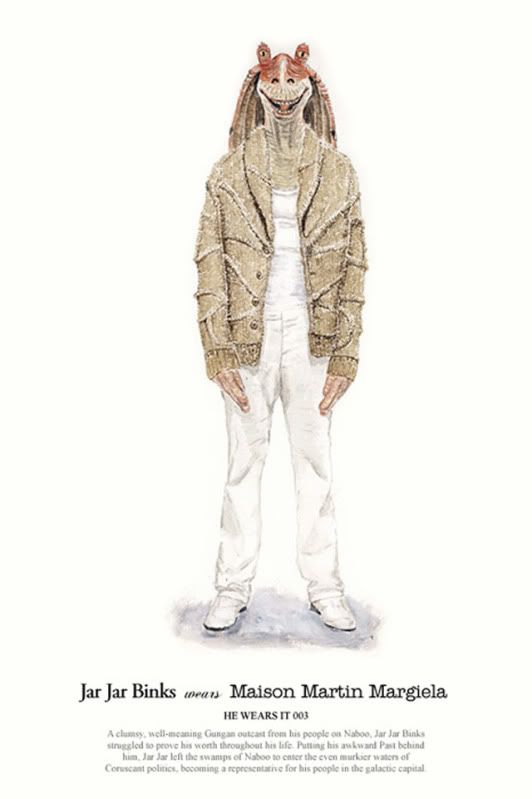
Death Star Fashion

Illustrator John Woo (not that John Woo, the other one) has Star Wars villains as fashion plates. Amazingly, the despised Jar-Jar* has some style. He's made the prints available through wooszoo, his etsy shop


*He took a franchise for which I had nothing but joyous nostalgia and made me cringe. Defintely a villain.

{Surprisingly, this is via The Globe And Mail}

Monday, June 28, 2010

Stats, Lines and Stars

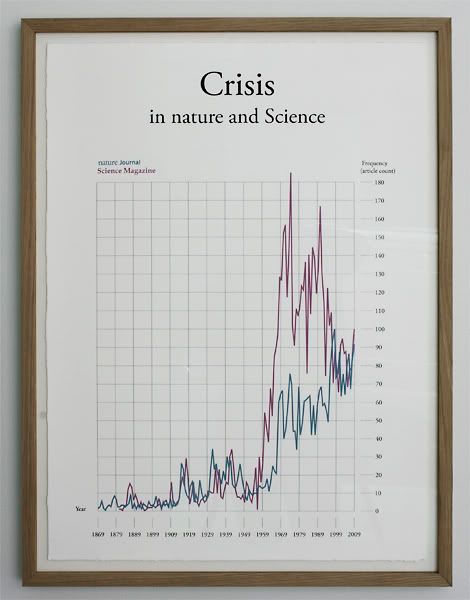
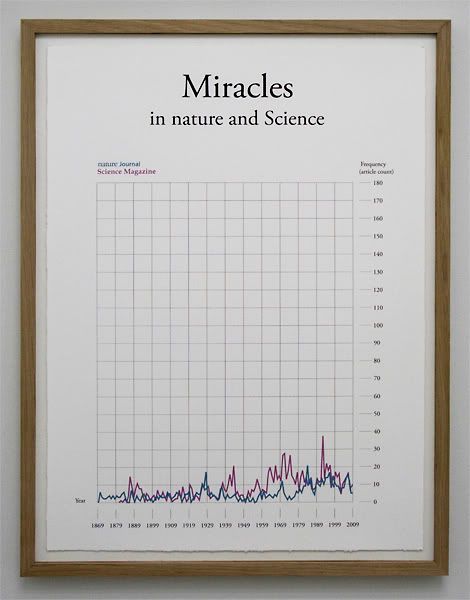
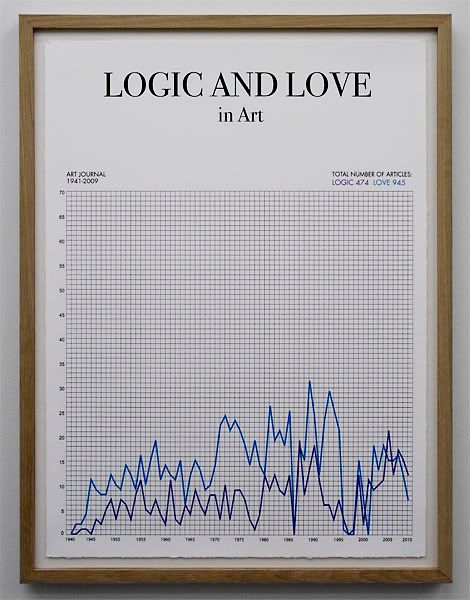
I came across Norwegian artist Toril Johannessen via I'M REVOLTING. She's made some interesting pieces in Words and Years by simply making elegant plots (even Tufte would approve) of the yearly occurances of certain words in certain journals, such as 'Crisis' in nature and Science:


or as 'Miracles' in nature and Science:

which we can contrast with 'Logic" and 'Love" in Art


or 'Hope" and 'Reality' in Politcal Science
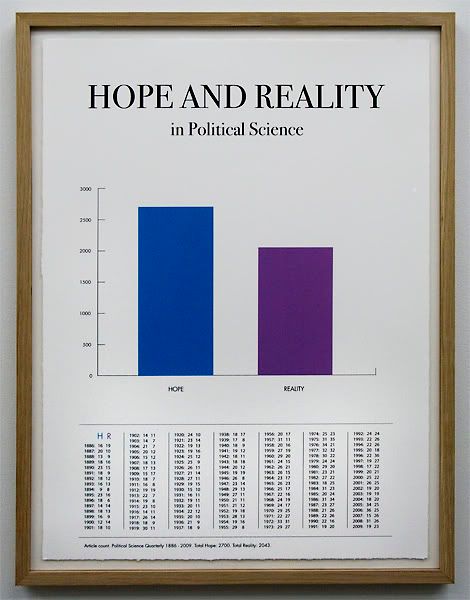

I love the simplicity of these pieces. These are real data and really say something, but, like in science (and other scholarship) itself, the interpretation of the data is left to the viewer. There is both insight and humour in the data she chooses to present.

She's previously tackled science and that inspiring place where art and science intersect. In Transcendental Physics she imagined the intersection of German astrophysicist Johann Zöllner (1834-1882), who studied optical illusions, and the Canadian/US visual artist Agnes Martin (1912-2004), an abstract expressionist who employed lines and grids. Zöllner discovered that parallel lines appear like they will intersect if cross-hatched with shorter lines at an angle - this is known as Zöllner's illusion as shown to the left. She drew her imagined Agnes Martin interpretation of this effect:
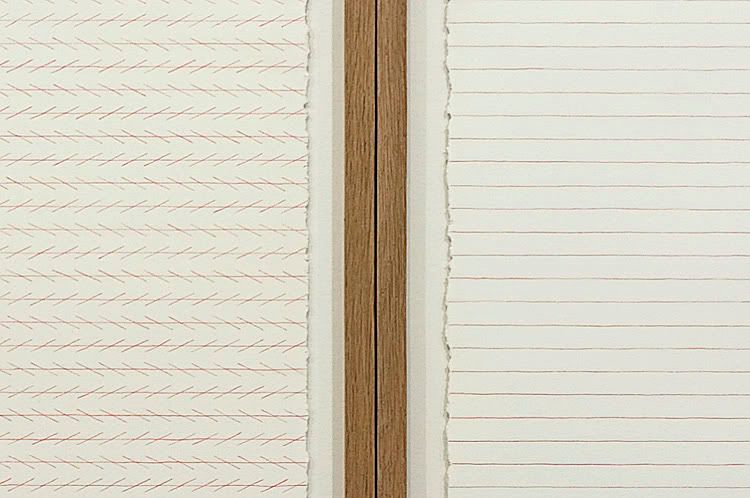

Zöllner's illusion and Agnes Martin's lines
Color pencil drawing (diptych). 46 x 101 cm.
Detail.
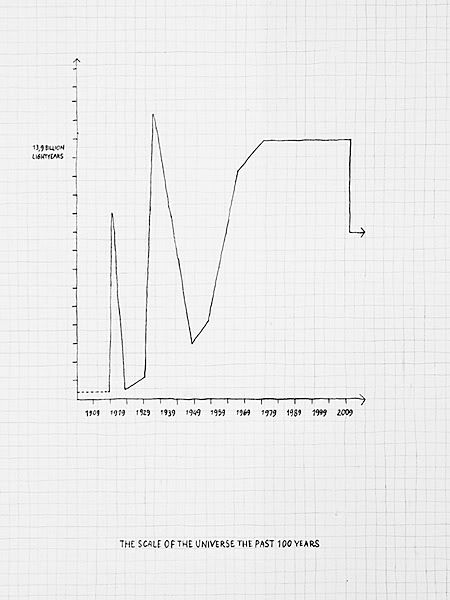


The Scale of The Universe The Past 100 Years.
Drawing. Pencil on paper. 29,7 x 42 cm.
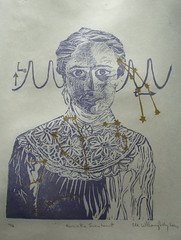
Henrietta Swan Leavitt In 2009, she tackled a topic I've also depicted, in Variable Stars. She points out that at the beginning of the 20th century our estimated scale for the Universe increased radically, and she describes how the project of mapping and photographing the entire sky at the Harvard College Observatory, Cambridge, MA, employed cheap yet conveniently accurate female labour, with all the work done by 'The Havard Computers'. These women were literally treated as automatons and had no status as scientific staff. Nonetheless, as several 'Computers' were outstanding astronomers, they also developped theories about the immense dataset they painstakingly gathered. Henrietta Swan Levitt (shown in my lino block print portrait at left) made a discovery which forever changed our understanding of the scale of the Universe, allowed Hubble's later insight about the age and expansion of the universe and gave us 'Standard Candles' as a metre-stick for the Universe at large. She found a correlation between brightness and period of a particular type of variable stars, the Cepheid Variable stars. I tackled this subject by printing a portrait of Swan Leavitt with how luminosity varies with time and the constellations around and including Cepheus, where she made her discovery. Johannessen travelled to the Harvard College Observatory and dug through the archives, selecting plates showing any stars which would be visible from her location in Norway. She made copies of the photographs, she cut out the cepheid or RR Lyrae star (those used as 'Standard Candles') and them as seeds for growing crystals of alum, a substance that is used as a component in photographic paper. Her installation also included the plot above, photographs and the telescopes below.
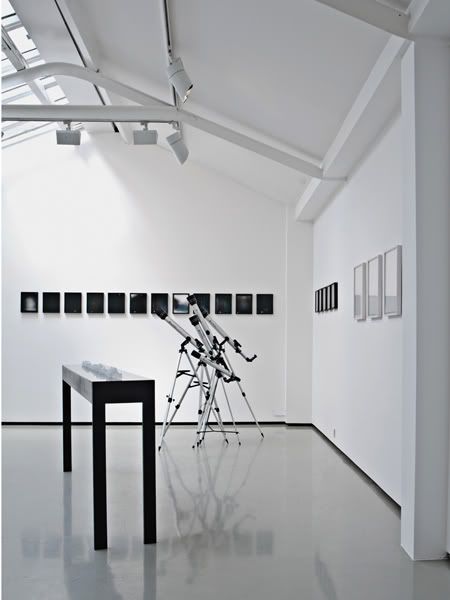


Variable Stars
Installation view. Photographs, crystals on table, drawings, telescopes. Oslo Kunstforening, January 2009.

Her work also alludes to geology, orienteering, engineering and technology. It's fascinating. Go check out her portfolio! I really enjoy the artwork and her sophisticated understanding of science, the propagation and dissemination of scientific ideas, and the interplay between science and society.

Wednesday, June 16, 2010

promise & uncertainty of science


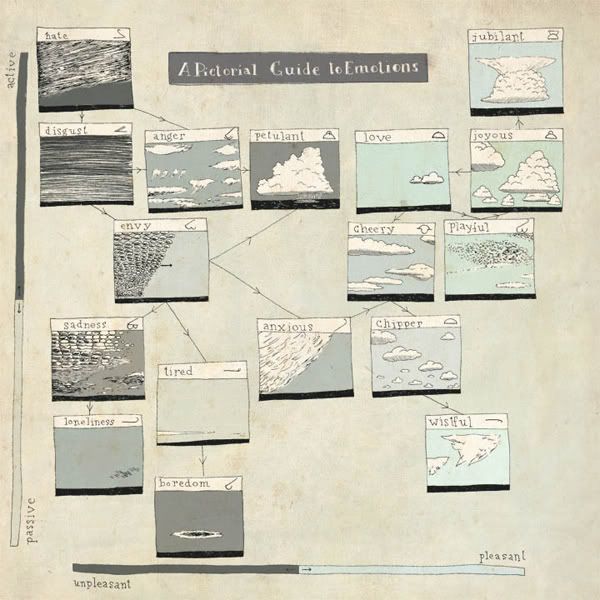
A Pictorial Guide to the correlation between emotions and cloud formations

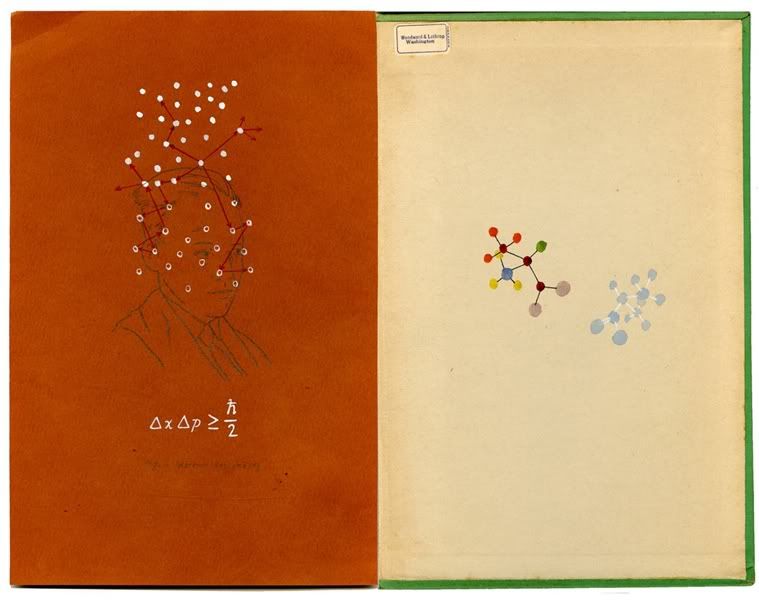
Shannon May is an illustrator living in Baltimore, MD. She writes that she is "fascinated by the promise and aesthetics of science and loves exploring, being uncomfortable, books, clouds, and geometry." Her intersection of art and science is up my alley. In fact, her portrait of Heisenberg reminds me of my own approach to portraits of scientists: combining their face with their work. At first I thought this was not that literal, that the dots were merely molecules. But, if you look closely, you can see that she is specifically trying to illustrate the nature of the Heisenberg Uncertainty Principle (no mean feet). One formulation,
Δx Δp ≥ ħ/2

appears at the bottom. This inequality means that the product of the uncertainty in the position of ANYTHING and the uncertainty in its momentum is greater or equal to a half h-bar (Planck's constant divided by 2π, or ħ=h/2π). This means we can never know the position and momentum (mass times velocity, or basically, the motion) of ANYTHING with absolute precision. It turns out that Planck's constant is very small, so this limit on the knowability of both location and motion is largely irrelevant to everyday life of things we can see (people, trees, planets, cars, mice, or even bacteria). But, in the quantum world of the very small, this limit has profound implications. The only way we can 'see' the very small, for instance, an electron (we'll call him Bob), involves hitting Bob with at least a single quantum of light (a photon). But if you hit Bob with a photon he'll go off running in all directions, since the photon will transfer some momentum to Bob - so, we might know exactly where Bob was, when he was hit with the photon, but we don't know his momentum at all. Conversely, we could measure Bob's collision with another particle or photon and know his momentum but we could no longer know where he was. Also we can know both position and momentum, but only with a certain fuzziness or lack of precision (dictated precisely by the inequality above). Thus, we can precisely describe behaviours of groups of small things in a statistical way, but it is inherently impossible to precisely predict the behaviour of individual quanta like Bob.


I think in this illusration, Shannon May is trying to show this with her filled and hollow circles, to denote positions (filled) and posible positions (hollow) of particles and their interactions shown by little red arrows.

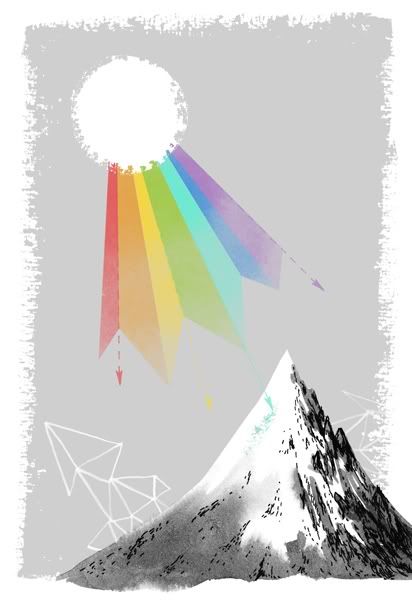
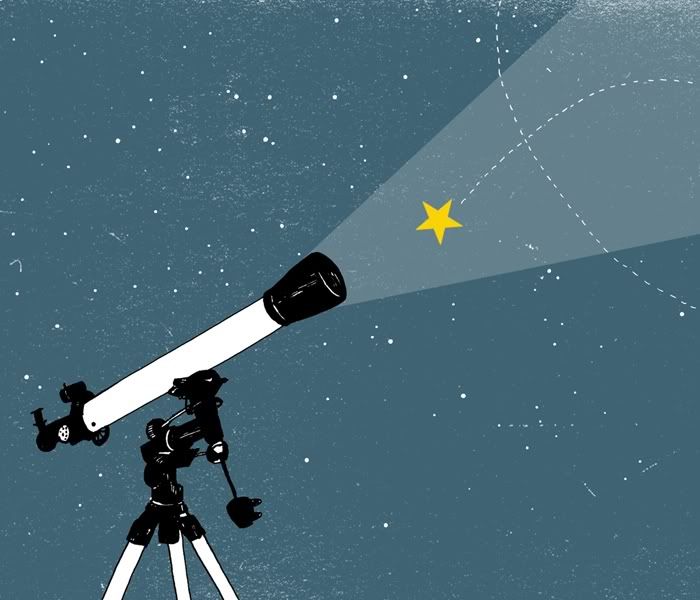
Other illustrations like A Pictorial Guide to the correlation between emotions and cloud formations seem both humourous metaphor, with a wink and a tip of the hat to the science of cloud physics. Some are straightforward wonder at astronomy.


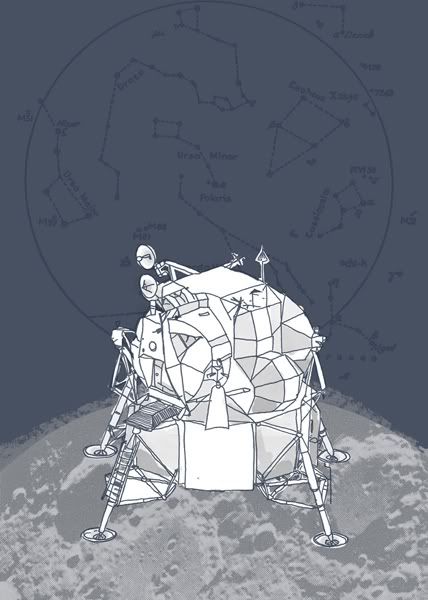
illustration for Italo Calvino's 'Cosmicomics'


Lunar Park, personal work


Illustration for article Contrarian Investor Sees Economic Crash in China


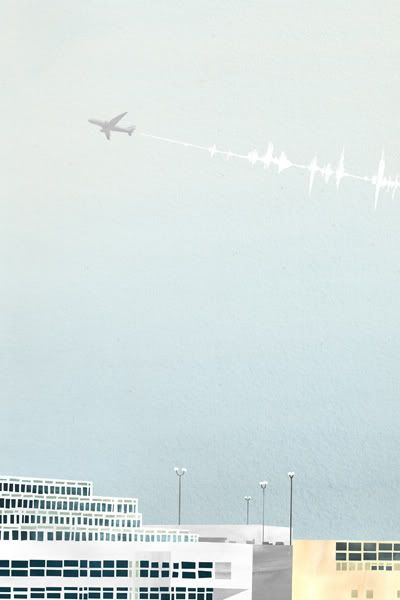
Music for Airports, illustration for article about the history of rock music

I love how that last one combines the sound waveform and airplane steam trail.

You can find her site, her blog and an etsy shop for craftier endeavours and check out the rest of her work.

{via both design sponge and the shallow end}

LinkWithin

Related Posts with Thumbnails