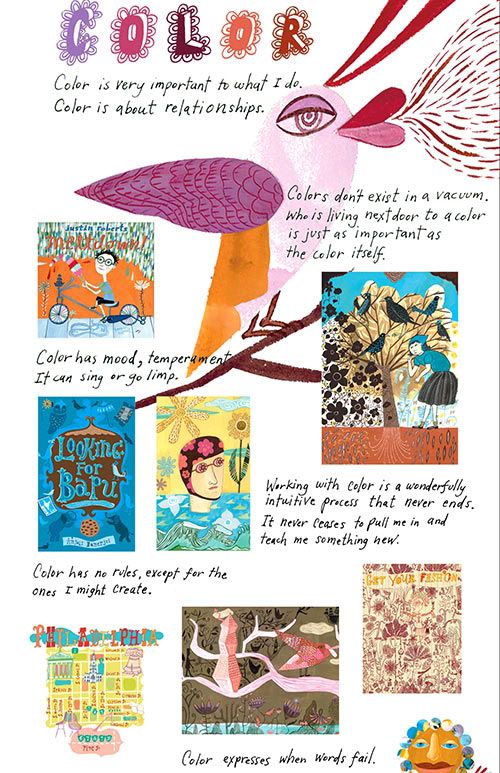
Creature Comforts featured the work of LA artist Sarajo Frieden. This is someone who knows about textures, lines and colour, has a good sense of humour, and a whimsical thing for the birds. See what she has to say about colour:
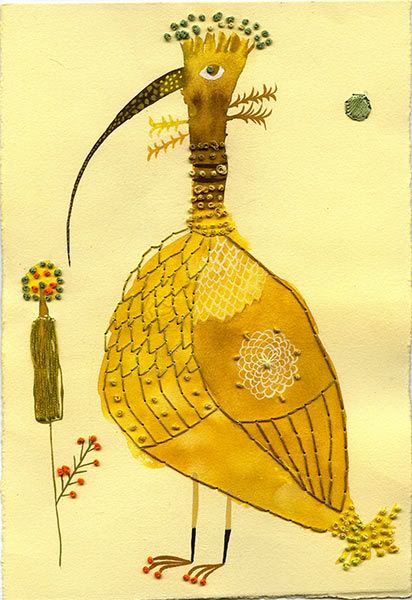
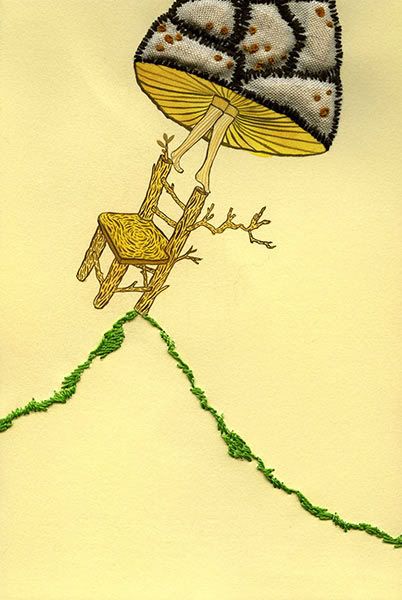
Some of her work incorporates embroidery, like this:
stitched bird 4 (7.5”w x 11”h framed: 11.5”w x 15”h)
lady leaving chair (7.5”w x 11”h framed: 11.5”w x 15”h)
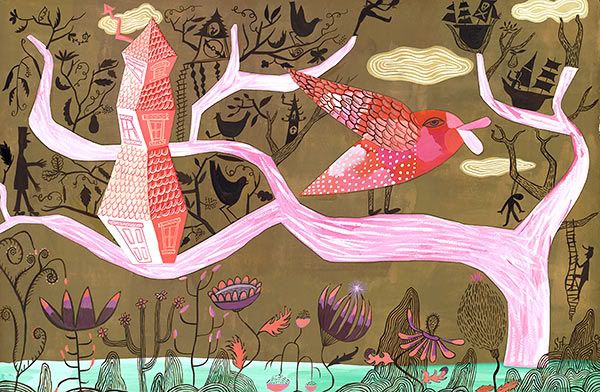
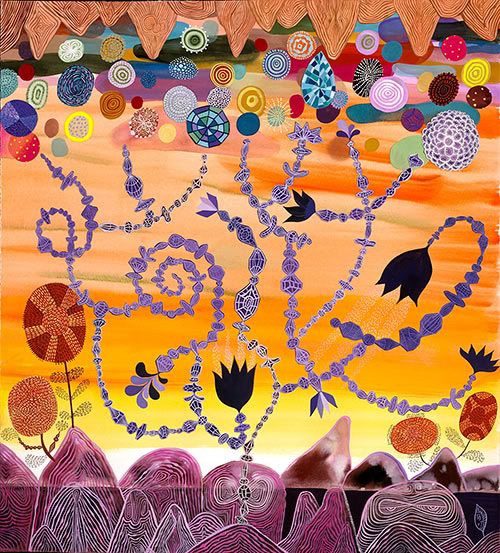
pinktree (gouache, collage on paper 28 1/2″w x 22″h)
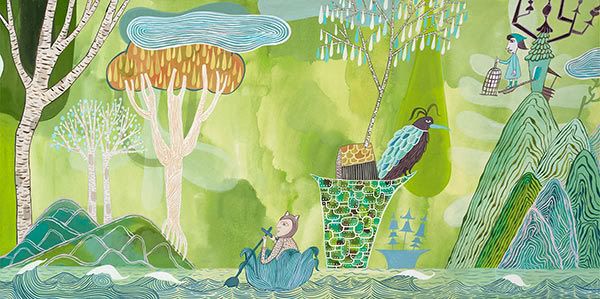
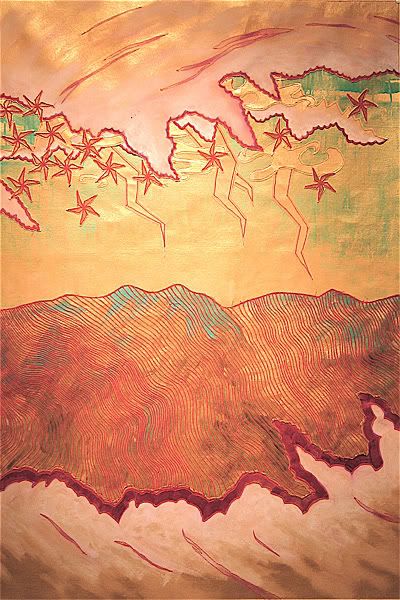
green journey 2 (gouache on paper 23 3/4″w x 15″h 2005)
Recurring images include the "mini me", birds, trees, people dressed as cats, mushrooms, water, silhouettes, ship and gems. Which leads me to ponder, what is it with all the crystals in contemporary art, anyway?
jewelled bush (gouache, collage on paper 22.25″w x 24.5″h 2007)
Crystals appear frequently in a stylized network of lines and explicitly as gems.
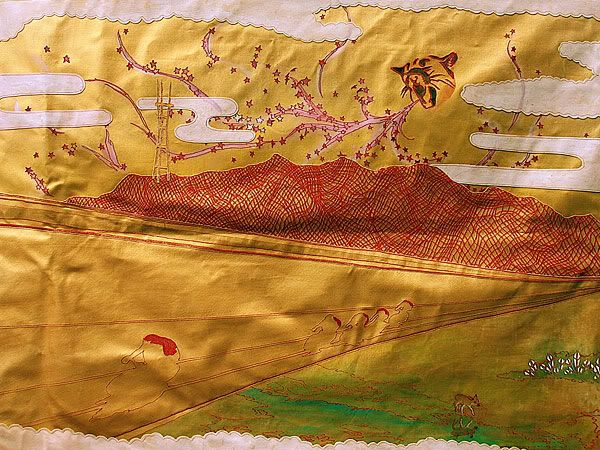
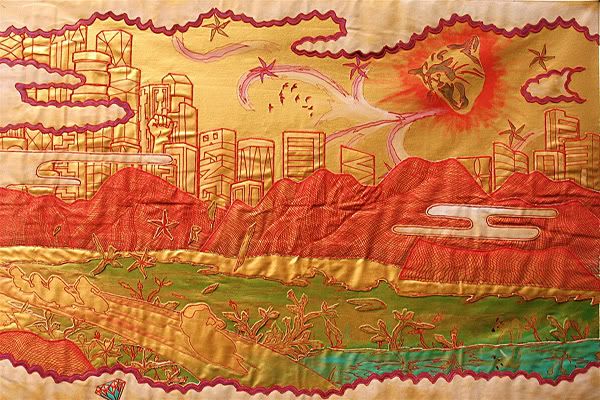
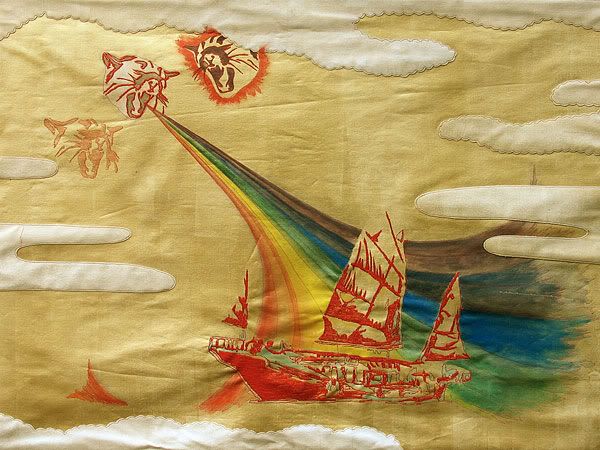
These are the work of NYC artist Ramblin Worker (Steve MacDonald), whom I first found years ago on www.craftster.org. He also combines drawing and painting and sewing. For the record, most of his work does not contain disembodied puma heads- I just happen to really like them. Beyond the multimedia, these artists have something in common in their exuberant colours, lines and nets, and layering of pattern (as well as boats and natures as subjects). Some of the tapestries (I can think of no better word) are incorporated into 3D sculptural pieces.
Part of the raison d'être of Magpie&Whiskeyjack is to preserve and re-invent the old PF blog, so today, I bring you an anthology of sorts on the topic of bioluminescence.
3. Firefly squid: This blue-glowing squid, Japan’s most famous bioluminescent creature, measures 5 to 7 centimeters long and is often found at depths greater than 200 meters. In spring, when firefly squid rise to the surface to spawn en masse, they become Toyama’s great tourist attraction and end up on dinner plates nationwide. One reason the firefly squid glows is to hide itself from predatory fish swimming below. When the squid lights up its bottom surface, fish looking up have a hard time seeing it because it blends with the sky above.
2. Bioluminescent plankton: Measuring 0.1 centimeter long and found in oceans around the world, this type of dinoflagellate glows blue when disturbed. Professor Omiya keeps a flask of the light-emitting plankton in his fridge, because just looking at the cool blue glow helps him relax when he’s feeling stressed. While bioluminescent creatures are generally believed to emit light in order to intimidate their enemies, attract mates or defend themselves from predators, it is not entirely clear why this plankton glows.
1. Bioluminescent comb jelly: This 10 to 15 centimeter long gelatinous deep-sea creature, found at dark ocean depths of more than 200 meters, glows seven different colors in an otherworldly display of light. Many questions remain unanswered about why this comb jelly glows, making it a fantastic rainbow-colored mystery.
I have seen the bioluminescent comb jelly when using an Remotely Operated Vehicle (ROV) off Vancouver Island and it made me think of strings of multi-coloured LEDs. I have also seen seals coated in bioluminescent plankton, which is rather nifty.
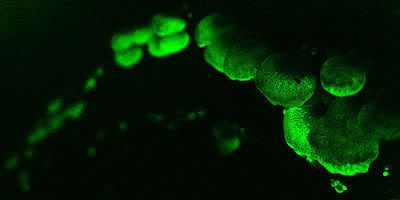
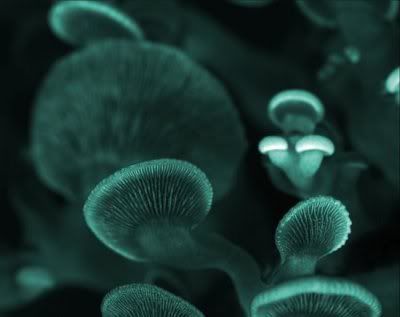
Foxfire is the term for the bioluminescence created by a fungus that can grow on decaying wood in the right conditions. It is often attributed to members of the genus Armillaria, though others are reported, and as many as 40 individual species have been identified. On the suggestion of Benjamin Franklin it was used for light in the Turtle, an early submarine. In the novel The Adventures of Huckleberry Finn by Mark Twain, the characters of Huckleberry Finn and Tom Sawyer use foxfire as a source of light in order to dig a tunnel.
Foxfire is a natural phenomenon sometimes visible at night in forests. It's caused by bioluminescent fungi in special conditions—usually on rotting bark. Foxfire is caused by a range of different species of fungi, though Armillaria mellea appears to be the most common source. This particular species emits a bluish-green glow, like glow in the dark toys. ... Recorded observations of fungal luminescence date back to Aristotle and Pliny the Elder. Pliny identified an "Agaricke" that "grows on the tops of trees and shines at night." Renaissance philosophers wrote of `"Fungus igneus, which shines like stars with a bluish light." In folklore, "Fairy sparks" in decaying wood indicated the place where fairies held their nightly revels.
—BIOLUMINESCENCE FUNGI: LIVING LIGHT, Spores Illustrated, Conn.-Westchester Myco. Assoc., Summer 1999, via Boston Mycological Club Bulletin, Sept. 1999 ...
People from many parts of the world have found uses for these natural lanterns. The Swedish historian Olaus Magnus wrote in 1652 that people in the far north of Scandinavia would place pieces of rotten oak bark at intervals when venturing into the forest. They could then find their way back by following the light.
—Elio Schaechter, from his book In the Company of Mushrooms ...
"In an episode of Lassie, Timmy and Boomer hunt for foxfire so as to scare the girls into not kissing them at the Hallowe'en party." [Sean B. Palmer]
(Foxfire is also apparently the name of two films, several books, a play, a town, a botanical garden, dog breeders, a bluegrass band, comic books and software- not to be confused with Firefox).