Showing posts with label astrophysics. Show all posts

Wednesday, July 15, 2015

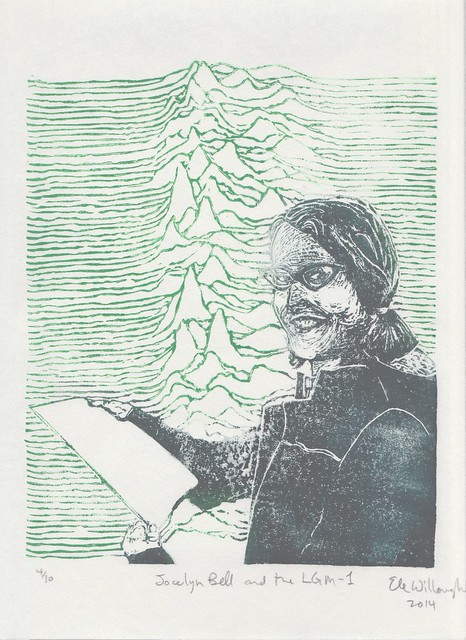
Jocelyn Bell Burnell and the LGM-1

Jocelyn Bell and the LGM-1
Jocelyn Bell and the LGM-1, linocut portrait by Ele Willoughby 2014

Happy birthday to astrophysicist Jocelyn Bell Burrell (born, 1943), who discovered pulsars! As I wrote previously:

In November, 1967, Jocelyn Bell (Burnell) was just a graduate student when she discovered the first radio pulsar (or pulsating star), a highly magnetized, rotating neutron star that emits a beam of electromagnetic radiation. This radiation (light in the radio frequency band) can only be observed when the star is point towards us; so, like the light from a distant lighthouse, it appears to pulse at a precise frequency. She had been working with her supervisor Antony Hewish and others to construct a radio telescope to study quasars (quasi-stellar objects which emit radio waves). She noted some "scruff" on her chart-recorder, and then that the pulses were incredibly regular, occurring every 1.337 seconds. Hewish was initially scornful and insisted the regular pulses must be noise from a human made source. He first dubbed this object, emitting with such regularity 'LGM 1' for "Little Green Men 1", a playful joke about their uncertainty about what could emit radiation so regularly - obviously it could only be a communication from extraterrestrials hahaha! Only after she found other such sources, in different places with different frequencies, were her colleagues convinced and this lead to the development of the pulsar model. It is now known PSR B1919+21.

The 1968 paper announcing this discovery in Nature has five authors, lead by Hewish, followed by Jocelyn Bell. In 1974, Hewish won the Nobel Prize for this discovery, along with fellow radioastronomer Marlin Ryle). Jocelyn Bell was not included as it was assumed that the "senior man" was responsible for the work. This was controversial and has been condemned by many leading astronomers like Fred Hoyle (who with Thomas Gold was first able to explain the signals as due to a rapidly rotating neutron star). Jocelyn Bell Burnell herself has stated she was not upset. Bell Burnell has a great on-going career and won many honours after her impressive start, but her exclusion from the Nobel win, based on her own research strikes me and many others as one of the more blatant and egregious examples of gender bias in the selection of Nobel prize recipients.

Read the full post about how her beautiful dataset itself has lead a life of its own as a cultural meme.

Thursday, June 20, 2013

Astrophysical Meme: Jocelyn Bell Burnell's Pulsar, Little Green Men, Joy Division, and Beautiful Data

In November, 1967, Jocelyn Bell (Burnell) was just a graduate student when she discovered the first radio pulsar (or pulsating star), a highly magnetized, rotating neutron star that emits a beam of electromagnetic radiation. This radiation (light in the radio frequency band) can only be observed when the star is point towards us; so, like the light from a distant lighthouse, it appears to pulse at a precise frequency. She had been working with her supervisor Antony Hewish and others to construct a radio telescope to study quasars (quasi-stellar objects which emit radio waves). She noted some "scruff" on her chart-recorder, and then that the pulses were incredibly regular, occurring every 1.337 seconds. Hewish was initially scornful and insisted the regular pulses must be noise from a human made source. He first dubbed this object, emitting with such regularity 'LGM 1' for "Little Green Men 1", a playful joke about their uncertainty about what could emit radiation so regularly - obviously it could only be a communication from extraterrestrials hahaha! Only after she found other such sources, in different places with different frequencies, were her colleagues convinced and this lead to the development of the pulsar model. It is now known PSR B1919+21.

The 1968 paper announcing this discovery in Nature has five authors, lead by Hewish, followed by Jocelyn Bell. In 1974, Hewish won the Nobel Prize for this discovery, along with fellow radioastronomer Marlin Ryle). Jocelyn Bell was not included as it was assumed that the "senior man" was responsible for the work. This was controversial and has been condemned by many leading astronomers like Fred Hoyle )(who with Thomas Gold was first able to explain the signals as due to a rapidly rotating neutron star). Jocelyn Bell Burnell herself has stated she was not upset. Bell Burnell has a great career and won many honours after her impressive start, but her exclusion from the Nobel win, based on her own research strikes me and many others as one of the more blatant and egregious examples of gender bias in the selection of Nobel prize recipients.

Not only the discovery, but the presentation of the data is impressive and elegant. The diagram above (from the Cambridge Encyclopaedia of Astronomy) shows superimposed images of successive pulses. Stripped down to their essential information like sparklines (chart lines without annotation or axes, but drawn of course to a common scale) so their regularity really stands out, and they can be easily compared and contrasted. If you are used to looking at time series, you'll know that since they can be easily superimposed and the pulses line up, that the frequency is quite regular. The diagram is downright eloquent, and would warm Edward Tufte's heart. It appeared even earlier in the January 1971 edition of Scientific American article “The Nature of Pulsars” by Jeramiah P. Ostriker (shown above on pale blue) and 1974 graphic design book on data visualisation ‘Graphis Diagrams’(via Gia's Blog).

From there, the image began a sort of life of its own. The British rock band Joy Division included the image from the Cambridge Encyclopaedia of Astronomy in a folder of reference material for their 1979 album Unknown Pleasures submitted to Peter Saville, who designed the album cover- iconic in white on black, it's the pulsar data graphically on a square field (at left). It of course appeared as art, without explanation of its source. The beauty of the image itself, as well as the devotion of fans of the enigmatic album, lead to it propagating as a meme to this day. Peter Saville himself gives a great explanation of the life of this diagram in this video.


Data Visualization Reinterpreted by VISUALIZED from VISUALIZED on Vimeo.

Consider how the image has propagated, from tattoos
via Gia's Blog and tattoo by dodie

to sculpture
[unkn0wn pleaSures 1919] by Marvin Bratke, Lasercut Sculpture 40x40cm, wood/acrylic glass

to food
Brock Davis

through fashion (both consciously of its original source, and more tongue-in-check critique of our contemporary cult of images disconnected from their source - though ironically, I'm pretty sure the tee shirt was designed by someone who thought kids today should know Unknown Pleasures, rather than radioastronomy).

PULSAR 1919 SKIRT by lovelysally

Graphic artist Adam J. Kurtz has created this humorous t-shirt via laughing squid

We've arrived at something interesting to look at on tumblr, without reference to Joy Division or pulsars, an enigmatic but captivating image with an unknown source... an unknown pleasure if you will.


Wednesday, September 26, 2012

Communicating the Cosmos, and the Role of Science


Neil deGrasse Tyson 'saints of science' illustration by Steven Hughes


I enjoyed this interview by Stephen Colbert (himself, not his character) of Neil deGrasse Tyson. I watched - or rather, listened to, the whole thing. It wasn't that it revealed a great deal of new science (though they do touch on some recent discoveries), it was simply a wide ranging, interesting conversation by gifted communicators. 


swissmiss

I particularly enjoyed hearing how he came to astrophysics, through the shock of actually seeing the stars when he finally made a trip out of the Bronx. Also, his feelings about movies and interactions with James Cameron are both hilarious and make perfect sense. I know that I can handle self-consistent science fiction even when it plays fast and loose with science, but am irked by allegedly accurate SF which isn't. For instance, I was perfectly happy with the highly speculative premise behind Cameron's Avatar of mapping one's mind onto an alien body but irked (*spoiler alert, in case you somehow have not seen the movie*) that the plot centered around the inability to mine something without spoiling the surface environment, which is such a simple problem to solve. We have directional drilling now, here on Earth, which allows resource extraction kilometers away laterally, as well as deep. For a science nerd like Cameron, this seemed just sloppy to me. I'm not trying to imply that mining has no environmental impact (which would be absurd); I'm saying that the specific problem he used is something we already have the technology to avoid. It wouldn't have been hard to come up with a more convincing-to-earth-scientists problem. I'm sure people who don't know anything about drilling into planets would be mystified by this annoyance of mine (though I'm pretty sure the chemists find the imaginary target of the mining, 'unobtanium' hilarious at best and infuriating at worst). In the end, though, science in entertainment isn't a pressing issue, tempting as it may be to employ the power of blockbuster movies made by science enthusiasts to spread knowledge. Far more important, of course, is the cogent argument for a scientifically literate populace, who can question things for themselves, and who comprehend what science is and what it is not.

Wednesday, May 30, 2012

Measuring the Universe, Animated

This is a lovely, very graphic animation, with simple lines and sparing use of colour, gives one of the most straightforward, yet rather thorough explanations I've heard of the sheer scale of our Universe and how we measure astronomical distances. It is directed by Richard Hogg, animated by Robert Milne,Ross Philips, and Kwok Fung Lam and narrated by astrophysicist Olivia Johnson.


↬ Brain Pickings

I particularly liked her efficient explanation of 'standard candles', which is something I've tried to put as simply and plainly as possible, when I describe the importance of Henrietta Swan Leavitt's discovery of the relationship between luminosity, or brightness, of a certain type of star, the Cepheid variable stars. Thanks to her discovery, we now know there is a simple relationship between period and luminosity for these stars - something which radically changed the theory of modern astronomy, an accomplishment for which she received almost no recognition during her lifetime.

Cepheid variables are a class of pulsating star. They are named for the star Delta Cephei in the Cepheus constellation. The relationship between a Cepheid variable's luminosity and pulsation period is quite precise, securing Cepheids as viable standard candles and the foundation of the Extragalactic Distance Scale.

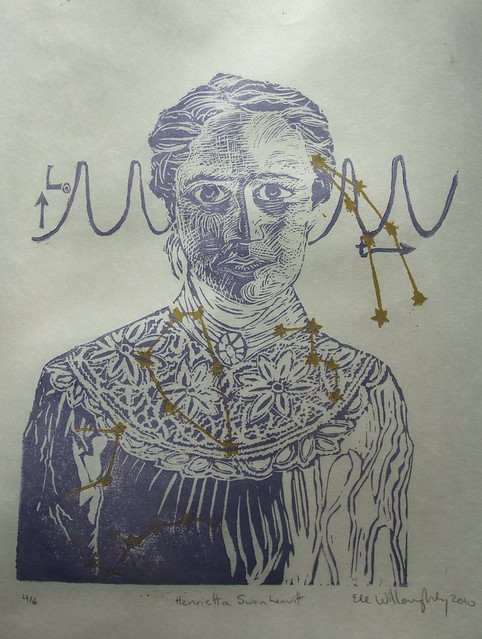
Henrietta Swan Leavitt


My portrait of Swan Leavitt, shows Henrietta, related constellations, and a plot of her period-luminosity relation. This is a first edition lino block print in lavender-silver and gold ink on Japanese kozo paper (10" by 12.5" or 25.4 cm by 31.8 cm). The first edition is a run of 6 prints.

LinkWithin

Related Posts with Thumbnails