Showing posts with label metal. Show all posts

Wednesday, October 10, 2012

Bespoke Insects


 The 'muscle bug (Coleoptera Tendonitis)' by Mark Oliver

For some reason, I've been seeing a quite a few insects in art of late. After the recent post on the photographic work of Laurent Seroussi, today I bring you more than 2D insects: sculptural and animated fanciful insects.

Working with trash (and found objects), British artist Mark Oliver has created the 'litterbugs', building their bodies and classifying his imaginary creatures with scientific and common names. The 'muscle bug (Coleoptera Tendonitis)' for instance involves anatomical illustrations of the muscles in human limbs. The 'frequency moth (Lepidoptera Doppler)' has clock arms for legs. The 'celebellar bug (Coleoptera Mesmerical)' contains anatomical drawings of human heads and brains. Some are more metaphorical in classification. The 'Prophet Moth (Lepidoptera Inspiration)' contains the spine of a bible. He describes his beautiful and whimical Litter Bugs thus as, "A creature whose instinctual and physical qualities have adapted so uniquely to the modern urban environment that it has rendered itself, by nature of camouflage, virtually invisible" in its habitat. They make a truly wonderous collection; be sure to peruse the whole collection.


The 'frequency moth (Lepidoptera Doppler)' by Mark Oliver


 The 'celebellar bug (Coleoptera Mesmerical)' by Mark Oliver


 The 'Prophet Moth (Lepidoptera Inspiration)' by Mark Oliver

(design boom)

Mark Oliver isn't the only artist inventing species of insects. The previously mentioned Finland-based artist Vladimir Stankovic invented Cephalopodoptera, which, as the name suggests, combines the cephalopods (octopi and squids) with insects. What makes them magical is that he has not only illustrated them but animated them, like the often colour-changing or bioluminescent cephalopods. Find more here.

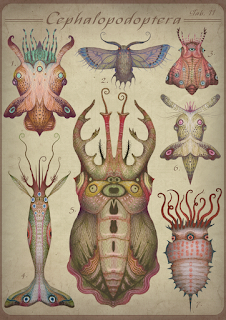
Cephalopodoptera by Vladimir Stankovic

Cephalopodoptera by Vladimir Stankovic

I am really taken with the work of Canadian metalsmith and jeweller Elizabeth Goluch. Her gorgeous metal and gemstone insect sculptures include clever little allusions to nomenclature or folklore. There are a dragons and flies on her dragonfly. Insider her ladybugs are a house engulfed in flames ("Ladybug, ladybug, fly away home. Your house is on fire..."). Her Violin Beetle has a violin, bow and scored music included. Her carpenter arts contain the tools of the trade (hammer, nails and saw). Her work isn't limited to insects; I love the medusa jellyfish with medusa head. Have a look at her marvellous portfolio.

DRAGONFLY by Elizabeth Goluch

DRAGONFLY by Elizabeth Goluch
Sterling silver, 18k & l4k gold, fresh water pearls, garnets
9.5"l x 11.75"w x 2.75"h


LADYBUG #2 by Elizabeth Goluch
sterling silver, 18k + 14k gold, garnets, enamel, ceramit
5.5"l x 4.5 "w x 1.5 "h
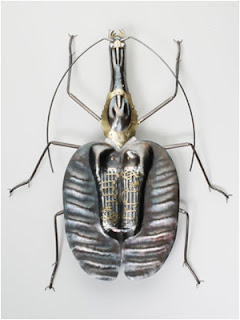
VIOLIN BEETLE by Elizabeth Goluch

VIOLIN BEETLE by Elizabeth Goluch
VIOLIN BEETLE by Elizabeth GoluchVIOLIN BEETLE by Elizabeth Goluch
sterling silver, 18k & 14k gold
10.5"l x 8.5"w x 1.5"h

CARPENTER ANTS by Elizabeth Goluch
Sterling silver, 14K & 18K gold
8.5"l x 7.25"w x 2.25"h
10"l x 8.75"w x 3"h
9"l x 7"w x 2.75"h

This work reminds me of the Insect Lab Studio. "Borrowing from science fiction and fact, Insect Lab customizes insect specimens with antique watch parts and other mechanical components for a luxurious and whimsical effect." Insect Lab creates sort of steampunk robot-like insects; they don't function robotically, but they merely look like Victoria cyborg insects (or cybugs).

Cetonidae: Amaurodes Passerinii Linnei by Insect Lab
Steel watch parts, gears and screw
2.75"
3"x4" dome

Cetonidae: Dicarphaneous Adamsi by Insect Lab
Steel watch parts, gears, spring and screw
3"
4"x4" dome

Cerambycidae: Batocera Numitor by Insect Lab
Steel pocket watch parts, gears, springs and shafts.
5"
5.5"x5.5" dome

I notice that what all these bespoke insect sculptures (and animations) have in common is that they are made of disparate parts. This seems entirely apt. The word insect itself means segment or cut, refering to their separate parts.

Sunday, June 28, 2009

roccoco jellyfish

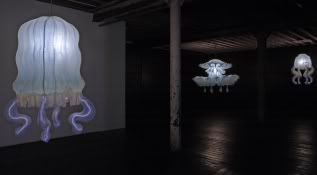
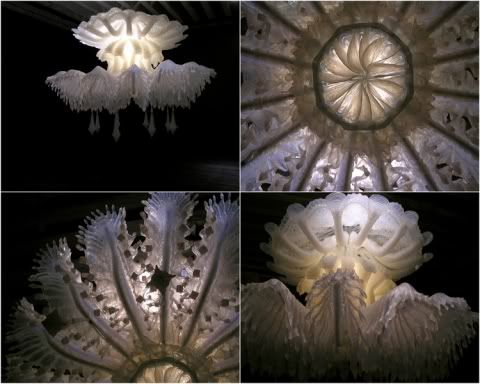
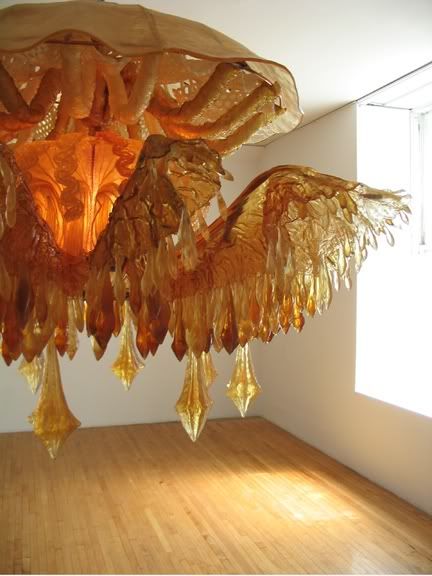
Australian-born, US-based sculptor Timothy Horn has a taste for the roccoco, and tells ironic fairytales with his allusions to ornate historical objects, on unusually large scales or in unexpected media. Check out his gorgeous, yet humourous jewellery on a heroic scale. He caught my attention with his hommage to my favorite (& yours) 19th century German biologist-taxonimist-scientific illustrator par excellence Ernst Haeckel and his jellyfish. These are some chandeliers made in transparent rubber!
discomedusae by Timothy Horn
Discomedusae
2004
Transparent rubber, copper tubing, lighting fixtures
7ft diameter


Timothy Horn - Villa Medusa installation
Villa Medusa - installation view, 2006

Timothy Horn - 4 views of Medusa
Medusa
2006
Silicone rubber, copper tubing, fiber optics
9ft diameter


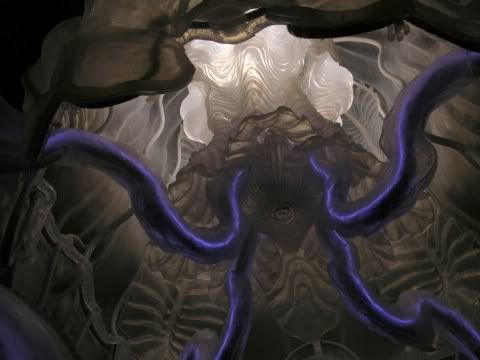
Timothy Horn - Stheno detail
Stheno (detail)
2006
Silicone rubber, copper tubing, fiber optics


I have always wanted to create jellyfish in 3D. I have so far made 2D relief prints, inspired by Ernst Haeckel, like my avatar (seen in the column to the right), but no sculptures - with the exception of my Portuguese man-of-war costume, which involved a paper jellyfish headdress. Sometimes I think about learning how to work with glass for the sole purpose of making jellyfish. Of course, I am not alone in my appreciation of the spectacular form and light interactions (transmission, reflection, refraction and emission) found in these creatures. A quick google search reveals many glass jellies for sale. But I also admire those who, like Horn, have made such sculpture in unexpected media.

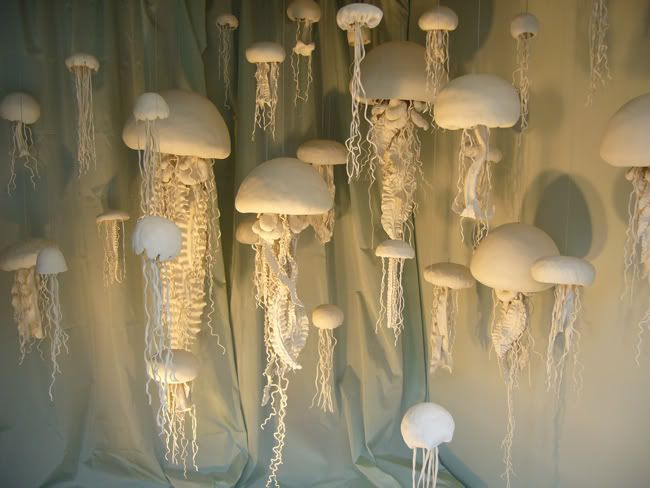
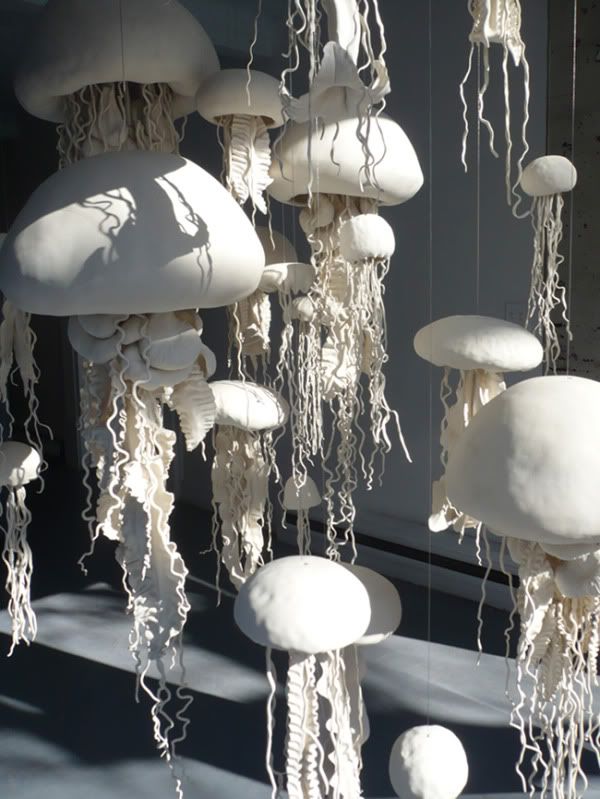
I really enjoyed Alyssa Coe and Carly Waito -Coe and Waito's ceramic jellyfish installation which appeared in the window of Magic Pony in May, 2007, (amongst other places) as part of the MADE show Come Up to My Room.

Coe and Waito - jellyfish
25 - 30 handsculpted porcelain jellyfish

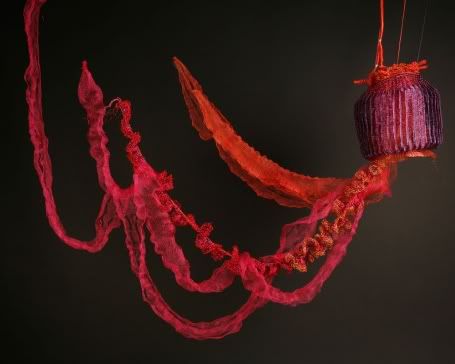
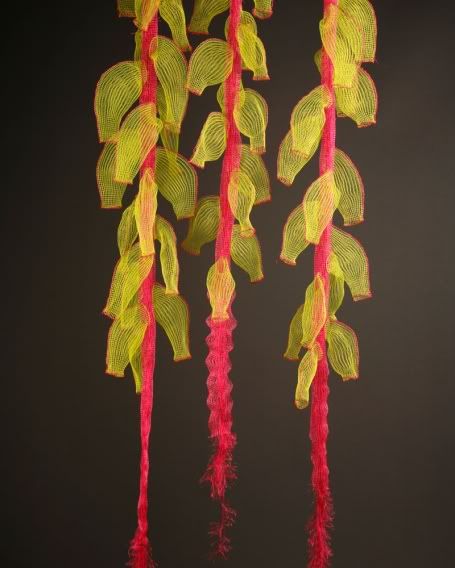
American jeweler Arlene Fisch applies textile techniques to metal to produce her larger-than-life jellyfish. Her exhibition involved blown air to allow her creatures to move naturally (encorportating the fourth dimension of time):
Arlene Fisch
Black Sea Nettle

Arlene Fisch
Orthocanna

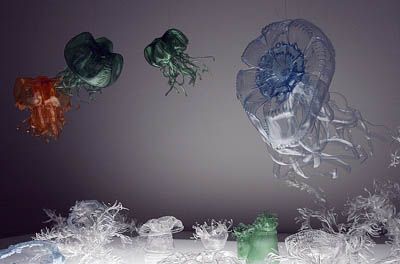
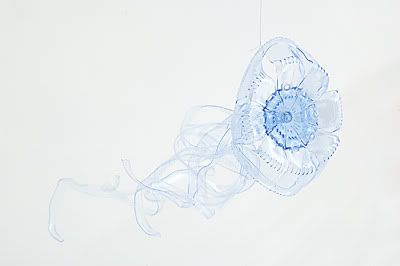
Miwa Koizumi employed trash - specifically PET (polyethylene terephthalate) water bottles - to make her water animals. She manipulated the shape of the empty bottles using heat guns, soldering irons and cutting tools. The results are magical.
Miwa Koizumi
plastic water bottles, 2005
installation view at sawaguzo at Redux


Koizumi
Volvic water bottle, 2005

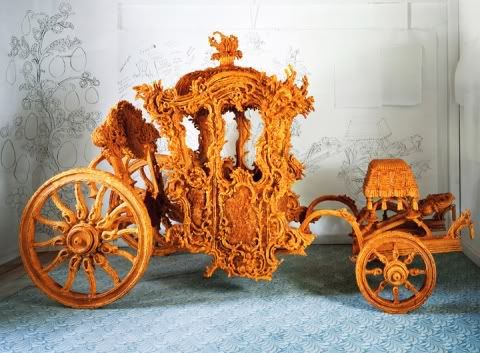
p.s. Check out Timothy Horn's other exhibitions when you visit his site. Who could resist replica of a gilded 18th-century Neapolitan sedan chair made with crystalized rock sugar?

Timothy Horn - Mother Load
Mother-Load
2008
Crystallized rock sugar, ply-wood, steel
9ft.6in. x 6ft. x 5ft. 6in.

LinkWithin

Related Posts with Thumbnails