Showing posts with label glass. Show all posts

Wednesday, July 31, 2013

The Blaschka Glass Menagerie Dynasty

The Natural History Museum (NHM)
German glass artists Leopold (1822-1895) and his son Rudolf (1857-1939) Blaschka produced wonderous glass anotomical models of organisms, including many marine invertebrates and flowers, which went on to populate the natural history museums of the world, universities and aquaria. These were creatures and plants they wished to display but which were difficult to preserve and often rarely observed. Previously, models were limited to drawings, pressed specimens, photos, paper and wax models. The famous Blaschka models not only provided views of anatomy in a full three dimensions, they were beautiful and quite accurate. There were other glass artists making zoological and botanical models, but the Blaschkas were known for their attention to detail - and for the perhaps unexpected way this very specialized career in scientific illustration (in glass) was passed from father to son and how this one family of scientific artisans produced so much of the world's collections of glass specimen models.

Octopus from the Cornell collection
Leopold even kept an aquarium in his home to study these creatures for his models.

Physalia arethusa (glass model of a Portuguese Man-of-War). There are about two hundred tentacles made of thin coloured glass, supported and attached by fine copper wires. (via National Museum Wales)  
 Despite its unexpected resemblance to the 'Golden Snitch' of Harry Potter and the imaginary game of Quidditch fame, the 'sea gooseberry' is a is a common genus of Ctenophora.
A 'sea gooseberry' or 'comb jellyfish' (Pleurobranchia rhododactyla).
Length: 205mm.

Charybdea periphyllum (glass model)
Pelagia cyanella (glass model).
Sea anenomies displaying a territorial dispute.
Here S. troglodytes fires stinging cells at A. mesembryanthemum who has ventured too close. This behaviour was observed first hand in the aquaria at the Blaschka's home.
Base: 180x110mm. Height: 80mm. (via National Museum Wales)
 
collection of 5 marine invertebrates in glass from the Aurelia aurita, Berenice euchroma, Physophora hydrostatica and Pelagia noctiluca species from the Fonazione Scienzia e Tecnia, Florence, Italy

Highly magnified model of single cell amoeba (Amoeba proteus).
Diameter: 120mm.
Life sized model of marine snail (Cerithium vulgatum) with glass body fitted in real shell.
Length: 90mm.
From the Harvard glass flower collection

Thursday, November 24, 2011

Doily Science

Sometimes I neglect to mention artists who strike me as well-known, or blogosphere favorites. But, I would be remiss to neglect Lisa Solomon's 'doily drawings' which are at the cross-section of art, science and needlework, as they are both beautiful and very much in keeping with magpie&whiskeyjack's favorites things.


doily brain: 2006, coloured pencil and embroidery on duralar, 12 x 9 inches


doily lungs: 2006, coloured pencil and embroidery on duralar, 12 x 9 inches

Solomon writes, "when I started drawing doilies I realized that en masse they reminded me of internal organs.... these doily body drawings represent the 4 things I think you need to make art: your lungs, heart, brain, and guts." She's also used doilies and colour pencils to show beautiful versions of the chemical structure of toxins and the geometry of viruses. More recently she's moved on to even more sculpture representations of molecules by combining the crochet with glass balls.


carbon tetrachloride, 2007
colored pencil, acrylic, graphite, watercolor and embroidery on duralar
10" x 10"


chloro benzine, 2007
colored pencil, acrylic, graphite, watercolor and embroidery on duralar
16 3/4" x 20 1/2"


Chloroform
2011
crochet doilies on glass
3.5 x 8.5 x 8.75 inches
8.9 x 21.6 x 22.2 cm

As well as anatomy, chemistry, toxicology, and microbiology, she's also tackled deforestation, tanks and rifles (which would fit in with the craftivism post) and a variety of domestic themes. Her work includes the aim of fusing and 'mending' masculine icons with traditionally feminine crafts. You should check out her extensive portfolio.

Thursday, December 9, 2010

Glass Wunderkammer

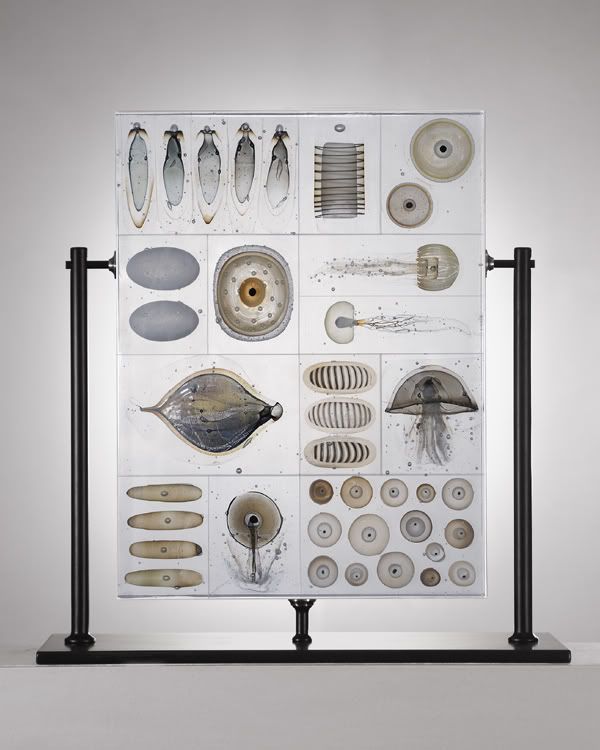
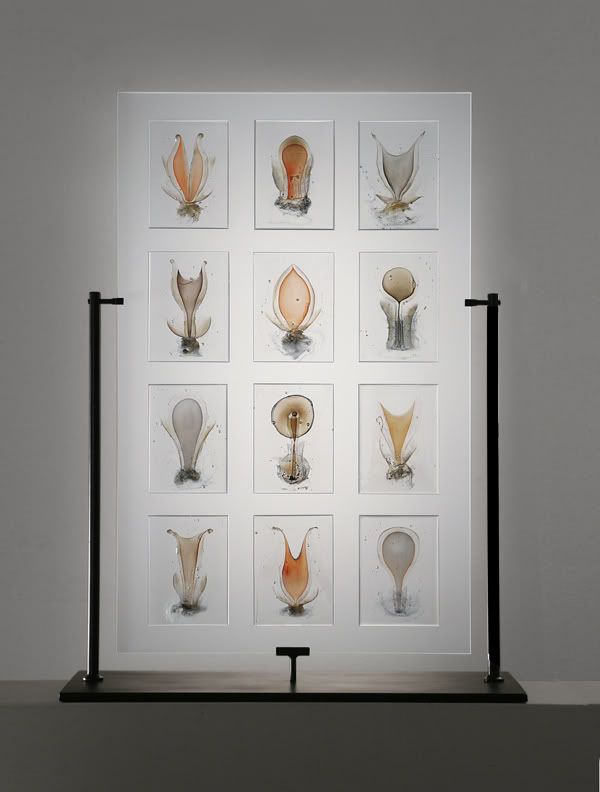
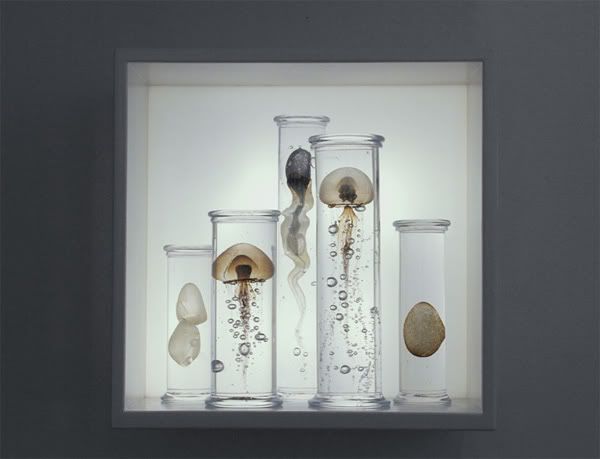
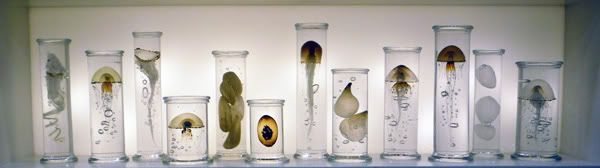
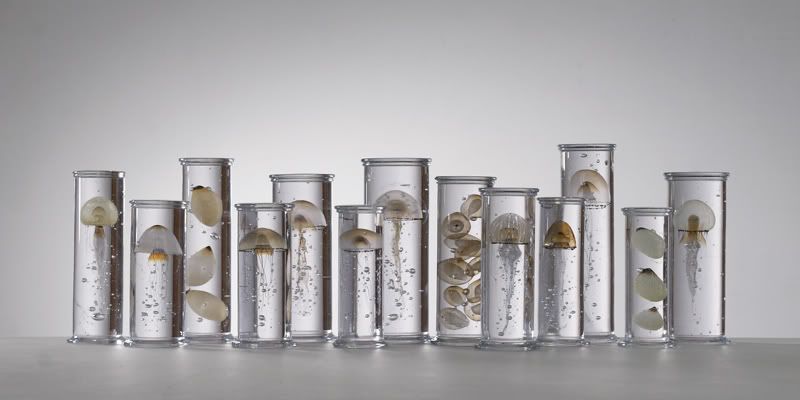
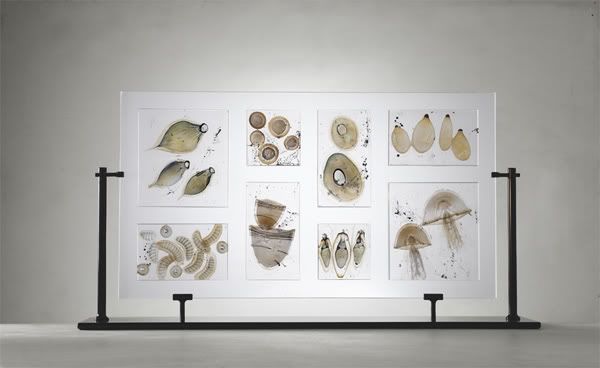
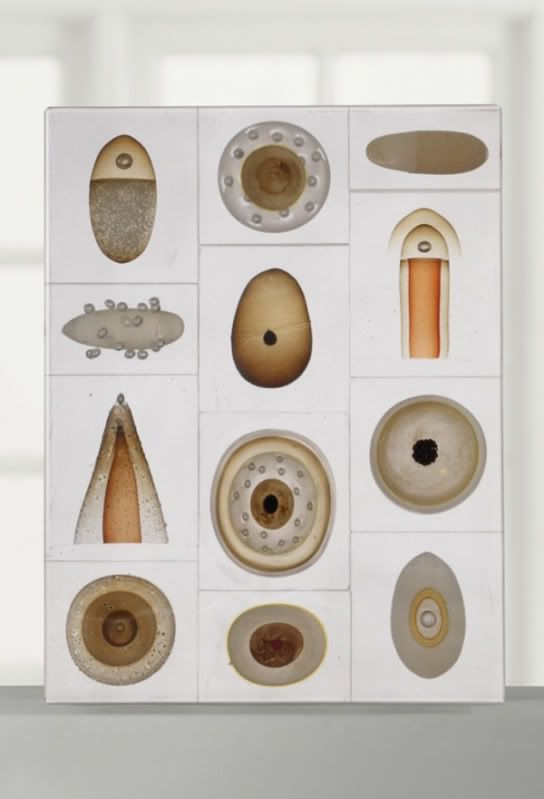
Danish artist Steffen Dam works wonders in glass to create masterful, luminuous art, like glass wunderkammer (or cabinets of curiousity). His subject matter are precisely what every wunderkammer collector would want: botanicals, bottled marine creatures including jellyfish, fossils, egg specimens, though these specimens have been gathered from within his own mind, inspired but not dictated by natural history. This creative area where art meets science is where I want to live. They make me wish I knew how to work in glass.


Biological Panel, blue. 2009.


The secret life of plants. 2006.


SMALL BOX 2. 2010.
glass/wood/lighting fixture
12 X 12 X 9 in. (30.48 X 30.48 X 22.86 cm)


12 JARS. 2009.
glass/wood
14 3/4 X 41 X 9 3/4 inches


Marine Group. Commision for The Museum of Art and Design. New York, NY, USA.


FOSSIL PANEL. 2009.
glass/metal
19 X 35 X 8 in. (48.26 X 88.9 X 20.32 cm)


EGG BLOCK. 2010.
glass
8 1/2 X 14 X 1 1/2 in. (21.59 X 35.56 X 3.81 cm)

Find more wonderous things at his site or at theHeller Gallery {via Lady Lavona's Cabinet of Curiosities}

LinkWithin

Related Posts with Thumbnails