Showing posts with label Helle Jorgensen. Show all posts

Tuesday, June 25, 2013

Fibre Art Specimens

Sometimes the artifacts of science are beautiful in and of themselves. This is of course true of most biological specimens, as lifeforms themselves are beautiful. Thus you do see them recreated in various media. Today I bring you textile art specimens. Be sure to also see previous magpie & whiskeyjack posts Naturalia & Mirabilia on the art of Lyndie Dourthe, Barnacles which includes crocheted marine creatures like the Hyperbolic Crochet Coral Reef, Felt & Food Geology about the photos of Eszter Burghardt, and Doily Science on Lisa Solomon's anatomical and chemical doilies.

Laura Splan's microbial doilies "explores the 'domestication' of microbial and biomedical imagery. Many recent events, epidemics, and commercial products have brought this imagery into our living rooms, kitchens, and bathrooms," by employing this old-fashioned, domestic medium.


all by Laura Splan, 2004
freestanding computerized machine embroidered lace mounted on velvet
16.75H x 16.75W inches each (framed dimensions)
(via she walks softly)

Her 2002 'Vigilant' show also featured hand latch-hooked yarn on stretched latch-hook canvas images of petri dishes of various microbes.


Laura Splan, Vigilant, 2002, hand latch-hooked yarn on stretched latch-hook canvas, 120H x 204W inches (installation dimensions variable)

I've mentioned Australian artist Helle Jorgensen previously (for her crocheted Barnacles) but her plastic crochet sea creatures are worth exploring again.

Helle Jorgensen, 'Diploria'

Helle Jorgensen, 'Medusa'

Helle Jorgensen, 'The Retail Reef'

Laura Katherine McMillan's fibre art Petri dishes are quite lovely.

Laura Katherine McMillan, Cell series

Jessica Polka has made some wonderful fibre art specimens, from sea creatures to mushrooms (and she sells crochet patterns through her Etsy shop, which she describes as a wunderkammer, much to my delight).


Jessica Polka, chiton anatomy

Jessica Polka, mollusk anatomy

Jessica Polka, scaphopod anatomy

(you should also check out her laser-cut Turing patterns and her blog in general!)

Aubrey Longley-Cook's embroidered animals include their skeletons. See more on his blog spool spectrum.

Aubrey Longley-Cook

Amongst other work, Andrea V. Uravitch has made small insects and bugs from embroidered and sewn fabric and wire.

Andrea V. Uravitch

Andrea V. Uravitch


Hiné Mizushima makes wonderful and whimsical needle felted sculptures, including a variety of biological specimen.
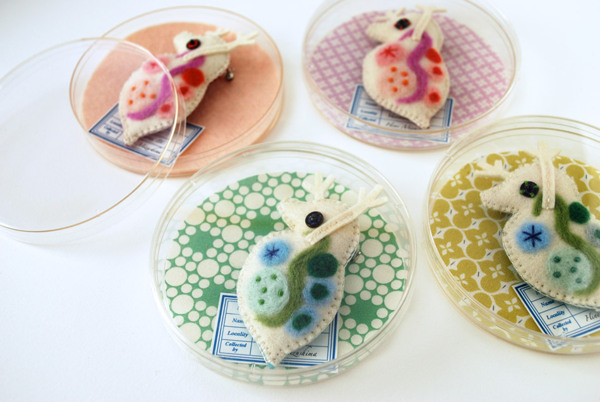

Hiné Mizushima, Giant Daphnia brooches

Hiné Mizushima


Monday, August 20, 2012

Barnacles

 The lowly barnacles (all 1220 species) are a strange, generally imobile, sometimes parasitic marine creatures which encrust things - hard things, from shells to boats to piers to whales. Their anatomy (and creative means of procreation) is more than a little surprising. They are odd looking - not something you would necessarily find aesthetically pleasing. Though, they tend to occur in large colonies, and almost any shape repeated can make fascinating paterns. They have in fact inspired more than a little art and design. (The image left is an illustration by Charles Darwin himself, 1851, Living Cirripedia, A monograph on the sub-class Cirripedia, with figures of all the species. The Lepadidæ; or, pedunculated cirripedes. London: The Ray Society. Volume 1)


Morgan Herrin, Untitled, dimensional lumber (2x4's), h: 82 x w: 18 x d: 12 in , 2008

The wood carved barnacles on that sculpture are quite astounding.

Alexander McQueen takes the patterns of barnacles and sculptural forms of barnacles as inspiration for a series of dresses like these below (both a fairly literal interpretation and then a more stylized, 2D print.


Nervous System (mentioned in the Radiolarians post) has also made some barnacle-inspired generative art (read more on their blog).


Ceramic artist Carol Gouthro has a veritable wunderkammer of ceramic vessels (of a botanical and zoological bent). The Aurlia gouthroii "Barnacles" vessel looks amazing.


Artist Lauren Kussro has created many sea-life multimedia. She has made some barnacle pieces by printing mulberry paper (monotype and screen printing), coating and waxing the paper, forming their shapes, sewing them together, embellishing with beads and hemming - which sounds tremendously labour-intense, but consider what she can create. This is called, “We held to each other so tightly, we became as one”.


Combining cherry and poplar wood veneers and paper, Andrew Kudless and the design studio he founded, MATSYS, digitally designed and fabricated (but hand-assembled) Chrysalis (III), inspired by cellular morphologies and barnacles. (↬the fox is black)


Chrysallis III, 2012, 190cm x 90cm x 90cm, Composite paper-backed wood veneers from Lenderink Technologies. Cherry veneer (exterior) and poplar veneer (interior).

Textile artist Helle Jorgensen creates magical ocean-inspired artwork. Consider some of her crocheted plastic(!) barnacles. (Be sure to check out her portfolio of marine creatures crocheted from plastic paper 'yarn'.)


Another textile artist who has crocheted (and embroidered) barnacles is Emily Barletta.

Pelt, 2007, crocheted yarn, 51 x 31 x 2 inches

Bean, 2007,crocheted yarn, 16 x 7 x 3 inches


The Manitoba Craft Museum houses this woven piece, called 'Prairie Barnacles' made to commemorate the 50th Anniversary of the Manitoba Crafts Guild in 1979.

Barnacles have made it into our homes. You can find pieces which are actually encrusted with real barnacles (on purpose) and pieces inspired by barnacles. This is a lovely porceline piece by Lilach Lotan Ceramic-Art, the Coral Tea-Light: Barnacles.


You can get ceramic wall barnacles from the knowhow shop.


For the DIYer:
Ellen McHenry provides instructions to make her pop-up barnacle, illustrating their anatomy, free for download here.

 Design*sponge posted this DIY for paper clay barnacles.

LinkWithin

Related Posts with Thumbnails