Showing posts with label women in science. Show all posts

Tuesday, October 11, 2016

Ursula Franklin for Ada Lovelace Day #ALD16

Ursula Franklin, linocut, 11" x 14" by Ele Willoughby, 2016
Cross-posted from the minouette blog 

This year, to celebrate the international celebration of the achievements of women in science, technology, engineering and math, Ada Lovelace Day (ALD16), I am returning again to my first subject: Ursula Franklin (16 September 1921 – 22 July 2016). Every year since 2009, people have devoted the 2nd Tuesday in October to blogging about (and otherwise celebrating) the under-recognized and under-appreciated women who have made pivotal contributions to STEM throughout history, in the name of Countess Ada Lovelace. (I hope you'll all recall, Ada, brilliant proto-software engineer, daughter of absentee father, the mad, bad, and dangerous to know, Lord Byron, she was able to describe and conceptualize software for Charles Babbage's computing engine, before the concepts of software, hardware, or even Babbage's own machine existed! She foresaw that computers would be useful for more than mere number-crunching. For this she is rightly recognized as visionary - at least by those of us who know who she was. She figured out how to compute Bernouilli numbers with a Babbage analytical engine. Tragically, she died at only 36.)

A preliminary mock-up of one of the Phylo cards
in this new Women in Science and Engineering set
featuring my portrait of today's namesake: Ada Lovelace
I began participating in Ada Lovelace Day in 2010, and I knew immediately I should write about Ursula Franklin. For me she really personifies the goals of ALD; not only did she represent excellence in science and engineering, but she was a great, perhaps even visionary, thinker on the very role of technology in our society, as well as a fearless and tireless advocate for women in STEM, peace and social justice. Her research interests and achievements were clearly guided by her principles, including gathering evidence of the harmful health effects of radiation from atmospheric testing of nuclear weapons to or her work on the political and societal impacts of support of the technologies and their use. When she died earlier this year, I wrote about her life, work and how she has been one of my heroes since I was too young to fully appreciate the importance of role models in my scientific career. Her influence as a roll model of women in physics and engineering here cannot be overstated. She was one of the most impressive people I have ever met. I got some encouragement from friends to do something I had long contemplated: add her portrait to my growing collection of scientists. When I finally sat down to do so this September, I was really tickled to open my email and receive a commission to do precisely that! I'm really pleased to say I'm going to be contributing some artwork to latest edition of the Phylo Project from Dave Ng and the Advanced Molecular Biology Laboratory (the science education facility within the Michael Smith Laboratories, UBC): a trading card game about Women in Science and Engineering! Sometimes you get several hints of what work you should do next; this portrait's time clearly had arrived.

Franklin was born in Munich in 1921 and survived being interned by the Nazis. She received her PhD in physics from the Technical University of Berlin in 1948 and immigrated to Canada, where after a post-doc at U of T, she joined the faculty. She pioneered archeometry - the use of modern materials analysis in archeology, dating prehistoric artifacts made of metals and ceramics. In my portrait I include an image of an ancient Chinese ding vessel to represent both her metallurgical research and archeometry and her writing about "prescriptive" versus "holistic" technologies used in mass production versus technologies used by craft workers and artisans. Her science was always engaged with societal concerns. During the 60s she advocated for the atmospheric nuclear test ban treaty, citing her studies of strontium-90 radioactive fallout found in children's teeth. Strontium-90 (90Sr) is called a "bone-seeker" because biochemically it behaves like calcium and when absorb it in our bodies what isn't excreted finds its way to our bones. Thus, this radioactive product of nuclear fission (for instance, in atmospheric tests of nuclear weapons) is particularly dangerous and can cause cancers. It decays by beta decay, giving off electrons, as shown by the child's tooth in my portrait. During the 70s she was part of the Science Council of Canada investigation of how we could better conserve resources and protect nature. She began to develop her ideas about complexities of modern technological society.

She consistently has stood up for her beliefs in peace and social justice. As a member of the Voice of Women (now called Canadian Voice of Women for Peace), she tried to persuade Parliament to disengage Canada from supplying any weapons to the US during the Vietnam war, to shift funding from weapons research to preventative medicine, to withdraw from NATO and disarm. She later fought to allow conscientious objectors to redirect part of their income taxes from military uses to peaceful purposes (though the Supreme Court declined to hear the associated case). She joined other retired female faculty in a class action law suit against the University of Toronto for claiming it had been unjustly enriched by paying women faculty less than comparably qualified men. The University settled in 2002 and acknowledged that there had been gender barriers and pay discrimination.

As an applied scientist, her writings on technology benefit from the insight of an insider, but her priorities are justice and peace and she critiques and analyses technology in this light. She does not view technology as neutral; it is a comprehensive system that includes methods, procedures, organization, "and most of all, a mindset". It can be work-related or control-related, holistic and prescriptive. Franklin argues that the dominance of prescriptive technologies in modern society discourages critical thinking and promotes "a culture of compliance". She investigated the relationship between technology and power. She investigated how we interact with communication technologies and advocated for the right to silence - long before our contemporary concern with these issues.

Many of her articles and speeches on pacifism, feminism, technology and teaching are collected in The Ursula Franklin Reader (2006). A nod to her pacifism and feminism is built into the structure of her portrait which encompasses the symbols for peach and women in the negative space. Franklin is one of many respected scholars and thinkers to have delivered a series of Massey Lectures, in 1989. Hers were gathered and published as The Real World of Technology. She has been recognized for her work in many ways, including receiving the Order of Canada, Governor General's Award in Commemoration of the Persons Case for promoting the equality of girls and women in Canada and the Pearson Medal of Peace for her work in advancing human rights. She was inducted into the Canadian Science and Engineering Hall of Fame in 2012. Locals may know the Ursula Franklin Academy, a Toronto high school, named in her honour. I think this University, city, country and in fact, society at large were made a better place because Ursula Franklin was a part of it. So, though she has received this recognition, I think she should be a household name, so that's why I am happy to add her to my portrait pantheon of scientists and write about her again this Ada Lovelace Day 2016. I also think that it is very apt to combine making her portrait using holistic technologies of the artisan and sharing it through more prescriptive digital technologies with the world.

(NB: much of the biographical information is recycled from my own previous post about Franklin) .

Saturday, April 2, 2016

Metamorphosis and Maria Sibylla Merian; Backyard Butterflies to New World Entomological Explorer

Maria Sibylla Merian, linocut by Ele Willloughby, 2015.
Maria Sibylla Merian (1647-1717), leading entomologist of her day,
traveller and scientific illustrator is shown complete with
pomegranate branch and the life cycle of a butterfly from
caterpillar, to chrysalis in its cocoon to butterfly, inspired by
her famous work 'Metamorphosis insectorum Surinamensium'
- a process she carefully documented and explained.
Born April 2, 1647, Maria Sibylla Merian was the leading entomologist of her day, a great traveller and scientific illustrator. The German-born naturalist came from a Swiss family who founded one of one of Europe's largest publishing houses in the 17th century. This allowed her early access to many books on natural history. After she lost her father at age three, and her mother remarried still life painter Jacob Marrel. Her step-father and his students trained her as an artist. She began painting insects and plants by 13. She wrote, "I spent my time investigating insects. At the beginning, I started with silk worms in my home town of Frankfurt. I realized that other caterpillars produced beautiful butterflies or moths, and that silkworms did the same. This led me to collect all the caterpillars I could find in order to see how they changed".

She married her step-father's apprentice Johann Andreas Graff, they had a daughter Johanna Helena, and moved to his home city of Nurenburg. She was able to contribute to the family income by painting, creating embroidery designs, and teaching drawing lessons to unmarried daughters of wealthy families, something which also allowed her access to the finest gardens where she continued collecting and documenting. She published her first book of natural illustrations, titled Neues Blumenbuch, in 1675 at age 28. In 1679, she first published her insect research in a two-volume, illustrated book focusing on insect metamorphosis. She moved twice to be with her mother after her step-father's death, then to join her half-brother at a Labadist religious community. She also split with her husband. After her mother's death, she moved to Amsterdam in 1691 and divorced her husband in 1692.

In Amsterdam, she was able to observe some of the collections of insects which had been brought back from Suriname. She became curious whether the life cycles of the exotic butterflies and other insects mirrored those Europe species she knew well. She was able to secure the city of Amsterdam's permission and and travel grant to travel to Suriname in South America, along with her younger daughter Dorothea Maria. She further funded her travels by selling 255 paintings. She planned a five year mission to study insects, making her perhaps the first person to plan a proper scientific expedition!

Maria Sibylla Merian, from
Metamorphosis insectorum Surinamensium, Plate LX. 1705
She travelled throughout the colony sketching insects and plants. She criticized the Dutch planters treatment of indigenous people and black slaves (though she relied upon amerindian slaves in her residence and her excursions, and brought a young amerindian woman named Indianin back with her to Holland). She used local native names for the plants and described local uses. Malaria likely cut her expedition short and forced her return to the Dutch Republic in 1701. She sold her collected specimen and in 1705 she published a book Metamorphosis Insectorum Surinamensium about the insects of Suriname.

She suffered a stroke in 1715 which left her partially paralysed and died a pauper in 1717. Her daughter Dorothea published Erucarum Ortus Alimentum et Paradoxa Metamorphosis, a collection of her mother's work, posthumously. Both Dorothea and Johanna followed their mother's lead and became botanical illustrators.

Copper engraving from Maria Sibylla Merian's
Metamorphosis insectorum Surinamensium, Plate XLIX.
Modern scholars now appreciate her pioneering scientific work as well as the beauty of her scientific illustrations. During her life time insects were still reviled and people still put credence in the Aristotelian idea that they were spontaneously generated or "born of mud". She meanwhile detailed the life cycle of 186 species and explained the poorly-understood or even unknown process of metamorphosis. Science was conducted in Latin and her publications were in the vernacular, making them more popular with high society than contemporary scientists. Despite her knowledge and original research contributions she was not really recognized as a scientist in her day (though Carl Linnæus (1707-1778), father of taxonomy, did cite her in his Systema Naturæ of 1753). It was very unusual for a woman in her day to pursue science, let alone travel the world in its pursuit. She was able to do so because she began her studies with the accessible - animals she could find in her own backyard, and become the leading expert on metamorphosis. During her great expedition, she also noted their habitats, feeding habits and uses to indigenous people. Her classification of butterflies and moths are still relevant today. She detailed plants, frogs, snakes, spiders, iguanas, and tropical beetles and was the first European to describe both army ants and leaf cutter ants as well as their effect on other organisms.

Speckled caiman and a false coral snake by Maria Sibylla Merian
from Metamorphosis insectorum Surinamensium II., Plate LXX.
Her work had a strong influence on future scientific illustration. Her work shows great accuracy and she was the first to illustrate the complete life cycle of insects. In her time, funding her expedition and her unladylike devotion to insects was ridiculed, but she is remembered as one of the best insect and flower illustrators of all time. Her daughters and student Rachel Ruysch (1664-1750) all went on to be renown botanical illustrators.

Shortly after her death, Peter the Great saw and purchased a large number of her works in Amsterdam. Her portrait was printed on the 500 DM note before Germany converted to the euro. Her portrait has also appeared on a 0.40 DM stamp and two American 32 cent stamps. Many schools, place names, a scientific research vessel and a crater on Venus have been named in her honour.

One last tidbit (or two) for you history of science buffs: Dorothea's daughter, Maria Sibylla Merian's granddaughter married mathematician Leonhard Euler (1707-1783). Maria Sibylla Merian was also first cousin to Jacob Christoph Le Blon (1667-1741), painter and engraver who invented the four colour printing process (using an RYBK color model similar to the modern CMYK system).

Saturday, November 7, 2015

Double laureate Marie Skłodowska-Curie & the hunt for elements

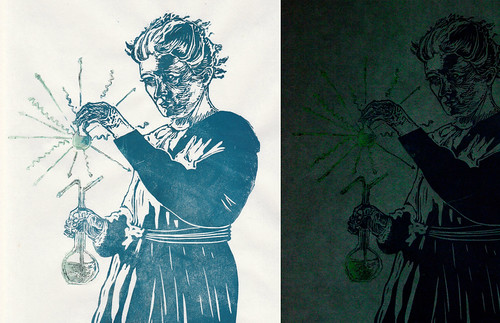
MarieCurie_glow
Marie Curie, details of linocut with glow-in-the-dark ink, by Ele Willoughby, 2014

The most well-known woman in the history of physics - or perhaps science - was born almost a century and a half ago today. The famous Polish-born, naturalized-French physicist and chemist Marie Skłodowska-Curie (7 November 1867 – 4 July 1934) was the first woman to win a Nobel prize, the only woman to ever win TWO Nobel prizes, and the only person ever to win in two different sciences: physics and chemistry! Happy birthday Madame Curie! You can read more about her in my post for Ada Lovelace Day, 2014.

Tuesday, October 13, 2015

Anna Atkins on Ada Lovelace Day


Ada Lovelace, 3rd edition
Ada, Countess Lovelace, 3rd edition linocut by Ele Willoughby
Today is the 7th annual international day of blogging to celebrate the achievements of women in technology, science and math, Ada Lovelace Day 2015 (ALD15). I'm sure you'll all recall, Ada, brilliant proto-software engineer, daughter of absentee father, the mad, bad, and dangerous to know, Lord Byron, she was able to describe and conceptualize software for Charles Babbage's computing engine, before the concepts of software, hardware, or even Babbage's own machine existed! She foresaw that computers would be useful for more than mere number-crunching. For this she is rightly recognized as visionary - at least by those of us who know who she was. She figured out how to compute Bernouilli numbers with a Babbage analytical engine. Tragically, she died at only 36. Today, in Ada's name, people around the world are blogging.
You can find my previous Ada Lovelace Day posts here. 
This year, I thought I'd take the opposite approach from last year. I wrote about Marie Skłodowska-Curie last year, despite her fame and the risk that she was likely the only women in STEM that many people can name. I chose to write about her because it was artificial to avoid her; she really did make incredible discoveries and lived an extraordinary life. This year, I've selected a scientist who is rather new to me, and who was not an icon of science. She was nonetheless a pioneer. I've selected her because she is precisely the sort of scientist we forget - especially if female. What she did was important, and cutting edge in her time, and while it may not have been epochmaking it was the sort of important, incremental, methodical work which represents much of the scientific entreprise, and most of the advance of science throughout history. I believe the concept of the "paradigm shift" might be useful, but it is often dangerously simplistic and leads to a false narrative of a series of great men (almost invariably it is a man who is selected to represent the bringer of the new idea) revolutionizing science. Science, and its history, is more often much more involved, non-linear, over-lapping and interwoven than this type of narrative presents. Lastly, I love that this particular scientist was working at the intersection of art and science.

This is a portrait of English botanist and photographer Anna Atkins (1799-1871), née Children. It combines both a hand-carved lino block portrait in dark silver ink, and a screenprint of the silhouette of fern leaves in cobalt blue ink, mimicking the cyanotypes she was known for. It is printed by hand on lovely Japanese kozo (or mulberry) paper, 11" x 14" (28 cm x 35.6 cm). (c) Ele Willoughby, 2015

Anna Atkins (1799-1871), née Children, was an English botanist and photographer. She is the first person to have illustrated a book using photographs, Photographs of British Algae: Cyanotype Impressions in October 1843. Note that: not the first woman, the first person. She lived at a time when it was possible to be a self-trained scientist, especially if you were middle or upper class and received an education and the financial freedom to devote your time to pursue your subject. (The Mary Annings of the world, who managed to make a name for themselves in science despite her class, religions and complete lack of financial ressources, are rare indeed). She was raised and instructed by her father, a naturalist, and her social circle included those who were developing (no pun intended) the latest, brand new photographic technology. So, she was at the right place at the right time. But that doesn't take away from the fact that she had the knowledge, skill, insight and ability to immediately see the utility of the method for descriptive science and to document a specific field of sub-field of botany, with her collection of the algae (seaweeds) of Britain. I think this should be understood as equivalent to a modern-day scientist keeping abreast of other fields of study and rapidly mastering a new high-tech tool to apply it to her field. Even William Henry Fox Talbot, who who invented the salted paper and calotype processes, precursors to modern photographic methods, was not able to publish The Pencil of Nature the first commercially printed photographic book, until eight months after she produced Photographs of British Algae: Cyanotype Impressions.

Her mother died when she was still an infant, but she was close with her naturalist father and received a much more scientific education than was common for women in her time. Her 250 detailed engravings of shells were used to illustrate her father's translation of Lamarck's 'Genera of Shells'. This translation was important to the nomenclature of shells, because her illustration allowed readers to properly identify Lamarck's genera. She married John Pelly Atkins in 1825 and devoted herself to botany and collecting specimen, including for Kew Gardens. In 1839, she became a member of the Botanical Society of the British Isles, one of the few scientific organizations open to women. She became interested in algae, after William Henry Harvey published A Manual of the British marine Algae in 1841.

Through her father, she was friends with both William Henry Fox Talbot and Sir John Herschel, who (amongst other things) invented the cyanotype photographic process in 1842. Within a single year of its invention, she self-published the first known book of illustrated with cyanotype photographs and was likely one of the two first women to make a photograph. She recorded her seaweed specimen for posterity by making photograms by placing the unmounted dried-algae original directly on the cyanotype paper. Atkins self-published her photograms in the first installment of Photographs of British Algae: Cyanotype Impressions in October 1843, and two further volumes in the next decade. She collaborated with Anne Dixon (1799–1864) to produce further books of cyanotypes on ferns and flowering plants and also published other non-scientific or photographic books. In 1865, she donated her collections to the British Museum.

I've shown her based on an early photographic portrait, along with some fern leaves which I've worked with directly, much how she illustrated her own specimen.

Have a look at her cyanotypes and a video of one of the surviving copies of her book.


(Cross-posted from the minouette blog)

Thursday, July 30, 2015

How the Earth's Crust is Born: Marie Tharp "girl talk" and the Mid-Atlantic Ridge

Marie Tharp and the Mid-Atlantic Ridge Linocut
Marie Tharp and the Mid-Atlantic Ridge,
9" x 12" linocut on Japanese paper, by Ele Willoughby, 2015
Happy birthday to American geologist and oceanographic cartographer Marie Tharp (July 30, 1920- August 23, 2006), whose pioneering, thorough and complete ocean floor maps made with her partner in science Bruce Heezen revealed the Mid-Atlantic Ridge. The mid-ocean ridge itself, based on their 1957 physiographic map, is illustrated behind her, along with the sort of echo sounder or precision depth recorder tracks she used, in front of her.

Tharp had struggled to find the the right university major; she wanted something she could do, and enjoy, but there were not many options for women in her day. More opportunities opened up during WWII and she took the chance to return to school and study geology and then math. Looking for something challenging (but not tedious) she contacted Maurice 'Doc' Ewing at Lamont-Doherty Earth Observatory at Columbia, who hired her to draft data, including the thousands of echo sounder profiles they were gathering. Women were still not allowed to participate in research cruises, but they could work with the data. Before long, Heezen came to Lamont and required so much drafting work that Tharp worked exclusively with him.

Scientists once imagined the ocean floor as a largely featureless plain. Early depth measurements were taken with lead weights (such as canon balls) and a whole lot of rope! As early as the late 19th century, such laboriously collected datasets began to hint at a broad rise in the centre of the Atlantic. By the mid 20th century, there was a push to try and map these submarine mountains.

Tharp spent months painstakingly "plotting, drawing, checking, correcting, redrawing and rechecking" profiles of the North Atlantic. The ship tracks across the Atlantic were a sparse web, but when Tharp compared half a dozen more or less parallel transects she noticed no only the general similarities of the ridge, but a V-shaped notch in the centre of all the profiles. She suspected they coincided because they indicated a rift valley all along the ridge crest. The early ideas about plate tectonics or the "continental drift" theory were still quite controversial and unpopular. Heezen dismissed Tharp's observation as "girl talk" for looking too much like continent drift - as in fact it was indeed a vital piece of the plate tectonics puzzle. We now know that surface of the Earth is itself a jigsaw puzzle of pieces known as tectonic plates, jostling one another at a stately, geological pace. Mid-ocean ridges are underwater volcanic mountain chains which roughly bisect all ocean basins. They are all cut by a rift valley which is the spreading centre. These rifts are where new crust is born, pushing upwards and outward. This drives the two plates on either side slowly apart over geological time. On our own timescales of everyday life, we notice the bumps in this slow ride: the sporadic earthquakes, rather than the slow creep (though today, we can meticulously measure both).

Tharp believed the rift was real though her contour maps hadn't convinced Heezen. In 1952, they began working on physiographic maps, which would show seafloor topography as if you were flying just above it, and the water were drained away. These had the advantage of really giving a sense of the variety of geology, from plains to mountains, seamounts to trenches. Also, unlike detailed contour maps, physiographic maps were not US Navy classified information, so Tharp and Heezen would be able to publish what they produced. Further, they were beginning to gather much better precision depth recorder data, which revealed far more features, along with better navigation to plot ships' positions along tracks more accurately. A second project in their research group involved plotting earthquakes, and Heezen insisted they work at the same scale. Heezen then noticed that ocean earthquake epicentre data also formed long lines - and in fact, when one map was placed above the other on a light table they found the earthquakes formed near continous lines along the Mid-Atlantic ridge right where Tharp had indicated there was a rift valley. Using the earthquake data to extrapolate and plot the rift position where there was no seafloor sounding data, they found that the rift extend landward into the Rift Valley of East Africa - a well-known, easy to observe terrestrial rift valley. Heezen was then convinced. They had discovered a worldwide mid-ocean ridge system, tens of thousands of kilometres long. Tharp was able to mine existing data to show the Mid-Atlantic Ridge extended to the south Atlantic and found similar features in other oceans. These all similarly lined up neatly with earthquake epicentres. Ewing and Heezen announced their findings in 1956. In 1957 Tharp and Heezen published their North Atlantic physiographic map; I've shown my version of their map behind her. The ridge snakes from top to bottom (north to south-south-west), above and almost mimicking the line of her arm.

They continued this work, extending to other oceans over the next 25 years, ultimately producing detailed physiographic maps of the world oceans. Their pioneering work mapping the oceanic plate boundaries, and showing their clear alignment with seismic data helped fuel the revolution in geology and geophysics, the paradigm shift of plate tectonics.

Tharp's work was largely in the background during her university career, though she won a number of prizes during her retirement and has continued to gain posthumous recognition for the importance of her work and observations. I was very pleased to see her recognized recently in Neil DeGrasse Tyson's Cosmos reboot. I want to bring her incredible insight and excellent work to a wider audience as both artist and marine geophysicist myself.


(cross posted from the minouette blog)

Wednesday, July 15, 2015

Jocelyn Bell Burnell and the LGM-1

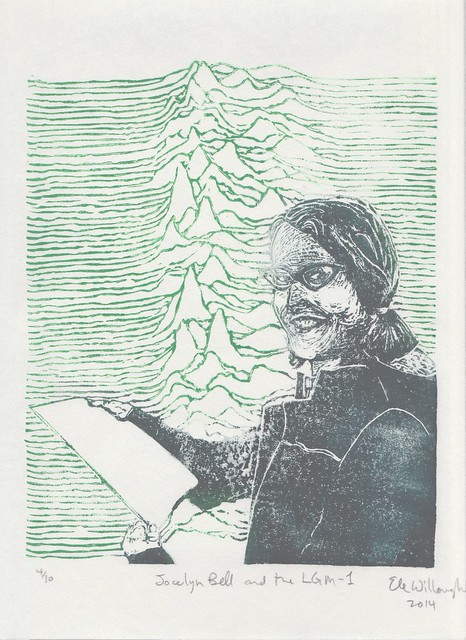
Jocelyn Bell and the LGM-1
Jocelyn Bell and the LGM-1, linocut portrait by Ele Willoughby 2014

Happy birthday to astrophysicist Jocelyn Bell Burrell (born, 1943), who discovered pulsars! As I wrote previously:

In November, 1967, Jocelyn Bell (Burnell) was just a graduate student when she discovered the first radio pulsar (or pulsating star), a highly magnetized, rotating neutron star that emits a beam of electromagnetic radiation. This radiation (light in the radio frequency band) can only be observed when the star is point towards us; so, like the light from a distant lighthouse, it appears to pulse at a precise frequency. She had been working with her supervisor Antony Hewish and others to construct a radio telescope to study quasars (quasi-stellar objects which emit radio waves). She noted some "scruff" on her chart-recorder, and then that the pulses were incredibly regular, occurring every 1.337 seconds. Hewish was initially scornful and insisted the regular pulses must be noise from a human made source. He first dubbed this object, emitting with such regularity 'LGM 1' for "Little Green Men 1", a playful joke about their uncertainty about what could emit radiation so regularly - obviously it could only be a communication from extraterrestrials hahaha! Only after she found other such sources, in different places with different frequencies, were her colleagues convinced and this lead to the development of the pulsar model. It is now known PSR B1919+21.

The 1968 paper announcing this discovery in Nature has five authors, lead by Hewish, followed by Jocelyn Bell. In 1974, Hewish won the Nobel Prize for this discovery, along with fellow radioastronomer Marlin Ryle). Jocelyn Bell was not included as it was assumed that the "senior man" was responsible for the work. This was controversial and has been condemned by many leading astronomers like Fred Hoyle (who with Thomas Gold was first able to explain the signals as due to a rapidly rotating neutron star). Jocelyn Bell Burnell herself has stated she was not upset. Bell Burnell has a great on-going career and won many honours after her impressive start, but her exclusion from the Nobel win, based on her own research strikes me and many others as one of the more blatant and egregious examples of gender bias in the selection of Nobel prize recipients.

Read the full post about how her beautiful dataset itself has lead a life of its own as a cultural meme.

Sunday, May 31, 2015

Chien-Shung Wu & the Violation of Parity

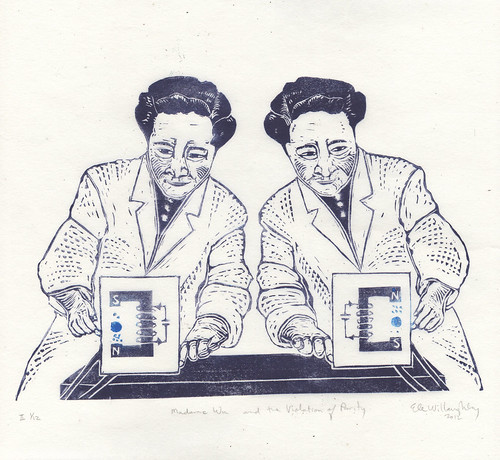
Mme Wu
Madame Wu and the Violation of Parity, 2nd ed. linocut, 2012, Ele Willoughby

Happy birthday to Mme. Wu! Chien-Shiung Wu (May 31, 1912- February 16, 1997, Chinese-born American physicist, whose nicknames included the “First Lady of Physics”, “Chinese Marie Curie,” and “Madame Wu”) came up with a truly beautiful experiment to test whether the weak force conserves parity (whether beta decay would be the same if reflected in the mirror). In my print on the left I show Mme. Wu in her lab and a schematic diagram in the box of her beautiful experiment. On the right I show her reflection, as in the mirror, and in the box I show the mirror reflection of the experimental set-up and the shocking result, that the reaction is not the mirror opposite.

In 1956, theoretical physicists Tsung Dao Lee and Chen Ning Yang suggested that perhaps the weak force might not be the same 'through the looking-glass'. The idea that the "Law of Conservation of Parity" might be broken was hard to believe. The laws of physics are the same in the mirror for anything else. Face a friend, as in the mirror. If you drop a pencil from your right hand, and your friend mirrors you and drops a pencil with his or her left, the pencils will fall at the same rate. This is because Parity is conserved by the force of gravity - as it is with the electromagnetic force and even the strong (nuclear) force within atomic nuclei. Lee and Yang pointed out that no one had checked to make sure that the weak force, which controls beta decay in radioactive materials, also conserves parity. Lee convinced the brilliant experimentalist to test this.

Madame Wu did a subtle and technically difficult experiment with her collaborators which is shown schematically in the print. She took Cobalt-60 (shown as the cobalt blue sphere in the box), which is radioactive. Its neutrons spontaneously give off electrons and become protons. The electrons are the tiny blue dots. On the left, we see that the Cobalt-60 in an electromagnet (a wire wrapped metal horseshoe with a source of power). Because of the spiral-wrap of the wire, we know that the North pole of the magnet will be on the bottom (you can figure this out by mimicking the curl of the wire with the fingers of your right hand and look at the direction your thumb points). It turns out that the emitted electrons are given off preferentially towards the North pole.

Next, she reversed the set-up as in the mirror. On the right you see the horseshoe and wire spiral reflected. If you use your right hand to check the direction of the magnet field, you'll see that it is the opposite way; the North pole is now on the top. It turns out that the electrons are preferentially emitted upwards toward the North pole. Thus, beta decay IS NOT the same in the mirror! Madame Wu showed that a "Law" of physics did not hold! This result was staggering and shocked the physics world. Lee and Yang won the Nobel prize for their theoretical work. Many physicists thought Mme. Wu should have been included in this win.

She won many honours for her incredible career. Wu took part in the Manhattan Project (she is believed to be the only Chinese person to do so) and literally wrote the book on beta decay. She was the first: Chinese-American to be elected to the U.S. National Academy of Sciences; Female instructor in the Physics Department of Princeton University; Woman with an honorary doctorate from Princeton University; Female President of the American Physical Society, elected in 1975; winner of the Wolf Prize in Physics (1978); Living scientist to have an asteroid named after her. She won many awards and fellowships including: the Research Corporation Award 1958; the Achievement Award, American Association of University Women 1960; John Price Wetherill Medal, The Franklin Institute, 1962; Comstock Prize in Physics, National Academy of Sciences 1964; Chi-Tsin Achievement Award, Chi-Tsin Culture Foundation, Taiwan 1965; Scientist of the Year Award, Industrial Research Magazine 1974; Tom W. Bonner Prize, American Physical Society 1975; National Medal of Science (U.S.) 1975; the aforementioned Wolf Prize in Physics, Israel 1978; Honorary Fellow Royal Society of Edinburgh; Fellow American Academy of Arts and Sciences; Fellow American Association for the Advancement of Science; Fellow American Physical Society. And I bet you hadn't heard of her! I'm trying to redress that.

Wednesday, May 13, 2015

Inge Lehmann & the Earth's Solid Inner Core

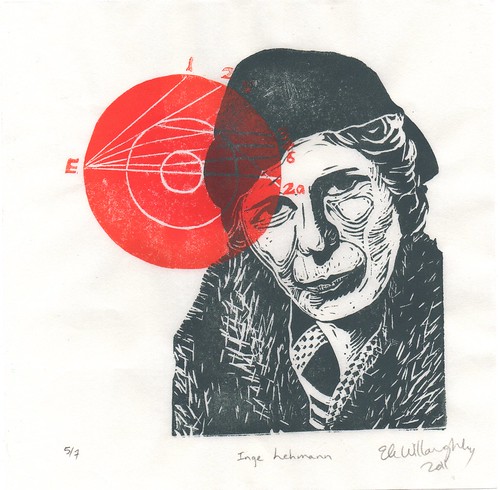
Inge Lehmann print
Inge Lehmann, linocut, 8" x 8", by Ele Willoughby, 2011

Happy birthday to Inge Lehmann! Inge Lehmann (May 13, 1888 – February 21, 1993) was a Danish seismologist who first demonstrated that the Earth's core is not one single molten sphere, but contained an inner (solid) core, in 1936. She was a pioneer woman in science, a brilliant seismologist and lived to be 105, so I've selected her for my offering for the Mad Scientists of Etsy April challenge on earthquake seismology. Each is 8" (20.5 cm) square and printed in dark cyan and red-orange ink on white Japanese kozo (mulberry) paper.

We now know, as she first postulated, that the earth has roughly three equal concentric sections: mantle, liquid outer core and solid inner core. The crust, on which we live is merely a thin, um, scum really, on top of this slowly boiling pot. The only way to probe deep into the earth's core is to employ massive earthquakes, the waves they generate and the paths they follow. There are two main types of seismic waves used for studies of the globe, unimaginatively named Primary (or P, or compressional) and Secondary (or S, or shear). Imagine a glass of water with a straw; the straw will appear broken at the air-water interface, because light bends as it enters the water. Just like light travelling through different media, these seismic waves can bend, reflect or be transmitted at any boundary. The difference in physical properties between the mantle and outer core causes a P-wave shadow. (For S-waves, the shadow zone is absolute because liquids, like the outer core, do not support shear - imagine trying to cut water with a pair of shears and you can see this for yourself. Thus, no shear waves can make it through the outer core, and thus we can be certain the outer core is fluid). That means, the compressional waves from an earthquake can be recorded at seismic stations out to 105 degrees from an epicentre and then there is a zone which is in the core's shadow. Lehmann found that there were some late-arriving P-waves are much larger angles (142 to 180 degrees) which had been vaguely labelled 'diffractions'. She showed that these could be explained instead by deflections of the waves which travelled through the outer core at her postulated inner core boundary.

She later discovered a discontinuity in the mantle (confusingly also called the Lehmann discontinuity). She did important work well into her 70s.

When she received the Bowie medal in 1971 (she was the first woman to receive the highest honour of the American Geophysical Union), her citation noted that the "Lehmann discontinuity was discovered through exacting scrutiny of seismic records by a master of a black art for which no amount of computerization is likely to be a complete substitute...".

I think her accomplishment is downright astonishing. To have the exactitude to work with the data and the daring to neglect the irrelevant and offer up a simple, elegant - correct! - explanation is a rare and marvellous thing. To be the top of her field in 1936, when she was a pioneer for women in science and had to compete in vain with incompetent men (her words) is heroic.

I based my portrait on an earlier photo, to match the date of her phenomenal P' paper. I also show her model of the earth in red-orange ink, complete with mantle, inner and outer core, and travel paths for rays through the layers, including into the shadow zone.

Tuesday, May 12, 2015

Florence Nightingale; Nursing, Statistics and Data Visualization Pioneer

Florence Nightingale portrait
Florence Nightingale, 2nd edition linocut on kozo, Ele Willoughby, 2014

I confess that Florence Nightingale (12 May 1820 – 13 August 1910) wasn't on my shortlist of women in science I wished to portray. I felt a little like she was an old-fashioned heroine, from a time where if a woman wasn't going to be defined strictly as a person who served and cared for her family, it was okay if (and only if) she cared for other people. This bias was somewhat reinforced by my own family history: my mother is a nurse, her mother was a nurse, whereas I am a physicist. I know my grandmother wanted to be a pharmacist, and my mother felt her career options were school teacher or nurse. Plus, I take after my father's side of the family and have been known to have a vasovagal response to the mere description of medical procedures; I have a high pain threshold, but am squeemish, and faint like the rest of them. All of which means I partially define myself by not being a nurse. However, I was (luckily) commissioned to make a portrait of Florence Nightingale. The more I read, the more interesting she became to me.

Nightingale earned the nickname "The Lady with the Lamp" during the Crimean War, from a phrase used by The Times, describing her as a “ministering angel” making her solitary rounds of the hospital at night with “a little lamp in her hand”. The image was immortalized by Henry Wadsworth Longfellow's 1857 poem Santa Filomena in the stanza:


Lo! in that house of misery
A lady with a lamp I see
Pass through the glimmering gloom,
And flit from room to room.

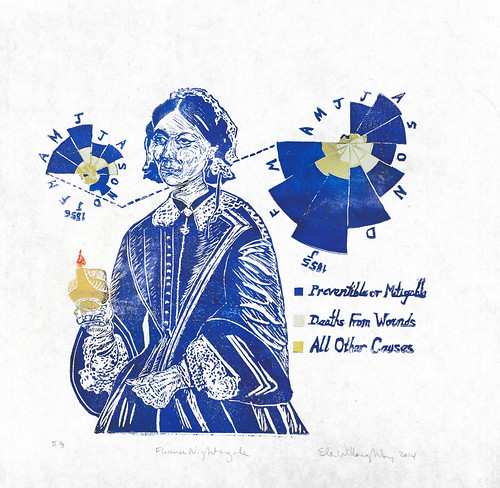
So, I’ve shown Nightingale with her little lamp, based on contemporary photos and illustrations. But inventing modern nursing wasn't her only accomplishment. Taking up a profession, travelling to a war zone, nursing the wounded, taking on hospital administration and the training of a professional class of nurses weren't the only things she did which were so unusual for a woman of her time to do. It turns out that her father fostered her gift for mathematics, and she made significant contributions to statistics and data visualization too.

Behind Nightingale is her own ‘Diagram of Causes of Mortality in the Army in the East’ plotted as a polar area diagram – her own statistical and data visualization innovation, sometimes called a Nightingale Rose Diagram. It illustrates the causes of death in the military hospital she managed during the Crimean War. April 1855 to March 1856 is shown on the left and April 1854 to March 1855 to the right. When she researched the causes of mortality, looking back at the data, she saw clearly that the lack of hygiene was a far greater risk to soldiers’ lives than being wounded. The sections represent one month of data {J,F,M,A,M, J,J,A,S,O,N,D} for each month of the year. The green “wedges measured from the centre of the circle represent area for area the deaths from Preventible or Mitigable Zymotic diseases, the [yellow] wedges measured from the centre the deaths from wounds, & the [orange] wedges measured from the centre the deaths from all other causes. The […] line across the [yellow] triangle in Nov. 1854 marks the boundary of the deaths from all other causes during the month. In October 1854, & April 1855, the [orange] area coincides with the [yellow], in January & February 1856, the [green] coincides with the [orange]. The entire areas may be compared by following the [green], the [yellow], & the […] lines enclosing them.” This "Diagram of the causes of mortality in the army in the East" was published in Notes on Matters Affecting the Health, Efficiency, and Hospital Administration of the British Army and sent to Queen Victoria in 1858.

This experience influenced her later career and she campaigned for sanitary living conditions, knowing how dangerous unsanitary conditions can be to survival. She also made extensive use of similar polar area diagrams on the nature and magnitude of the conditions of medical care in the Crimean War, or sanitation conditions of the British army in rural India, to make such statistics transparent to Members of Parliament and civil servants who would have been unlikely to read or understand traditional statistical reports. This is an excellent example of how careful selection of how data is presented can influence whether the information is successfully communicated and how important that can be - occassionally even influencing people's survival!

In 1859, Nightingale was elected the first female member of the Royal Statistical Society. She later became an honorary member of the American Statistical Association.

Though her own opinion  of other women was often harsh, she has been credited with contributing to feminist literature with a book she wrote while sorting out her thoughts on her role in the world, including the essay Cassandra, which protested the over-feminisation of women into near helplessness. She helped abolish laws regulating prostitution that were overly harsh to women. She also clearly expanded the acceptable forms of female participation in the workforce.

This, and in particularly, the way she insisted on making decisions based on scientific evidence, and using data to save lives, makes her an apt addition to the women in science portrait series.

Monday, March 16, 2015

Caroline Herschel: Scientific Cinderella to Comet Sweeper

Caroline Herschel
Caroline Herschel, linocut by Ele Willoughby, 2014
Happy birthday Caroline Herschel! German-born Caroline Herschel (16 March 1750 – 9 January 1848), while overshadowed by her brother William (who discovered Uranus, amongst his other astronomical accomplishments), was a real pioneer as a woman in astronomy and made her own important contributions. In fact, she became the first salaried female scientist, when King George III hired her to assist her brother, at a time when there were few professional scientists anywhere. Hers was a real life sort of Cinderella story, where rather than marrying a prince, she made a life and career for herself. Marriage was the expected role for a woman of her time, but she was deemed unmarriageable, since a childhood bout of typhus stunted her growth. Her mother thought she should train to be a servant, and purposely stood in the way of her learning French, or music, to prevent her from seeking employment as a governess. She wanted a perpetual unpaid maid. Her father sometimes managed to include her in William's lessons when their mother was absent. William had fled to England after the Seven Years War and made a life as a musician and composer in Bath. William managed to rescue his younger sister from their mother's clutches, under the pretext that she might have the voice to be a solo singer in Handel's oratorios, as she too was a natural musician. Of course, he also wanted a woman to manage his bachelor household. Meanwhile, he developed a real passion for astronomy. So, by the time she arrived, all his spare time away from music was devoted to astronomy and she found that despite her singing talent, she was roped into assisting with the construction of telescopes, rather than receiving music lessons. By 1781, William had discovered a new planet - Uranus , which he cannily dubbed the 'Georgian Star' after King George III. This had the desired effect of securing himself a pension, so that he could spend his time on astronomy (so long as he would present it to the King when asked).

William and Caroline worked together at Slough, observing the night sky with a variety of telescopes. William built some very large telescopes and had Caroline take notes of what he observed, while she used smaller 'sweeper' telescopes to sweep the skies for interesting object. She discovered 11 nebulae (2 of which turned out to be galaxies) which were previously unknown! She also found 8 or 9 comets, as well as making and sharing observations of comets discovered by others. The portrait is based on a miniature of Caroline, as well as her own notes and diagrams from 1 August 1786, when she discovered her first comet, now known as Comet C/1786 P1 (Herschel). On the left, her sketches of the object "like a star out of focus" which she correctly identified as a comet, is at the centre of the three circular diagrams labelled I, II and III. On the right, her Fig I and Fig II show her observations the following night, noting the position of the comet relative to the constellations of Ursa Major and Coma Berenices.

She also independently re-discovered Comet Encke in 1795, first recorded by Pierre Méchain in 1786. Later, in 1819, her observations help Johann Franz Encke recognize it was a periodic comet, like Halley's comet. Encke was able to calculate its orbit, partially due to her observations. The comet shown behind Caroline is based on a recent photo of Comet Encke, which returns every 3 years.

In order to calculate orbits of newly discovered comets, it was important to let other astronomers know as soon as possible. The letter post was often not fast enough, if the weather turned cloudy. She discovered her 8th comet while her brother was away. So, she took matters into her own hands. After an hour's sleep, she saddled a horse, and road the roughly twenty-six miles to the Greenwich Observatory of the Astronomer Royal, Nevil Maskelyne, much to his astonishment.

One of her important impacts on astronomy was that her early success showed her brother how even an amateur using a small telescope could find previously unobserved nebulae, and hence that there was real value in making systematic sweeps of the night sky. Partnering together, with William sweeping the sky with his 20 foot telescope and Caroline taking notes by lamplight just inside the window, they went on to discover 2507 nebulae and clusters over two decades of work. Further, she acted as 'computer', doing the mathematical grunt work for her brother's observations. William's study completely revolutionized astronomy, and it couldn't have happened without Caroline's help.

They worked side by side nightly until 1788, when William married (at age 49). Caroline was no longer needed to run his household, and he offered her money as compensation. She, however, convinced him to request her own salary from the King, which she received. She moved to a cottage in the garden. She did a lot of her own observing for the next nine years (while William was otherwise occupied at nights), and gained more fame in her own right.

In 1797 the standard star catalogue used by astronomers was published by John Flamsteed. It was tough to use since it appeared in two volumes, with discrepancies. William suggested that a proper cross-reference would be a great help and a project for Caroline. She produced the resulting Catalogue of Stars, published by the Royal Society in 1798. It contained a index of all of Flamsteed's observed stars, all of the errors in his volumes and a further 560 additional stars.

When William died in 1822, she returned to Hanover, where she was born, but she continued her cataloguing and confirming of William's observations. Her catalogue of nebulae aided her nephew John Herschel in his astronomical work. The Royal Astronomical Society presented her with their Gold Medal in 1828 for this catalogue. She was the first woman to receive the honour (and remained the only woman until Vera Rubin in 1996).

She and Mary Sommerville were the first women admitted to the Royal Astronomical Society, when they were elected Honorary Members in 1835. In 1838 she was elected an honorary member of the Royal Irish Academy in Dublin. In 1846, at age 96 she also received a Gold Medal from the King of Prussia, for her astronomical work (presented by none other than Alexander von Humboldt). An asteroid and moon crater have been named in her honour.

You can find more in the great article  on Caroline Herschel by Micheal Hoskin AAS Comittee on the Status of Women site (to which this blog post is indebted), Caroline Herschel's wikipedia entry,  and the ROYAL ASTRONOMICAL SOCIETY/SCIENCE PHOTO LIBRARY entry on her notes.

Thursday, January 15, 2015

Nihilist Girl: Great Russian Mathematician Sofia Kovalevski

Sofia Kovalevski linocut
'Sofia Kovalevski', linocut 9.25" by 12.5" (23.5 cm by 32 cm), 2014 by Ele Willoughby
Today is the birthday of the great Russian mathematician and writer, Sofia Vasilyevna Kovalevski (1850-1891), in honour of which, I'm going to make the first of a series of posts about scientists I've portrayed.

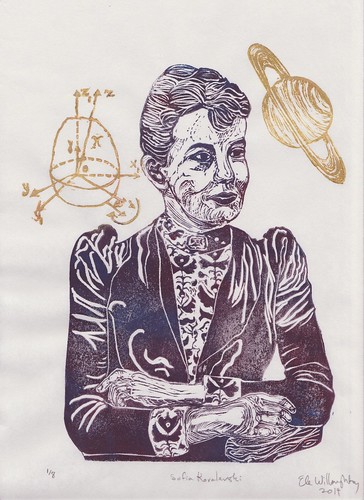
Also known as Sofie or Sonya, her last name has been transliterated from the Cyrillic Со́фья Васи́льевна Ковале́вска in a variety of ways, including Kovalevskaya and Kowalevski. Sofia's contributions to analysis, differential equations and mechanics include the Cauchy-Kovalevski theorem and the famed Kovalevski top (well, famed in certain circles, no pun intended). She was the first woman appointed to a full professorship in Northern Europe or to serve as editor of a major scientific journal. She is also remembered for her contributions to Russian literature. All of this despite living when women were still barred from attending university. Her accomplishments were tremendous in her short but astonishing life.

Born Sofia Korvin-Krukovskaya, in Moscow, the second of three children, she attributed her early aptitude for calculus to a shortage of wallpaper, which lead her father to have the nursery papered with his old differential and integral analysis notes. Her parents nurtured her early interest in math, and hired her a tutor. The local priest's son introduced her to nihilism. So both her bent for revolutionary politics and passion for math were established early.

Unable to continue her education in Russia, like many of her fellow modern, young women including her sister, she sought a marriage of convenience. Women were both unable to study at university or leave the country without permission of their father or husband. Men sympathetic to their plight would participate in "fictitious marriages" to allow them an opportunity to seek further education abroad. She married the young paleontology student, Vladimir Kovalevsky, later famous for his collaboration with Charles Darwin. They emigrated in 1867, and by 1869 she enrolled in the German University of Heidelburg, where she could at least audit classes with the professors' permission. She studied with such luminaries as Helmholtz, Kirchhoff and Bunsen. She moved to Berlin and studied privately with Weierstrass, as women could not even audit classes there. In 1874, she present three papers, on partial differential equations, on the dynamics of Saturn's rings (as illustrated in my linocut) and on elliptic integrals as a doctoral dissertation at the University of of Göttingen. Weierstrass campaigned to allow her to defend her doctorate without usual required lectures and examinations, arguing that each of these papers warranted a doctorate, and she graduated summa cum laude - the first woman in Germany to do so.

She and her husband counted amongst their friends the great intellectuals of the day including Fyodor Dosteyevsky (who had been engaged to her sister Ann), Thomas Huxley, Charles Darwin, Herbert Spencer, and George Elliot. The sentence "In short, woman was a problem which, since Mr. Brooke's mind felt blank before it, could hardly be less complicated than the revolutions of an irregular solid." from Elliot's Middlemarch, is undoubtedly due to her friendship with Kovaleski. Sofia and Vladimir believed in ideas of utopian socialism and traveled to Paris to help those the injured from the Paris Commune and help rescue Sofia's brother-in-law, Ann's husband Victor Jaclard.

In the 1880s, Sofia and her husband had financial difficulties and a complex relationship. As a woman Sofia was prevented from lecturing in mathematics, even as a volunteer. Vladimir tried working in business and then house building, with Sofia's assistance, to remain solvent. They were unsuccessful and went bankrupt. They reestablished themselves when Vladimir secured a job. Sofia occupied herself helping her neighbours to electrify street lamps. They tried returning to Russia, where their political beliefs interfered with any chance to obtain professorships. They moved on to Germany, where Vladimir's mental health suffered and they were often separated. Then, for several years, they lived a real marriage, rather than one of convenience, and they conceived their daughter Sofia, called Fufa. When Fufa turned one, Sofia entrusted her to her sister so she could return to mathematics, leaving Vladimir behind. By 1883, he faced increasing mood swings and the threat of prosecution for his role in a stock swindle. He took his own life.

Mathematician Gösta Mittag-Leffler, a fellow student of Weierstrass, helped Sofia secure a position as a privat-docent at Stockholm University in Sweden. She developed an intimate "romantic friendship" with his sister, actress, novelist, and playwright Duchess Anne-Charlotte Edgren-Leffler, with whom she collaborated in works of literature, for the remainder of her too short life. In 1884 she was appointed "Professor Extraordinarius" (Professor without Chair) and became the editor of the journal Acta Mathematica. She won the Prix Bordin of the French Academy of Science, for her work on the rotation of irregular solids about a fixed point (as illustrated by the diagram in my linocut) including the discovery of the celebrated "Kovalevsky top". We now know there are only three fully integrable cases of rigid body motion and her solution ranks with those of mathematical luminaries Euler and Lagrange. In 1889, she was promoted to Professor Ordinarius (Professorial Chair holder) becoming the first woman to hold such a position at a northern European university. Though she never secured a Russian professorship, the Russian Academy of Sciences granted her a Chair, after much lobbying and rule-changing on her behalf.

Her writings include the memoir A Russian Childhood, plays written in collaboration with Edgren-Leffler, and the semi-autobiographical novel Nihilist Girl (1890).

Tragically, she died at 41, of influenza during the pandemic. Prizes, lectures and a moon crater have been named in her honour. She appears in film and fiction, including Nobel laureate Alice Munro's beautiful novella 'Too Much Happiness', a title taken from Sofia's own writing about her life.

Tuesday, October 14, 2014

Ada Lovelace Day 2014: The hard-earned fame of Marie Skłodowska-Curie

Today is the 6th annual international day of blogging to celebrate the achievements of women in technology, science and math, Ada Lovelace Day 2014 (ALD14). I'm sure you'll all recall, Ada, brilliant proto-software engineer, daughter of absentee father, the mad, bad, and dangerous to know, Lord Byron, she was able to describe and conceptualize software for Charles Babbage's computing engine, before the concepts of software, hardware, or even Babbage's own machine existed! She foresaw that computers would be useful for more than mere number-crunching. For this she is rightly recognized as visionary - at least by those of us who know who she was. She figured out how to compute Bernouilli numbers with a Babbage analytical engine. Tragically, she died at only 36. Today, in Ada's name, people around the world are blogging.

(Cross-posted to the minouette blog)

This year I'm participating in an entire group art show celebrating Ada Lovelace Day. The Art.Science.Gallery show Go Ahead and Do It: Portraits of Women in STEM culminates today! I will share all of my portraits of women in science (and links to where I tell their stories) below.


Marie Curie linocut glows in the dark
Marie Skłodowska-Curie, linocut with glow-in-the-dark ink by Ele Willoughby, 2014

In previous years, I've specifically avoided writing about Marie Curie because she is often the one historical figure people can name. I don't like to do the obvious thing and particularly want to highlight the under appreciated heroines of science. However the result is that her truly remarkable achievements haven't been celebrated here, just because of her fame. So, with a collection of portraits and stories written on the less well known, today I'll write about the well-known and why she in fact deserves her fame.

Marie Skłodowska-Curie (7 November 1867 – 4 July 1934), Polish-born, naturalized-French physicist and chemist, as the first woman to win a Nobel prize, the only woman to ever win TWO Nobel prizes, and the only person ever to win in two different sciences: physics and chemistry! She was also the first female professor at the University of Paris, and in 1995 became the first woman to be entombed on her own merits in the Panthéon in Paris. Born Maria Salomea Skłodowska in Warsaw, she studied secretly at the Floating University there before moving to Paris where she earned higher scientific degrees, met her PhD supervisor and future husband Pierre.

She was one of the pioneers who helped explain radioactivity, a term she coined. She was the one who first developed a means of isolating radioacitve isotopes and discovered not one, but two new elements: polonium (named for her native country) and radium. She also pioneered radioactive medicine, proposing the treatment of tumors with radioactivity. She founded medical research centres, the Curie Institutes in Paris and Warsaw which are still active today. She created the first field radiology centres during World War I. Each one of these achievements alone would warrant being memorialized in the annals of science and medicine; she did all of these things. She died in 1934 from aplastic anemia brought on by exposure to radiation, including carrying test tubes of radium in her pockets during research and her World War I service in her mobile X-ray units.

Her pioneering work explaining radioactivity earned her the 1903 Nobel Prize in Physics with her husband Pierre Curie and with physicist Henri Becquerel. At first, the Committee intended to honour only Pierre and Becquerel, but Swedish mathematician Magnus Gösta Mittag-Leffler, an advocate of women in science, alerted Pierre to the situation. (You may recall that it was the same man who helped Sofia Kovalevski secure a University position in Stockholm and that she collaborated on works of literature and had what was called a "romantic friendship" with his sister Duchess Anne-Charlotte Edgren-Leffler).  After Pierre's complaint, Marie's name was added to the nomination. The 1911 Nobel Prize in Chemistry was awarded to her "in recognition of her services to the advancement of chemistry by the discovery of the elements radium and polonium, by the isolation of radium and the study of the nature and compounds of this remarkable element."

Her life and legacy are truly extraordinary!

MarieCurie_glow
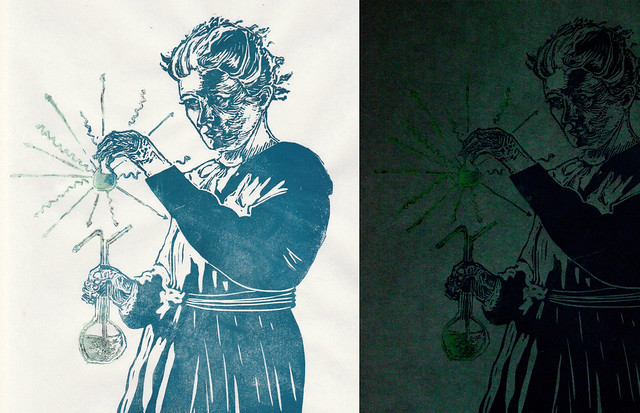
Marie Skłodowska-Curie, linocut with glow-in-the-dark ink show in the light and dark by Ele Willoughby, 2014

Not only was her work original and providing revolutionary insight on the theoretical side at the time, but the sheer heroic dedication and labour involved in her experimental work cannot be overstated. Having recognized that pitchblende ore must contain multiple elements which were giving off radiation, she and Pierre were able to show in 1898 that two new elements Polonium and Radium were needed to explain their observations. They then sought to actually isolate these elements. From a ton of pitchblende, she separated one-tenth of a gram of radium chloride in 1902. In 1910 Marie Curie isolated pure radium metal - a full 12 years after she and Pierre published their preliminary evidence for its existence. This involved working in a shed, meticulously separating the radioactive material from the inert and then dividing the radioactive material into its various sources for many years - all the while raising their young daughter when not at the lab.

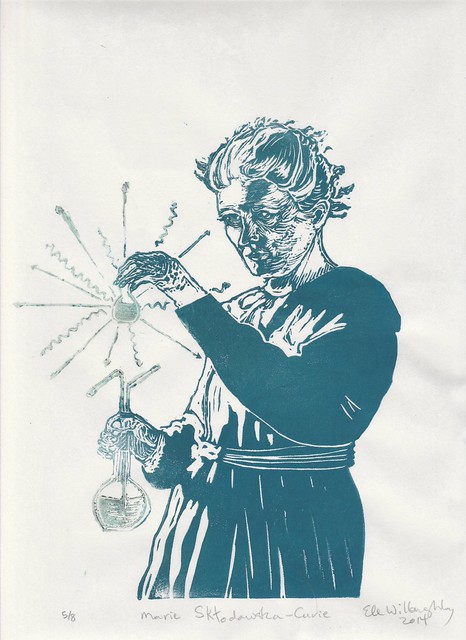
Both of the elements she discovered are radioactive, meaning that they spontaneously give off radiation. All of the isotopes of polonium emit alpha particles, but Polonium-210 will emit a blue glow which is caused by excitation of surrounding air. Radium emits alpha, beta and gamma particles - that is 2 protons and 2 neutrons, electrons as well as x-rays. Thus, I've shown her sample surrounded by the symbols of these particles: the straight and wiggly lined arrows for the massive particles and high-energy light photons or gamma rays respectively, and made the sample with glow-in-the-dark ink. While the materials she discovered and worked with would have glowed due to radioactivity, never fear... these prints glow due to phosphorescence - a different process which is not dangerous. The ink will absorb UV light (for instance, from sunlight) and re-emit it in the dark.

The linocut is printed on Japanese kozo paper 9.25" by 12.5" (23.5 cm by 32 cm) in an edition of eight.

You can also find my complete set of women in STEM portraits here.

Wednesday, March 26, 2014

Inspired by Science

Inspired by Science on The Etsy Blog


The Etsy blog just posted Karen Brown's article featuring 5 Etsy artists who are inspired by science, including me!

Lise Meitner
Lise Meitner and Nuclear Fission Linocut History of Physics by minouette


“I think the idea that art and science are separate is unfounded,” says print maker Ele Willoughby of minouette. “It takes creativity to be a good scientist and experimentation to be a good artist.” In her Etsy shop, Ele explores art and science through a series of portraits of scientists inspired by the bi-monthly challenges of the Mad Scientists of Etsy team. “I love hearing from parents who want to inspire young children with portraits of scientific heroes or heroines,” she says.

There are some fabulous artists in that inspiring intersection of art and science, and several of my prints included.


(x-posted to the on-going saga of minouette)

Tuesday, October 15, 2013

The Reconstructionists Women in Science for Ada Lovelace Day

Lisa Congdon, 'Ada Lovelace'
Today is the fifth annual international day of blogging to celebrate the achievements of women in technology, science and math, Ada Lovelace Day 2013 (ALD13). You may recall Ada, brilliant proto-software engineer, daughter of absentee father, the mad, bad, and dangerous to know, Lord Byron, she was able to describe and conceptualize software for Charles Babbage's computing engine, before the concepts of software, hardware, or even Babbage's own machine existed! She foresaw that computers would be useful for more than mere number-crunching. For this she is rightly recognized as visionary - at least by those of us who know who she was. She figured out how to compute Bernouilli numbers with a Babbage analytical engine. Tragically, she died at only 36. Today, in Ada's name, people around the world are blogging about women in science and technology, whose accomplishments have all too often gone unrecognized or unacknowledged.

Lisa Congdon, 'Maria Mitchell'
Today, I thought I would direct you to The Reconstructionists, a year-long collaboration of artist and illustrator Lisa Congdon and writer Maria Popova (of Brainpickings fame) to celebrate remarkable women, including the subset of the scientists I've selected to share here, artists, writers, other unsung heroes. Each woman they feature is illustrated by Congdon along with quotation and posted with a succinct biography by Popova.  Each represents someone "who have changed the way we define ourselves as a culture and live our lives as individuals of any gender." These two have created a beautiful and remarkable series. You should go enjoy the project in its entirety (thus far)!

Some of my favorite heroines of the history of science they've selected to portray include Ada Lovelace, shown above, astronomer Maria Mitchell (at right),  mathematician, physicist, writer and gifted educator and popularizer of science Mary Fairfax Somerville (read more about Somerville in my review of Seduced by Logic - Émilie du Châtelet, Mary Somerville And the Newtonian Revolution by Robyn Arianrhod cross-posted to sci&lit) and physicist Rosalind Franklin (whose incredible x-ray crystallography provided the first indication that DNA is a double helix - they gave the Nobel to the colleagues who helped themselves to her research and didn't happen to die). Other scientists portrayed include astronaut Sally Ride, primatologist Jane Goodall and unsung mathematical genius, pioneer of communications engineering and glamourous Hollywood actress Hedy Lemarr.
Lisa Congdon, 'Rosalind Franklin'

)
Lisa Congdon, 'Mary Somerville'

Thursday, June 20, 2013

Astrophysical Meme: Jocelyn Bell Burnell's Pulsar, Little Green Men, Joy Division, and Beautiful Data

In November, 1967, Jocelyn Bell (Burnell) was just a graduate student when she discovered the first radio pulsar (or pulsating star), a highly magnetized, rotating neutron star that emits a beam of electromagnetic radiation. This radiation (light in the radio frequency band) can only be observed when the star is point towards us; so, like the light from a distant lighthouse, it appears to pulse at a precise frequency. She had been working with her supervisor Antony Hewish and others to construct a radio telescope to study quasars (quasi-stellar objects which emit radio waves). She noted some "scruff" on her chart-recorder, and then that the pulses were incredibly regular, occurring every 1.337 seconds. Hewish was initially scornful and insisted the regular pulses must be noise from a human made source. He first dubbed this object, emitting with such regularity 'LGM 1' for "Little Green Men 1", a playful joke about their uncertainty about what could emit radiation so regularly - obviously it could only be a communication from extraterrestrials hahaha! Only after she found other such sources, in different places with different frequencies, were her colleagues convinced and this lead to the development of the pulsar model. It is now known PSR B1919+21.

The 1968 paper announcing this discovery in Nature has five authors, lead by Hewish, followed by Jocelyn Bell. In 1974, Hewish won the Nobel Prize for this discovery, along with fellow radioastronomer Marlin Ryle). Jocelyn Bell was not included as it was assumed that the "senior man" was responsible for the work. This was controversial and has been condemned by many leading astronomers like Fred Hoyle )(who with Thomas Gold was first able to explain the signals as due to a rapidly rotating neutron star). Jocelyn Bell Burnell herself has stated she was not upset. Bell Burnell has a great career and won many honours after her impressive start, but her exclusion from the Nobel win, based on her own research strikes me and many others as one of the more blatant and egregious examples of gender bias in the selection of Nobel prize recipients.

Not only the discovery, but the presentation of the data is impressive and elegant. The diagram above (from the Cambridge Encyclopaedia of Astronomy) shows superimposed images of successive pulses. Stripped down to their essential information like sparklines (chart lines without annotation or axes, but drawn of course to a common scale) so their regularity really stands out, and they can be easily compared and contrasted. If you are used to looking at time series, you'll know that since they can be easily superimposed and the pulses line up, that the frequency is quite regular. The diagram is downright eloquent, and would warm Edward Tufte's heart. It appeared even earlier in the January 1971 edition of Scientific American article “The Nature of Pulsars” by Jeramiah P. Ostriker (shown above on pale blue) and 1974 graphic design book on data visualisation ‘Graphis Diagrams’(via Gia's Blog).

From there, the image began a sort of life of its own. The British rock band Joy Division included the image from the Cambridge Encyclopaedia of Astronomy in a folder of reference material for their 1979 album Unknown Pleasures submitted to Peter Saville, who designed the album cover- iconic in white on black, it's the pulsar data graphically on a square field (at left). It of course appeared as art, without explanation of its source. The beauty of the image itself, as well as the devotion of fans of the enigmatic album, lead to it propagating as a meme to this day. Peter Saville himself gives a great explanation of the life of this diagram in this video.


Data Visualization Reinterpreted by VISUALIZED from VISUALIZED on Vimeo.

Consider how the image has propagated, from tattoos
via Gia's Blog and tattoo by dodie

to sculpture
[unkn0wn pleaSures 1919] by Marvin Bratke, Lasercut Sculpture 40x40cm, wood/acrylic glass

to food
Brock Davis

through fashion (both consciously of its original source, and more tongue-in-check critique of our contemporary cult of images disconnected from their source - though ironically, I'm pretty sure the tee shirt was designed by someone who thought kids today should know Unknown Pleasures, rather than radioastronomy).

PULSAR 1919 SKIRT by lovelysally

Graphic artist Adam J. Kurtz has created this humorous t-shirt via laughing squid

We've arrived at something interesting to look at on tumblr, without reference to Joy Division or pulsars, an enigmatic but captivating image with an unknown source... an unknown pleasure if you will.


LinkWithin

Related Posts with Thumbnails