Showing posts with label radioactivity. Show all posts

Tuesday, October 11, 2016

Ursula Franklin for Ada Lovelace Day #ALD16

Ursula Franklin, linocut, 11" x 14" by Ele Willoughby, 2016
Cross-posted from the minouette blog 

This year, to celebrate the international celebration of the achievements of women in science, technology, engineering and math, Ada Lovelace Day (ALD16), I am returning again to my first subject: Ursula Franklin (16 September 1921 – 22 July 2016). Every year since 2009, people have devoted the 2nd Tuesday in October to blogging about (and otherwise celebrating) the under-recognized and under-appreciated women who have made pivotal contributions to STEM throughout history, in the name of Countess Ada Lovelace. (I hope you'll all recall, Ada, brilliant proto-software engineer, daughter of absentee father, the mad, bad, and dangerous to know, Lord Byron, she was able to describe and conceptualize software for Charles Babbage's computing engine, before the concepts of software, hardware, or even Babbage's own machine existed! She foresaw that computers would be useful for more than mere number-crunching. For this she is rightly recognized as visionary - at least by those of us who know who she was. She figured out how to compute Bernouilli numbers with a Babbage analytical engine. Tragically, she died at only 36.)

A preliminary mock-up of one of the Phylo cards
in this new Women in Science and Engineering set
featuring my portrait of today's namesake: Ada Lovelace
I began participating in Ada Lovelace Day in 2010, and I knew immediately I should write about Ursula Franklin. For me she really personifies the goals of ALD; not only did she represent excellence in science and engineering, but she was a great, perhaps even visionary, thinker on the very role of technology in our society, as well as a fearless and tireless advocate for women in STEM, peace and social justice. Her research interests and achievements were clearly guided by her principles, including gathering evidence of the harmful health effects of radiation from atmospheric testing of nuclear weapons to or her work on the political and societal impacts of support of the technologies and their use. When she died earlier this year, I wrote about her life, work and how she has been one of my heroes since I was too young to fully appreciate the importance of role models in my scientific career. Her influence as a roll model of women in physics and engineering here cannot be overstated. She was one of the most impressive people I have ever met. I got some encouragement from friends to do something I had long contemplated: add her portrait to my growing collection of scientists. When I finally sat down to do so this September, I was really tickled to open my email and receive a commission to do precisely that! I'm really pleased to say I'm going to be contributing some artwork to latest edition of the Phylo Project from Dave Ng and the Advanced Molecular Biology Laboratory (the science education facility within the Michael Smith Laboratories, UBC): a trading card game about Women in Science and Engineering! Sometimes you get several hints of what work you should do next; this portrait's time clearly had arrived.

Franklin was born in Munich in 1921 and survived being interned by the Nazis. She received her PhD in physics from the Technical University of Berlin in 1948 and immigrated to Canada, where after a post-doc at U of T, she joined the faculty. She pioneered archeometry - the use of modern materials analysis in archeology, dating prehistoric artifacts made of metals and ceramics. In my portrait I include an image of an ancient Chinese ding vessel to represent both her metallurgical research and archeometry and her writing about "prescriptive" versus "holistic" technologies used in mass production versus technologies used by craft workers and artisans. Her science was always engaged with societal concerns. During the 60s she advocated for the atmospheric nuclear test ban treaty, citing her studies of strontium-90 radioactive fallout found in children's teeth. Strontium-90 (90Sr) is called a "bone-seeker" because biochemically it behaves like calcium and when absorb it in our bodies what isn't excreted finds its way to our bones. Thus, this radioactive product of nuclear fission (for instance, in atmospheric tests of nuclear weapons) is particularly dangerous and can cause cancers. It decays by beta decay, giving off electrons, as shown by the child's tooth in my portrait. During the 70s she was part of the Science Council of Canada investigation of how we could better conserve resources and protect nature. She began to develop her ideas about complexities of modern technological society.

She consistently has stood up for her beliefs in peace and social justice. As a member of the Voice of Women (now called Canadian Voice of Women for Peace), she tried to persuade Parliament to disengage Canada from supplying any weapons to the US during the Vietnam war, to shift funding from weapons research to preventative medicine, to withdraw from NATO and disarm. She later fought to allow conscientious objectors to redirect part of their income taxes from military uses to peaceful purposes (though the Supreme Court declined to hear the associated case). She joined other retired female faculty in a class action law suit against the University of Toronto for claiming it had been unjustly enriched by paying women faculty less than comparably qualified men. The University settled in 2002 and acknowledged that there had been gender barriers and pay discrimination.

As an applied scientist, her writings on technology benefit from the insight of an insider, but her priorities are justice and peace and she critiques and analyses technology in this light. She does not view technology as neutral; it is a comprehensive system that includes methods, procedures, organization, "and most of all, a mindset". It can be work-related or control-related, holistic and prescriptive. Franklin argues that the dominance of prescriptive technologies in modern society discourages critical thinking and promotes "a culture of compliance". She investigated the relationship between technology and power. She investigated how we interact with communication technologies and advocated for the right to silence - long before our contemporary concern with these issues.

Many of her articles and speeches on pacifism, feminism, technology and teaching are collected in The Ursula Franklin Reader (2006). A nod to her pacifism and feminism is built into the structure of her portrait which encompasses the symbols for peach and women in the negative space. Franklin is one of many respected scholars and thinkers to have delivered a series of Massey Lectures, in 1989. Hers were gathered and published as The Real World of Technology. She has been recognized for her work in many ways, including receiving the Order of Canada, Governor General's Award in Commemoration of the Persons Case for promoting the equality of girls and women in Canada and the Pearson Medal of Peace for her work in advancing human rights. She was inducted into the Canadian Science and Engineering Hall of Fame in 2012. Locals may know the Ursula Franklin Academy, a Toronto high school, named in her honour. I think this University, city, country and in fact, society at large were made a better place because Ursula Franklin was a part of it. So, though she has received this recognition, I think she should be a household name, so that's why I am happy to add her to my portrait pantheon of scientists and write about her again this Ada Lovelace Day 2016. I also think that it is very apt to combine making her portrait using holistic technologies of the artisan and sharing it through more prescriptive digital technologies with the world.

(NB: much of the biographical information is recycled from my own previous post about Franklin) .

Saturday, November 7, 2015

Double laureate Marie Skłodowska-Curie & the hunt for elements

MarieCurie_glow
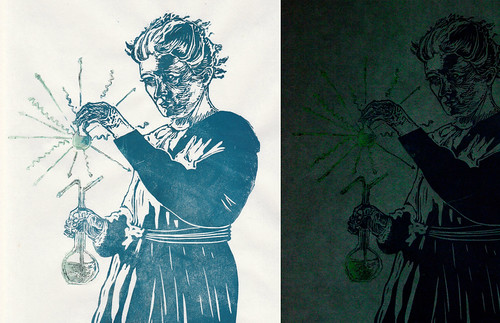
Marie Curie, details of linocut with glow-in-the-dark ink, by Ele Willoughby, 2014

The most well-known woman in the history of physics - or perhaps science - was born almost a century and a half ago today. The famous Polish-born, naturalized-French physicist and chemist Marie Skłodowska-Curie (7 November 1867 – 4 July 1934) was the first woman to win a Nobel prize, the only woman to ever win TWO Nobel prizes, and the only person ever to win in two different sciences: physics and chemistry! Happy birthday Madame Curie! You can read more about her in my post for Ada Lovelace Day, 2014.

Tuesday, October 14, 2014

Ada Lovelace Day 2014: The hard-earned fame of Marie Skłodowska-Curie

Today is the 6th annual international day of blogging to celebrate the achievements of women in technology, science and math, Ada Lovelace Day 2014 (ALD14). I'm sure you'll all recall, Ada, brilliant proto-software engineer, daughter of absentee father, the mad, bad, and dangerous to know, Lord Byron, she was able to describe and conceptualize software for Charles Babbage's computing engine, before the concepts of software, hardware, or even Babbage's own machine existed! She foresaw that computers would be useful for more than mere number-crunching. For this she is rightly recognized as visionary - at least by those of us who know who she was. She figured out how to compute Bernouilli numbers with a Babbage analytical engine. Tragically, she died at only 36. Today, in Ada's name, people around the world are blogging.

(Cross-posted to the minouette blog)

This year I'm participating in an entire group art show celebrating Ada Lovelace Day. The Art.Science.Gallery show Go Ahead and Do It: Portraits of Women in STEM culminates today! I will share all of my portraits of women in science (and links to where I tell their stories) below.


Marie Curie linocut glows in the dark
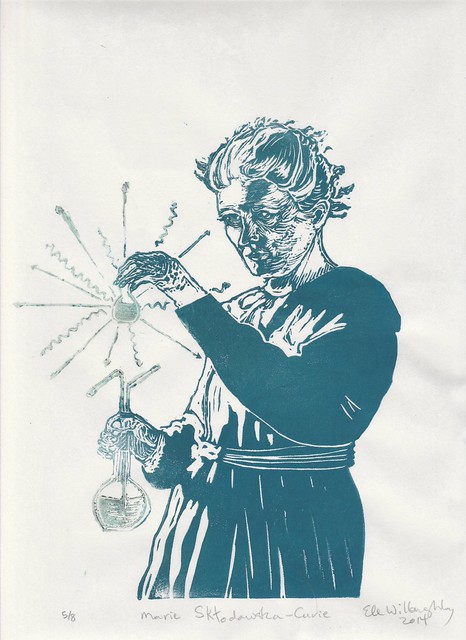
Marie Skłodowska-Curie, linocut with glow-in-the-dark ink by Ele Willoughby, 2014

In previous years, I've specifically avoided writing about Marie Curie because she is often the one historical figure people can name. I don't like to do the obvious thing and particularly want to highlight the under appreciated heroines of science. However the result is that her truly remarkable achievements haven't been celebrated here, just because of her fame. So, with a collection of portraits and stories written on the less well known, today I'll write about the well-known and why she in fact deserves her fame.

Marie Skłodowska-Curie (7 November 1867 – 4 July 1934), Polish-born, naturalized-French physicist and chemist, as the first woman to win a Nobel prize, the only woman to ever win TWO Nobel prizes, and the only person ever to win in two different sciences: physics and chemistry! She was also the first female professor at the University of Paris, and in 1995 became the first woman to be entombed on her own merits in the Panthéon in Paris. Born Maria Salomea Skłodowska in Warsaw, she studied secretly at the Floating University there before moving to Paris where she earned higher scientific degrees, met her PhD supervisor and future husband Pierre.

She was one of the pioneers who helped explain radioactivity, a term she coined. She was the one who first developed a means of isolating radioacitve isotopes and discovered not one, but two new elements: polonium (named for her native country) and radium. She also pioneered radioactive medicine, proposing the treatment of tumors with radioactivity. She founded medical research centres, the Curie Institutes in Paris and Warsaw which are still active today. She created the first field radiology centres during World War I. Each one of these achievements alone would warrant being memorialized in the annals of science and medicine; she did all of these things. She died in 1934 from aplastic anemia brought on by exposure to radiation, including carrying test tubes of radium in her pockets during research and her World War I service in her mobile X-ray units.

Her pioneering work explaining radioactivity earned her the 1903 Nobel Prize in Physics with her husband Pierre Curie and with physicist Henri Becquerel. At first, the Committee intended to honour only Pierre and Becquerel, but Swedish mathematician Magnus Gösta Mittag-Leffler, an advocate of women in science, alerted Pierre to the situation. (You may recall that it was the same man who helped Sofia Kovalevski secure a University position in Stockholm and that she collaborated on works of literature and had what was called a "romantic friendship" with his sister Duchess Anne-Charlotte Edgren-Leffler).  After Pierre's complaint, Marie's name was added to the nomination. The 1911 Nobel Prize in Chemistry was awarded to her "in recognition of her services to the advancement of chemistry by the discovery of the elements radium and polonium, by the isolation of radium and the study of the nature and compounds of this remarkable element."

Her life and legacy are truly extraordinary!

MarieCurie_glow
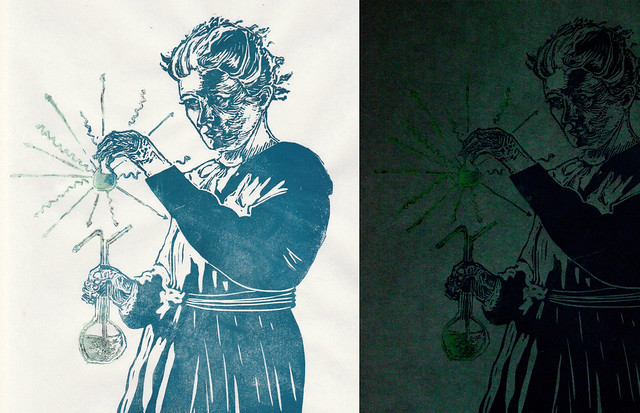
Marie Skłodowska-Curie, linocut with glow-in-the-dark ink show in the light and dark by Ele Willoughby, 2014

Not only was her work original and providing revolutionary insight on the theoretical side at the time, but the sheer heroic dedication and labour involved in her experimental work cannot be overstated. Having recognized that pitchblende ore must contain multiple elements which were giving off radiation, she and Pierre were able to show in 1898 that two new elements Polonium and Radium were needed to explain their observations. They then sought to actually isolate these elements. From a ton of pitchblende, she separated one-tenth of a gram of radium chloride in 1902. In 1910 Marie Curie isolated pure radium metal - a full 12 years after she and Pierre published their preliminary evidence for its existence. This involved working in a shed, meticulously separating the radioactive material from the inert and then dividing the radioactive material into its various sources for many years - all the while raising their young daughter when not at the lab.

Both of the elements she discovered are radioactive, meaning that they spontaneously give off radiation. All of the isotopes of polonium emit alpha particles, but Polonium-210 will emit a blue glow which is caused by excitation of surrounding air. Radium emits alpha, beta and gamma particles - that is 2 protons and 2 neutrons, electrons as well as x-rays. Thus, I've shown her sample surrounded by the symbols of these particles: the straight and wiggly lined arrows for the massive particles and high-energy light photons or gamma rays respectively, and made the sample with glow-in-the-dark ink. While the materials she discovered and worked with would have glowed due to radioactivity, never fear... these prints glow due to phosphorescence - a different process which is not dangerous. The ink will absorb UV light (for instance, from sunlight) and re-emit it in the dark.

The linocut is printed on Japanese kozo paper 9.25" by 12.5" (23.5 cm by 32 cm) in an edition of eight.

You can also find my complete set of women in STEM portraits here.

Friday, November 16, 2012

Music about Radioactivity: Radioactive Orchestra


adafruit industries blog

Using models from collaborating nuclear physicists, on how specific isotopes emit gamma radiation, media artist Kristofer Hagbard created an algorithm to translate this to music, and Axel Boman created songs based on melodies and sounds from the software Via the project webste:

The musical and artistic ambitions is about exploring a world that is not available to our senses and finding musically interesting pattens and to render them in a way that both resonates with popular culture while staying close to the subject matter.

The pedagogical aspect aims to inspire young people to learn about the natural sciences by making one of its most hidden phenomenas available in a new way and exposing complexity and beauty in the strange world of the atomic nuclei – using music.

I love the idea of making the ever-present though always changing ambient radiation audible and something we can sense. The physicists make the point that the general public tends to think ionizing radiation, these strong photons emitted, are unnatural, or something only associated with nuclear technology, when in fact, radiation is everywhere. Our Earth is filled with radioactivity and even our own bodies emit some radiation. By translating the frequencies of photos emitted by any given isotope to cascades of musical frequencies (or pitches) not only are they providing a means to think about this unsensed presence, but something lovely to listen to as well.

You can play with the software too, creating music from you favorite isotopes! It even allows you to export the music you create.

LinkWithin

Related Posts with Thumbnails