 |
Maria Sibylla Merian, linocut by Ele Willloughby, 2015.
Maria Sibylla Merian (1647-1717), leading entomologist of her day,
traveller and scientific illustrator is shown complete with
pomegranate branch and the life cycle of a butterfly from
caterpillar, to chrysalis in its cocoon to butterfly, inspired by
her famous work 'Metamorphosis insectorum Surinamensium'
- a process she carefully documented and explained. |
Born April 2, 1647, Maria Sibylla Merian was the leading entomologist of her day, a great traveller and scientific illustrator. The German-born naturalist came from a Swiss family who founded one of one of Europe's largest publishing houses in the 17th century. This allowed her early access to many books on natural history. After she lost her father at age three, and her mother remarried still life painter Jacob Marrel. Her step-father and his students trained her as an artist. She began painting insects and plants by 13. She wrote, "
I spent my time investigating insects. At the beginning, I started with silk worms in my home town of Frankfurt. I realized that other caterpillars produced beautiful butterflies or moths, and that silkworms did the same. This led me to collect all the caterpillars I could find in order to see how they changed".
She married her step-father's apprentice Johann Andreas Graff, they had a daughter Johanna Helena, and moved to his home city of Nurenburg. She was able to contribute to the family income by painting, creating embroidery designs, and teaching drawing lessons to unmarried daughters of wealthy families, something which also allowed her access to the finest gardens where she continued collecting and documenting. She published her first book of natural illustrations, titled Neues Blumenbuch, in 1675 at age 28. In 1679, she first published her insect research in a two-volume, illustrated book focusing on insect metamorphosis. She moved twice to be with her mother after her step-father's death, then to join her half-brother at a Labadist religious community. She also split with her husband. After her mother's death, she moved to Amsterdam in 1691 and divorced her husband in 1692.
In Amsterdam, she was able to observe some of the collections of insects which had been brought back from Suriname. She became curious whether the life cycles of the exotic butterflies and other insects mirrored those Europe species she knew well. She was able to secure the city of Amsterdam's permission and and travel grant to travel to Suriname in South America, along with her younger daughter Dorothea Maria. She further funded her travels by selling 255 paintings. She planned a five year mission to study insects, making her perhaps the first person to plan a proper scientific expedition!
 |
Maria Sibylla Merian, from
Metamorphosis insectorum Surinamensium, Plate LX. 1705 |
She travelled throughout the colony sketching insects and plants. She criticized the Dutch planters treatment of indigenous people and black slaves (though she relied upon amerindian slaves in her residence and her excursions, and brought a young amerindian woman named Indianin back with her to Holland). She used local native names for the plants and described local uses. Malaria likely cut her expedition short and forced her return to the Dutch Republic in 1701. She sold her collected specimen and in 1705 she published a book
Metamorphosis Insectorum Surinamensium about the insects of Suriname.
She suffered a stroke in 1715 which left her partially paralysed and died a pauper in 1717. Her daughter Dorothea published
Erucarum Ortus Alimentum et Paradoxa Metamorphosis, a collection of her mother's work, posthumously. Both Dorothea and Johanna followed their mother's lead and became botanical illustrators.
 |
Copper engraving from Maria Sibylla Merian's
Metamorphosis insectorum Surinamensium, Plate XLIX. |
Modern scholars now appreciate her pioneering scientific work as well as the beauty of her scientific illustrations. During her life time insects were still reviled and people still put credence in the Aristotelian idea that they were spontaneously generated or "born of mud". She meanwhile detailed the life cycle of 186 species and explained the poorly-understood or even unknown process of metamorphosis. Science was conducted in Latin and her publications were in the vernacular, making them more popular with high society than contemporary scientists. Despite her knowledge and original research contributions she was not really recognized as a scientist in her day (though Carl Linnæus (1707-1778), father of taxonomy, did cite her in his
Systema Naturæ of 1753). It was very unusual for a woman in her day to pursue science, let alone travel the world in its pursuit. She was able to do so because she began her studies with the accessible - animals she could find in her own backyard, and become the leading expert on metamorphosis. During her great expedition, she also noted their habitats, feeding habits and uses to indigenous people. Her classification of butterflies and moths are still relevant today. She detailed plants, frogs, snakes, spiders, iguanas, and tropical beetles and was the first European to describe both army ants and leaf cutter ants as well as their effect on other organisms.
 |
Speckled caiman and a false coral snake by Maria Sibylla Merian
from Metamorphosis insectorum Surinamensium II., Plate LXX. |
Her work had a strong influence on future scientific illustration. Her work shows great accuracy and she was the first to illustrate the complete life cycle of insects. In her time, funding her expedition and her unladylike devotion to insects was ridiculed, but she is remembered as one of the best insect and flower illustrators of all time. Her daughters and student Rachel Ruysch (1664-1750) all went on to be renown botanical illustrators.
Shortly after her death, Peter the Great saw and purchased a large number of her works in Amsterdam. Her portrait was printed on the 500 DM note before Germany converted to the euro. Her portrait has also appeared on a 0.40 DM stamp and two American 32 cent stamps. Many schools, place names, a scientific research vessel and a crater on Venus have been named in her honour.
One last tidbit (or two) for you history of science buffs: Dorothea's daughter, Maria Sibylla Merian's granddaughter married mathematician Leonhard Euler (1707-1783). Maria Sibylla Merian was also first cousin to Jacob Christoph Le Blon (1667-1741), painter and engraver who invented the four colour printing process (using an RYBK color model similar to the modern CMYK system).




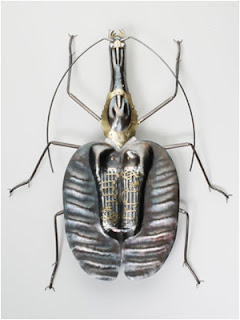

 VIOLIN BEETLE by Elizabeth Goluch


