Today is the 6th annual international day of blogging to celebrate the achievements of women in technology, science and math, Ada Lovelace Day 2014 (ALD14). I'm sure you'll all recall, Ada, brilliant proto-software engineer, daughter of absentee father, the mad, bad, and dangerous to know, Lord Byron, she was able to describe and conceptualize software for Charles Babbage's
computing engine, before the concepts of software, hardware, or even
Babbage's own machine existed! She foresaw that computers would be
useful for more than mere number-crunching. For this she is rightly
recognized as visionary - at least by those of us who know who she was.
She figured out how to compute Bernouilli numbers with a Babbage analytical engine. Tragically, she died at only 36. Today, in Ada's name, people around the world are blogging.
(Cross-posted to the minouette blog)
This year I'm participating in an entire group art show celebrating Ada Lovelace Day. The Art.Science.Gallery show
Go Ahead and Do It: Portraits of Women in STEM culminates today! I will share all of my portraits of women in science (and links to where I tell their stories) below.
In previous years, I've specifically avoided writing about Marie Curie
because she is often the one historical figure people can name. I don't
like to do the obvious thing and particularly want to highlight the
under appreciated heroines of science. However the result is that her
truly remarkable achievements haven't been celebrated here, just because
of her fame. So, with a collection of portraits and stories written on
the less well known, today I'll write about the well-known and why she
in fact deserves her fame.
Marie Skłodowska-Curie (7 November 1867 – 4 July 1934), Polish-born,
naturalized-French physicist and chemist, as the first woman to win a
Nobel prize, the only woman to ever win TWO Nobel prizes, and the only
person ever to win in two different sciences: physics and chemistry!
She was also the first female professor at the University of Paris, and
in 1995 became the first woman to be entombed on her own merits in the
Panthéon in Paris. Born Maria Salomea Skłodowska in Warsaw, she
studied secretly at the
Floating University there before moving to Paris where she earned higher scientific degrees, met her PhD supervisor and future husband Pierre.
She was one of the pioneers who helped explain radioactivity, a term
she coined. She was the one who first developed a means of isolating
radioacitve isotopes and discovered not one, but two new elements:
polonium (named for her native country) and radium. She also pioneered
radioactive medicine, proposing the treatment of tumors with
radioactivity. She founded medical research centres, the Curie
Institutes in Paris and Warsaw which are still active today. She
created the first field radiology centres during World War I. Each one
of these achievements alone would warrant being memorialized in the
annals of science and medicine; she did all of these things. She died in
1934 from aplastic anemia brought on by exposure to radiation,
including carrying test tubes of radium in her pockets during research
and her World War I service in her mobile X-ray units.
Her pioneering work explaining radioactivity earned her the 1903 Nobel
Prize in Physics with her husband Pierre Curie and with physicist Henri
Becquerel. At first, the Committee intended to honour only Pierre and
Becquerel, but Swedish mathematician Magnus Gösta Mittag-Leffler, an
advocate of women in science, alerted Pierre to the situation. (You
may recall that it was the same man who helped
Sofia Kovalevski
secure a University position in Stockholm and that she collaborated on
works of literature and had what was called a "romantic friendship" with
his sister Duchess Anne-Charlotte Edgren-Leffler). After Pierre's
complaint, Marie's name was added to the nomination. The 1911 Nobel
Prize in Chemistry was awarded to her "in recognition of her services
to the advancement of chemistry by the discovery of the elements radium
and polonium, by the isolation of radium and the study of the nature
and compounds of this remarkable element."
Her life and legacy are truly extraordinary!
Not only was her work original and providing revolutionary insight on
the theoretical side at the time, but the sheer heroic dedication and
labour involved in her experimental work cannot be overstated. Having
recognized that pitchblende ore must contain multiple elements which
were giving off radiation, she and Pierre were able to show in 1898 that
two new elements Polonium and Radium were needed to explain their
observations. They then sought to actually isolate these elements. From
a ton of pitchblende, she separated
one-tenth of a gram of
radium chloride
in 1902. In 1910 Marie Curie isolated pure radium metal - a full 12
years after she and Pierre published their preliminary evidence for its
existence. This involved working in a shed, meticulously separating the
radioactive material from the inert and then dividing the radioactive
material into its various sources for many years - all the while raising
their young daughter when not at the lab.
Both of the elements she discovered are radioactive, meaning that they
spontaneously give off radiation. All of the isotopes of polonium emit
alpha particles, but Polonium-210 will emit a blue glow which is caused
by excitation of surrounding air. Radium emits alpha, beta and gamma
particles - that is 2 protons and 2 neutrons, electrons as well as
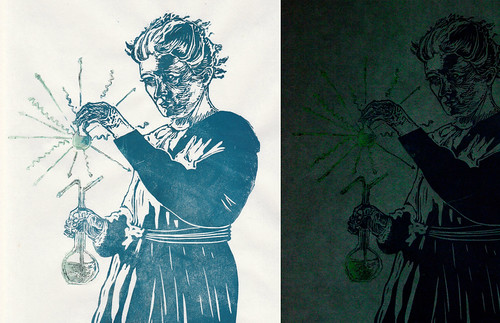
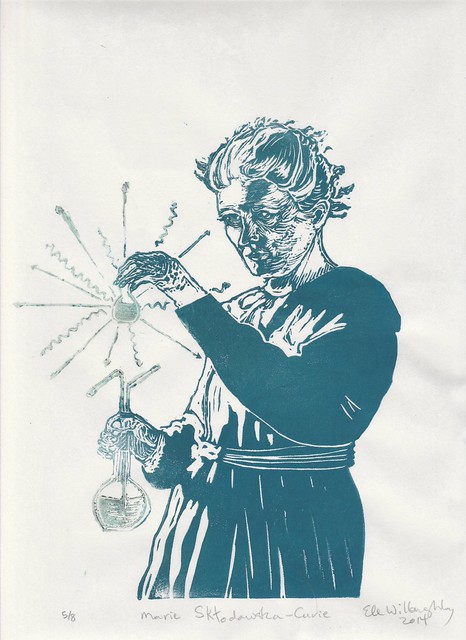
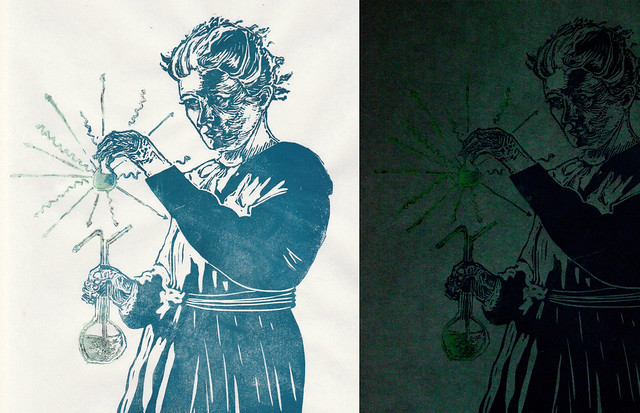
x-rays. Thus, I've shown her sample surrounded by the symbols of these
particles: the straight and wiggly lined arrows for the massive
particles and high-energy light photons or gamma rays respectively, and
made the sample with glow-in-the-dark ink. While the materials she
discovered and worked with would have glowed due to radioactivity,
never fear... these prints glow due to phosphorescence - a different
process which is not dangerous. The ink will absorb UV light (for
instance, from sunlight) and re-emit it in the dark.
The linocut is printed on Japanese kozo paper 9.25" by 12.5" (23.5 cm by 32 cm) in an edition of eight.
You can also find
my complete set of women in STEM portraits here.