Showing posts with label art about astronomy. Show all posts

Wednesday, June 9, 2021

Mildred Thompson and the Art of the Cosmos


Mildred Thompson 'Magnetic Fields' 1990, oil on canvas, 70.5 x 150” (triptych)
 

American artist Mildred Jean Thompson (March 12, 1936 – September 1, 2003) worked in many media, including printmaking, sculpture, painting, drawing and photography, as well as a writer. Critics see the influence of German Expressionism, West African textiles, Islamic architecture, spiritualism, metaphysics music and particularly jazz as her work grew increasingly abstract and improvisational. All these things are important, but her interest in physics and astronomy also shines through in the art about music and sound, to the later work specifically about mathematics, magnetic fields, radiation, particles and planetary systems. Thompson said, “My work in the visual arts is, and always has been, a continuous search for understanding. It is an expression of purpose and reflects a personal interpretation of the universe.” 

Mildred Thompsn, String Theory Series, 1999, acrylic on vinyl, 61.5 x 46”


Finding her ability to show as a Black woman in the US was hampered by racism and sexism, she spent a decade in Germany. She had studied at Art Academy of Hamburg and returned to live and work in the Rhineland town of Düren in the 60s. By the 70s her work had become completely abstract. From 1975 to 1986 she lived in Tampa, Washington D.C, Paris, before settling in Atlanta, where she wrote for the periodical Art Papers, taught at the Atlanta College of Art and worked as an artist for the rest of her life. Thompson explained, "My work has to do with the cosmos and how it affects us," to Essence magazine in 1990.

Mildred Thompson, Helio Centric III, 1993, intaglio vitreograph, 40" x 30" each
(image size 30" x 24")


For me the Helios Centric series evokes the swirling chaos of the nascent solar system, as masses spun in a disc around our sun, colliding and aggregating over time into a string of planets and smaller bodies. She did not make literal interpretations of sound, forces, space or any underlying physics of the universe but expressed these concepts imagination, emotion, colour and rhythm. There's a great deal of joy to be found in her work. She explored the universe from the smallest scales of her Wave Function, Radiation and String Theory series to the astronamical scale of our solar system and beyond and what she saw and expressed was quite beautiful.

Mildred Thompson
Radiation Explorations 8, 1994
Oil on canvas
87.5 x 110.1 inches (222.3 x 279.7 cm) overall


Wave Function III, 1993, intaglio vitreograph, 30" x 22.5" (image size 20" x 16")


References & Further Info

MildredThompson.org

Deanna Sirlin, Melissa Messina and the Mildred Thompson Legacy Project, interview on The Arts Section

Mildred Thompson, on Wikipedia.com 

Monday, August 21, 2017

Eclipsed - The art of the solar eclipse through time

Howard Russell Butler (1856–1934), Solar Eclipse, Lompoc 1923. Oil on canvas.
In honour of today's solar eclipse, the first of the century visible in this part of the world, I thought I would look at some of the artistic depictions of solar eclipses through time.

I'm a fan of the elegance and humour of astronomer Katie Mack's popular eclipse tweet:


As a science-artist, I often wonder how to portray astronomy, or earth and planetary science without reproducing actual diagrams, but some have done so in delightful and artistic ways. Artistic works incorporate both actual diagrams and abstractions, from Joseph Cornell's assemblages complete with scientific ephemera, through Roy Lichtenstein's stylized pop art with a true sense of movement of the celestial bodies, capturing the 4D event on the 2D plane. The always delightful Rachel Ignotofsky incorporates some diagrams in her retelling of the life and science of underappreciated Qing Dynasty astronomer and mathematician Wang Zhenyi (1768–1797) in her fabulous book Women in Science.

Joseph Cornell (1903 – 1972), Earth Eclipse
ca. 1960
Assemblage in box: wood, glass, steel, plaster, blue sand, and photograph
12.3 x 25.5 x 8 cm

Roy Lichtenstein, Eclipse of the Sun (1975)
Rachel Ignotofsky, spread on Wang Zhenyi and how she deduced the mechanism of solar eclipses, from Women in Science

Artists throughout time and across cultures have used the image of solar eclipses to bring a hint of the eerie or supernatural to their works and eclipses are not uncommon in religious art.

Raphael (and his workshop), 1483-1520, Isaac and Rebecca Spied on by Abimelech

Yoshitoshi Taiso (1839-1892), Mount Yoshino Midnight-Moon: Iga no Tsunone, from the series One Hundred Aspects of the Moon (1885-1892), ukiyo-e woodblook print on paper
Egon Schiele, (1890-1928) Crucifixion with Darkened Sun, 1907, oil on canvas
Some more contemporary works are more evocative than direct illustions.

Diego Rivera (1886 – 1957), Portrait of Ramón Gómez de la Serna, 1915, makes reference to the poet's own mentions of eclipses and hints at the artist's own love of eclipses


Rosemarie Fiore's "Smoke Eclipse #52," 2015. Firework smoke residue on Sunray paper.


Russell Crotty's "Blue Totality," 2017. Ink and watercolor, fiberglass, plastic and tinted bio-resin on paper, 48 inches by 48 inches by 1 inch
Many of these works benefited from the artists' own observations of actual eclipses and art historians can often tie works to recent eclipses in a given region. There are also wonderful images created as science communication, to literally depict events for research or teaching purposes. Princeton University has a wonderful exhibit website for the scientific illustration eclipse paintings of Howard Russell Butler (1856–1934). The site brought my attention to many of the works here and you should view and read more context there.

Adolf Fassbender (1884-1980), Sun's Total Eclipse, 1925, Gelatin silver print
William Langenheim (1807–1874)Eclipse of the Sun, 1854. Daguerreotypes, from 1 1/4 x 1 in. (3.2 x 2.5 cm) to 2 13/16 x 2 5/16 in. (7.2 x 5.9 cm). First known photographs of a solar eclipse

Illustration from Der Mond, 1876 by James Nasmyth and James Carpenter

Wednesday, July 15, 2015

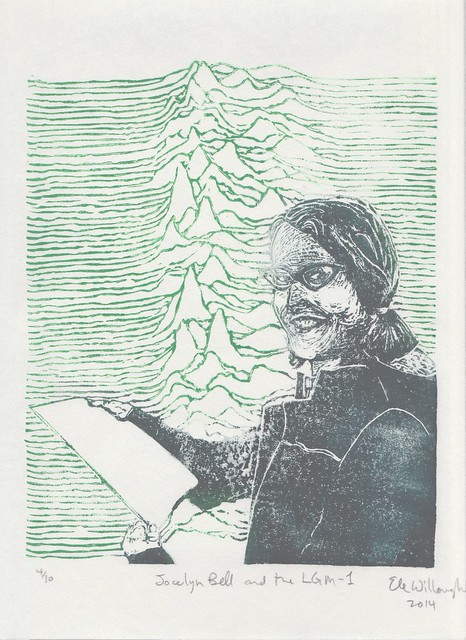
Jocelyn Bell Burnell and the LGM-1

Jocelyn Bell and the LGM-1
Jocelyn Bell and the LGM-1, linocut portrait by Ele Willoughby 2014

Happy birthday to astrophysicist Jocelyn Bell Burrell (born, 1943), who discovered pulsars! As I wrote previously:

In November, 1967, Jocelyn Bell (Burnell) was just a graduate student when she discovered the first radio pulsar (or pulsating star), a highly magnetized, rotating neutron star that emits a beam of electromagnetic radiation. This radiation (light in the radio frequency band) can only be observed when the star is point towards us; so, like the light from a distant lighthouse, it appears to pulse at a precise frequency. She had been working with her supervisor Antony Hewish and others to construct a radio telescope to study quasars (quasi-stellar objects which emit radio waves). She noted some "scruff" on her chart-recorder, and then that the pulses were incredibly regular, occurring every 1.337 seconds. Hewish was initially scornful and insisted the regular pulses must be noise from a human made source. He first dubbed this object, emitting with such regularity 'LGM 1' for "Little Green Men 1", a playful joke about their uncertainty about what could emit radiation so regularly - obviously it could only be a communication from extraterrestrials hahaha! Only after she found other such sources, in different places with different frequencies, were her colleagues convinced and this lead to the development of the pulsar model. It is now known PSR B1919+21.

The 1968 paper announcing this discovery in Nature has five authors, lead by Hewish, followed by Jocelyn Bell. In 1974, Hewish won the Nobel Prize for this discovery, along with fellow radioastronomer Marlin Ryle). Jocelyn Bell was not included as it was assumed that the "senior man" was responsible for the work. This was controversial and has been condemned by many leading astronomers like Fred Hoyle (who with Thomas Gold was first able to explain the signals as due to a rapidly rotating neutron star). Jocelyn Bell Burnell herself has stated she was not upset. Bell Burnell has a great on-going career and won many honours after her impressive start, but her exclusion from the Nobel win, based on her own research strikes me and many others as one of the more blatant and egregious examples of gender bias in the selection of Nobel prize recipients.

Read the full post about how her beautiful dataset itself has lead a life of its own as a cultural meme.

Monday, March 16, 2015

Caroline Herschel: Scientific Cinderella to Comet Sweeper

Caroline Herschel
Caroline Herschel, linocut by Ele Willoughby, 2014
Happy birthday Caroline Herschel! German-born Caroline Herschel (16 March 1750 – 9 January 1848), while overshadowed by her brother William (who discovered Uranus, amongst his other astronomical accomplishments), was a real pioneer as a woman in astronomy and made her own important contributions. In fact, she became the first salaried female scientist, when King George III hired her to assist her brother, at a time when there were few professional scientists anywhere. Hers was a real life sort of Cinderella story, where rather than marrying a prince, she made a life and career for herself. Marriage was the expected role for a woman of her time, but she was deemed unmarriageable, since a childhood bout of typhus stunted her growth. Her mother thought she should train to be a servant, and purposely stood in the way of her learning French, or music, to prevent her from seeking employment as a governess. She wanted a perpetual unpaid maid. Her father sometimes managed to include her in William's lessons when their mother was absent. William had fled to England after the Seven Years War and made a life as a musician and composer in Bath. William managed to rescue his younger sister from their mother's clutches, under the pretext that she might have the voice to be a solo singer in Handel's oratorios, as she too was a natural musician. Of course, he also wanted a woman to manage his bachelor household. Meanwhile, he developed a real passion for astronomy. So, by the time she arrived, all his spare time away from music was devoted to astronomy and she found that despite her singing talent, she was roped into assisting with the construction of telescopes, rather than receiving music lessons. By 1781, William had discovered a new planet - Uranus , which he cannily dubbed the 'Georgian Star' after King George III. This had the desired effect of securing himself a pension, so that he could spend his time on astronomy (so long as he would present it to the King when asked).

William and Caroline worked together at Slough, observing the night sky with a variety of telescopes. William built some very large telescopes and had Caroline take notes of what he observed, while she used smaller 'sweeper' telescopes to sweep the skies for interesting object. She discovered 11 nebulae (2 of which turned out to be galaxies) which were previously unknown! She also found 8 or 9 comets, as well as making and sharing observations of comets discovered by others. The portrait is based on a miniature of Caroline, as well as her own notes and diagrams from 1 August 1786, when she discovered her first comet, now known as Comet C/1786 P1 (Herschel). On the left, her sketches of the object "like a star out of focus" which she correctly identified as a comet, is at the centre of the three circular diagrams labelled I, II and III. On the right, her Fig I and Fig II show her observations the following night, noting the position of the comet relative to the constellations of Ursa Major and Coma Berenices.

She also independently re-discovered Comet Encke in 1795, first recorded by Pierre Méchain in 1786. Later, in 1819, her observations help Johann Franz Encke recognize it was a periodic comet, like Halley's comet. Encke was able to calculate its orbit, partially due to her observations. The comet shown behind Caroline is based on a recent photo of Comet Encke, which returns every 3 years.

In order to calculate orbits of newly discovered comets, it was important to let other astronomers know as soon as possible. The letter post was often not fast enough, if the weather turned cloudy. She discovered her 8th comet while her brother was away. So, she took matters into her own hands. After an hour's sleep, she saddled a horse, and road the roughly twenty-six miles to the Greenwich Observatory of the Astronomer Royal, Nevil Maskelyne, much to his astonishment.

One of her important impacts on astronomy was that her early success showed her brother how even an amateur using a small telescope could find previously unobserved nebulae, and hence that there was real value in making systematic sweeps of the night sky. Partnering together, with William sweeping the sky with his 20 foot telescope and Caroline taking notes by lamplight just inside the window, they went on to discover 2507 nebulae and clusters over two decades of work. Further, she acted as 'computer', doing the mathematical grunt work for her brother's observations. William's study completely revolutionized astronomy, and it couldn't have happened without Caroline's help.

They worked side by side nightly until 1788, when William married (at age 49). Caroline was no longer needed to run his household, and he offered her money as compensation. She, however, convinced him to request her own salary from the King, which she received. She moved to a cottage in the garden. She did a lot of her own observing for the next nine years (while William was otherwise occupied at nights), and gained more fame in her own right.

In 1797 the standard star catalogue used by astronomers was published by John Flamsteed. It was tough to use since it appeared in two volumes, with discrepancies. William suggested that a proper cross-reference would be a great help and a project for Caroline. She produced the resulting Catalogue of Stars, published by the Royal Society in 1798. It contained a index of all of Flamsteed's observed stars, all of the errors in his volumes and a further 560 additional stars.

When William died in 1822, she returned to Hanover, where she was born, but she continued her cataloguing and confirming of William's observations. Her catalogue of nebulae aided her nephew John Herschel in his astronomical work. The Royal Astronomical Society presented her with their Gold Medal in 1828 for this catalogue. She was the first woman to receive the honour (and remained the only woman until Vera Rubin in 1996).

She and Mary Sommerville were the first women admitted to the Royal Astronomical Society, when they were elected Honorary Members in 1835. In 1838 she was elected an honorary member of the Royal Irish Academy in Dublin. In 1846, at age 96 she also received a Gold Medal from the King of Prussia, for her astronomical work (presented by none other than Alexander von Humboldt). An asteroid and moon crater have been named in her honour.

You can find more in the great article  on Caroline Herschel by Micheal Hoskin AAS Comittee on the Status of Women site (to which this blog post is indebted), Caroline Herschel's wikipedia entry,  and the ROYAL ASTRONOMICAL SOCIETY/SCIENCE PHOTO LIBRARY entry on her notes.

Thursday, February 19, 2015

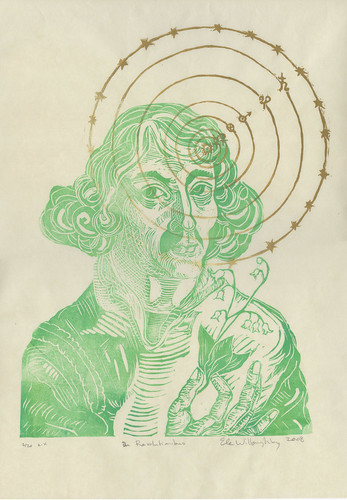
De Revolutionibus - a portrait of Copernicus & his heliocentric solar system

DeRevolutionibus1
De Revolutionibus, linocut, 2008, Ele Willoughby

To celebrate his birthday, here is my portrait Copernicus (19 February 1473 – 24 May 1543) and his model of the celestial spheres, or as we would say, the solar system. Copernicus is shown in green with a lily of the valley, the standard Renaissance symbol to indicate a medical doctor, since like most proto-scientists, or 'philosophers' (doctors of philosophy) he learned his astronomy incidentally, since astrology was considered a vital diagnostic tool for medicine. His planetary model is shown as he conceived it in gold. Using the ancient Greek and Roman symbols, the heliocentric solar system has the following planets: Mercury (the fleet-footed messenger with his serpents and staff, the caduceus), Venus (goddess of beauty - the mirror, like an ankh), Earth (4 cardinal directions), Mars (spear and shield), Jupiter (thunderbolt) and Saturn (the scythe of Time). The outer planets had yet to be discovered. Beyond Saturn, he envisioned the sphere of the "fixed stars".

Copernicus' great work, "De revolutionibus orbium coelestium libri sex" (or "Six Books on the Revolutions of the Heavenly Spheres"), commonly known as "De Revolutionibus" (or "On the Revolutions") was finally approved for publication as he lay on his death bed. Was this due to perfectionism, fears, or religious belief and the concerns that displacing the Earth from the centre of the universe might conflict with literal interpretations of the Bible? Perhaps we will never know. But we do know that as a consequence of the publication of this provocative volume, the Western world experienced what is now known as the Copernican Revolution. This is a landmark in the history of science and culture.
The story of precisely how De Revolutionibus entered Western culture is told in Owen Gringrich's The Book Nobody Read (see sci & lit), which details the census he made of existing first and second editions of Copernicus' famous posthumous work, how he went about this and what he learned. There are at least 600 existing copies of the 1st and 2nd edition. There is plenty of evidence of enthusiastic readings, rapid transfer of information about interpretations, as well as negative reactions, amongst a Renaissance who's who. I learned several things from this book including a convincing argument that the "epicycles upon epicycles" story is a myth (one does not need circles upon circles to be added to the Ptolemaic geocentric planetary system model to predict "retrograde" motion) and contemporaries of Copernicus were often more excited about the details of the math and getting rid of the Ptolemaic equant than they were about the idea that we could live on a moving planet in a sun-centred solar system (bizarre to the modern reader)! Also interesting, is that Eames, of mid-century designer-chair fame (amongst other things), took many of the photographs in the book (The Book Nobody Read), having been hired to design IBM's display in honour of the 500 year anniversary of Copernicus' birth.

Wednesday, January 21, 2015

Making Invisible Fields Visible

Illustration showing movement of air through various rooms,
from Lectures on Ventilation (1869) by Lewis W. Leeds.
Image via Wikimedia Commons.
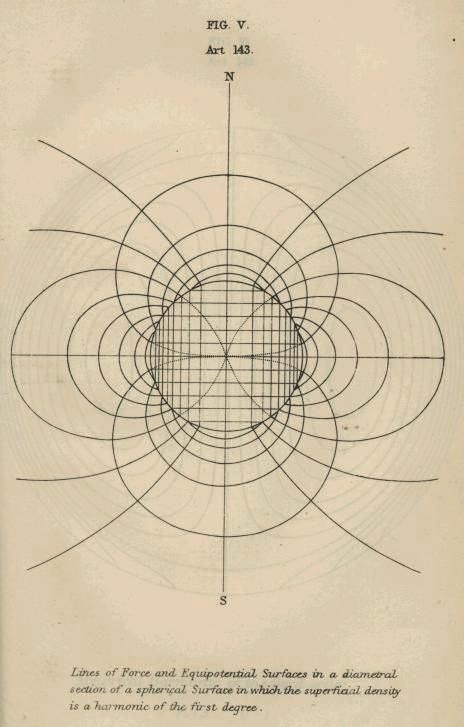
I used to teach physics to arts students and geophysics to environment science students. One of the mathematical concepts which was a challenge to convey was that of the field. In broad terms, it's rather simple really. A field is simply something which is defined at all points in space. A temperature field in a room is a scalar field; that means there is simply a value for temperature, a number you could measure, at any point (distance north from the corner, distance east from the corner and height off the floor) in the room. A vector field is the same thing, but at every point there is an amplitude and a direction. Add a fan or simply ventilation to the room and you can measure airflow at any point; this is a vector field. The illustration gives you an immediate sense of both the temperature and air flow field in a room - illustration as early data visualization.

Berenice Abbott (1898 - 1991) created brilliant
black and white science photographic illustrations like this one

Scifi loves the idea of a force field; this is a vector field descripting a force, like for instance, gravity, at all points in space. You can't see these fields; they are invisible - but they are (hopefully) easy to imagine. You may remember seeing a simple demonstration of magnetic field lines: iron fillings around a bar magnet, tracing out loops from pole to pole. Such a simple experiment is shown - complete with extra electrically conductive metal key - in Berenice Abbott's photo.


Our own Earth has a magnetic field of course, and it is really not that different from that of a bar magnet. Certainly, to first order as physicists say, you can imagine our earth with magnetic field lines from pole to pole tracing loops similar to those in the photo in a full three dimensions. The main complication to this picture is the sun, and way the solar wind intereacts with the Earth's magnetic field.

"Lines of Force and Equipotential Surfaces in a diametral section of a spherical Surface in which the superficial density is a harmonic of the first degree" from A Treatise on Electricity an Magnetism, James Clerk Maxwell, 1873


Schematic diagram of how the Sun interacts with the Earth's magnetic
field (curtesy of the USGS). The solar wind distorts the field basically
compacting the field in on the sunward side creating a bowshock and 
blowing a long 'magnetotail' outward on the night side of the Earth.
Geophysicists use the way these fields interact to probe our planet. We
can all enjoy the beauty of the auroras caused by this interaction. Solar 
storms can also interfer with radio communications, damage GPS and 
other satellites, and even cause electrical blackouts. 

I love the creative, eerie and entrancing take of Semiconductor (the duo of Ruth Jarman and Joe Gerhardt) take in their short film 'Magnetic Movie'. They let NASA space scientists talk about magnetic field lines, and then animate the Space Science Laboratories at UC Berkeley employing very low frequency radio audio recordings (3 Hz to 30 kHz) as an input for their animated embellishments. They are taking poetic license with reality, but somehow expressing more than we might, if we could literally reveal these invisible fields.


Magnetic Movie from Semiconductor on Vimeo.

They write,
The secret lives of invisible magnetic fields are revealed as chaotic ever-changing geometries . All action takes place around NASA's Space Sciences Laboratories, UC Berkeley, to recordings of space scientists describing their discoveries. Actual VLF audio recordings control the evolution of the fields as they delve into our inaudible surroundings, revealing recurrent ‘whistlers' produced by fleeting electrons . Are we observing a series of scientific experiments, the universe in flux, or a documentary of a fictional world?


Perhaps a little more literal, is another artistic work by Semiconductor, which strives to make the invisible geomagnetic field visible. In '20 Hz' they employ data gathered by CARISMA (the Canadian Array for Realtime Investigations of Magnetic Activity, the magnetometer element of the Geospace Observatory Canada project, operated by U of Alberta) of a geomagnetic storm in the Earth's upper atmosphere - data recorded at the frequency of 20 Hertz (of course). They 'play' the data as the audio track and use the data to generate the visuals.


20 Hz from Semiconductor on Vimeo.

They write,

20 Hz observes a geo-magnetic storm occurring in the Earth's upper atmosphere. Working with data collected from the CARISMA radio array and interpreted as audio, we hear tweeting and rumbles caused by incoming solar wind, captured at the frequency of 20 Hertz. Generated directly by the sound, tangible and sculptural forms emerge suggestive of scientific visualisations. As different frequencies interact both visually and aurally, complex patterns emerge to create interference phenomena that probe the limits of our perception.

LinkWithin

Related Posts with Thumbnails