Showing posts with label wunderkammer. Show all posts

Friday, May 12, 2017

WUNDERKAMMER: The Cabinet of Curiosity Show


I'm very excited to have curated the Toronto Etsy Street Team Gallery's first group art show, WUNDERKAMMER: The Cabinet of Curiosities from May 11 to 28. This art - or science art - show, is inspired by the Wunderkammer or Cabinet of Curiosity, the immense, eccentric, encyclopedic natural history collections gathered by collectors since the Renaissance. Cabinets of Curiosities featured treasured zoological, botanical, anatomical, fossil and gem specimen, collected by early citizen scientists. WUNDERKAMMER features original sculptures, drawings, hand-bound books, prints, paintings, printmaking, ceramics, jewellery, generative and multimedia specimen of natural and unnatural history on all scales, from the microscopic to the macroscopic. We are featuring the work of local artists (myself included):


István Aggott Hönsch

Erin Candela
Gavin Canning

Andrée Chénier
Carolyn Eady

Leslie Fruman
Monika Millar

Heather Ibbott
Colleen Manestar

Peggy Muddles
Teodora Opris

Christine Strait-Gardner
Tosca Teran

Rovena Tey
Lauren Vartanian

Ele Willoughby


Explore our curiousity cabinet of wildlife biology, mathematics, chemistry, mycology, micro and cellular biology, marine biology, entomology, botany, and fantastical lifeforms through the lens of art.

Join us Saturday, May 13, 6:00 pm to 10:00 for our Opening! FOLLOW THE LINK TO RSVP

Monday, February 16, 2015

Ernst Haeckel & Artforms in Nature

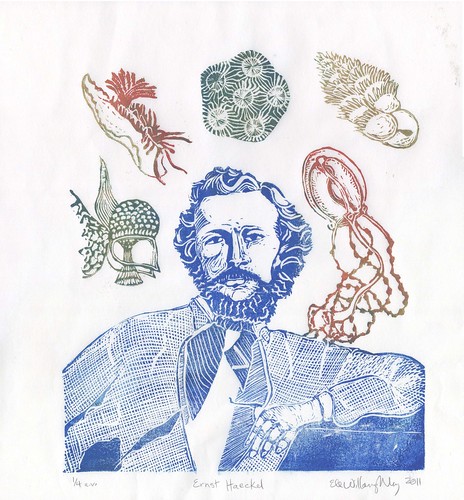
Ernst Haeckel portrait
Ernst Haeckel, linocut on kozo, 30.5 cm by 30.5 cm, 2011, by Ele Willoughby


Ernst Haeckel's Artforms in Naure, 1904 can be viewed here
Biologist, naturalist, and scientific illustrator par excellence Ernst Heinrich Philipp August Haeckel (February 16, 1834 – August 9, 1919), and his beautiful and well-known Artforms in Nature can be credited for the fact that people who are not say, marine microbiologists or geostratigraphers or their colleagues, know and are inspired by the extraordinary forms of radiolarians (as I've written about before), or are familiar with any number of exotic marine invertebrates.  Here we have the man himself, surrounded by several of the creatures he depicted. Clockwise from the top we have: rugosa, a foraminifer (or foram), a tubularid hydroid, homo sapiens (Ernst Haeckel), a dinoflagelate, and a sea slug or nudibranch. His was a form of descriptive science, where his art, his depictions of lifeforms was science, or his science was art. As such, he can be seen as a sort of culmination of centuries of work of his predecessors, gathering their cabinets of curiosity, their wunderkammer of creatures, driven almost as much by aesthetics as by exploration of the biosphere. You can trace this sort of scientific collecting from luminaries of the scientific revolution like Robert Hooke who gathered microscopic wunderkammer, and many others throughout the age of exploration, who travelled the world gathering specimen through to the Victorians whose obsession with cabinets of curiosity has been explained as an indication in fact of a morbid fear of death (in Olalquiaga's The Artificial Kingdom: A Treasury Of The Kitsch Experience).

His particular presentation of life*, which highlights the inherent patterns and beauty, has long been an influence on artists (myself included). Consider the rococco jellyfish chandeliers of Timothy Horn, a hommage to Haeckel's drawings. Haeckel's influence can also be seen in the surreal and imaginary zoological and botanical style drawings of Katie Scott, or the entire otherworldly visual encyclopedia in an alien language Codex Seraphinianus by Luigi Serafini. You can compare his drawings with the glass sculptures of the near contemporary Blaschka father and son, who created fabulous menageries filled with marine invertebrates as well as other creatures and botanicals and whose work likewise straddles art and science and their fertile intersection. His work lead to the incorporation of forms from nature finding their way into everything from furniture to architecture, as well as the more obvious influence on fine art and scientific illustration.

*Sadly, his deep appreciation of life in its many forms did not translate into an enlightened view of his own species. While he did make contributions to evolutionary biology, and was a great popularizer of Darwin's work in Germany, he also used a confused hodgepodge of Darwinian and Lamarkian ideas and far more speculation than a we would consider reasonable in a modern scientific sense. Some of his discredited scientific ideas were in vogue during his lifetime, and his errors should be considered within context. Most disappointing however, were his wrong-headed and repugnant social Darwinist ideas about race and his evolutionary racism which have been linked to the rise of Fascism. I've long enjoyed his extraordinary art/science and was saddened to read that he harboured such ideas, but I think it's important to avoid lionizing people, for instance for their artistic or scientific ideas, and to acknowledge their failings as well as achievements. I can admire his scientific illustration and tireless zoological investigations but still repudiate his ideas about human evolution.

Tuesday, June 3, 2014

Transparent Still Life

Physicist Arie van 't Riet specializes in radiation physics, and very low energy x-rays in particular. He began making artwork employing x-ray nature photographs, where radiography intersects fine art. His colourized x-ray photos of bioramas are a sort of see-through wunderkammer. He creates entire scenes in x-ray form. It makes me think of how the natural world might look if my eyes could see in x-ray wavelengths (or those back-of-the-comic-book x-ray specs really worked).

  Arie van 't Riet

Cameleon, begonia, Arie van 't Riet

Barn owl, Arie van 't Riet

Arie van 't Riet

frog, Arie van 't Riet

Arie van 't Riet
Arie & Hans van't Riet

 As a printmaker, I also appreciate how he's worked with Hans van 't Riet to produce Toboyo prints, or photo-polymer etchings, using UV light to transfer the x-rays to a plate which was inked and hand-printed. There's something poetic about using one non-visible wavelength to photograph right through lifeforms and show their structure, and then use another non-visible wavelength to bite an etching plate and print onto paper- combining the high tech with the centuries-old artistic medium.


Transparent flowers, revealing their skeletal structures, are also the subject of  architecture-student-turned-artist Macoto Murayama's work, but his is a very different medium. He uses computer graphics, 3dsMAX software usually employed in architecture (or animation), to model and then Photoshop and Illustrator depict the anatomy of flowers. It's like a specialized form of scientific illustration, as he bases his images on his own careful dissection of flowers
Chrysanthemum, Macoto Murayama
Rose, Macoto Murayama

Yoshino cherry, Macoto Murayama

Chrysanthemum, Macoto Murayama

Satsuki azalea, Macoto Murayama

(via the scientist)


Thursday, September 12, 2013

more magpie&whiskeyjack

Mark Twain participating in an experiment
in Tesla's laboratory. 
Century Magazine, April 1895. Source: peswiki.com


The magpie and the whiskeyjack are two members of the crow family, who have a reputation for gathering sparkly goodies (the magpie) and being a trickster (the whiskeyjack). This blog is a record of things I've found which intrigue me and things I find beautiful. Most of the posts are tagged art about science and focus on the fertile intersection between them. You can find all the posts about art about science using tags, but I've also added some new categories to help you find what you seek.

image via Brainpickings

sci&lit

On the the sci&lit page you'll find all the magpie&whiskeyjack posts about books about science or the intersection of science and literature. I've also included minouette book reviews of books with an underlying scientific theme; these include everything from popularization of science, history of science, to novels inspired by science, scientists and that fertile art/science intersection. I am (usually) an avid reader and have made it a habit to write reviews on various blogs over several years now, so I thought I may as well consolidate the dozens of reviews related in some way to science. Some reviews are concise, some long and opinionated.


wunderkammer

The wunderkammer section falls naturally out of gathering all these wonderous art about science items. I have been gathering large collections of these items for a long time, and am always adding more. The wunderkammer is a place to find items you can add to your own collections.


minouette

I've also added a couple of pages to make me a little less anonymous and to make my various sites a little more interconnected. You can find my personal blog at minouette (see the minouette blog tab or button) and my shop and other places you can find things from secret minouette places on the minouette shop tab or button above.

Tuesday, January 29, 2013

Naturalia & Mirabilia

French textile artist Lyndie Dourthe creates what she calls 'Naturalia & Mirabilia' - both marvels and natural history in her miniature cabinet of curiosity. She describes how in her secret laboratory she creates jewelry, soft sculpture and installations with a hint of botany, voodoo, anatomy, and superstition. Like any naturalist, she sorts, labels and boxes her specimens and treasures. Her jewelry also serve as childlike talismans.

Lyndie Dourthe - Source: lyndiedourthe.monsite-orange.fr


Lyndie Dourthe - Source: lyndiedourthe.monsite-orange.fr via minouette


Lyndie Dourthe - Source: lyndiedourthe.monsite-orange.fr via minouette


Lyndie Dourthe - Source: lyndiedourthe.monsite-orange.fr via minouette


Lyndie Dourthe -Source: lyndiedourthe.monsite-orange.fr via minouette


Lyndie Dourthe -Source: lyndiedourthe.monsite-orange.fr via minouette


I've long admired her work and can't imagine why I haven't written about her before! Check out her portfolio, blog, and shop.

Tuesday, September 4, 2012

Where entomology meets fashion

French photographer and graphic artist Laurent Seroussi has created a fascinating series of personal works entitled  Insectes combining photos of women (with a rather high fashion aesthetic) and anthropods, including scarab beetles, a leaf insect, a scolopendra centipede, a member of Heteroptera (the "true bugs"), and more. The melding of the women with the insects (and other anthropods) is quite seemless, creating beautiful, contemporary composite creatures, like a modern twist on images of fairies. I find the beautiful images have the intriguing effect of humanizing the 'bugs' rather than making the women into creatures.

Scarabée Chinois

Punaise

Scarab

Scolopandre

Phasme

He has an extensive portfolio of photographic and video work, including the more editorial place where jewellery design meets botany.

jvdarcy on pinterest
 

Wednesday, June 13, 2012

Ceramic Might-Have-Beens

British ceramicist Sophie Woodrow knows that the Victorian fascination with nature (though it was firmly defined as 'other' than human), collecting and romanticizing nature in a way which was ultimately kitsch is a great place to seek ideas and inspiration. Though most Victorian science was of the 'descriptive' sort, I know I find their romantic and sometimes heroic collecting an inspiration myself; it is definitely a class of activity at the fertile intersection of art and science, like the building of wunderkammers (Cabinets of Curiosity), gathering everything from rocks, to ferns, to fossils, to exotic animal species from around the world. I love how she describes the Victorian "enormous misinterpretations of geological evidence" (particularly of biological evolution) as "a game of Chinese whispers1 played over millennia". She's been inspired by natural history, and our changing ideas about evolution, to create a growing collection of ceramic "might-have-beens". This makes me think of the Rhinogrades, the wonderous "might-have-evolved" creatures of Harald Stümpke [Gerolf Steiner]. Her imaginary-animal pots are likewise truly wonderful.

 
Bear (41 cm height)


Totem (39 cm height)

 
 Little Owl


 Crowd Scene

Here she speaks about her process:
 

 Be sure to check out both her recent work and archive!

Lou Lou & Oscar

 1 "Chinese whispers" is the British name for what North Americans call the game of "broken telephone" where a message passed by whispers from person to person, mutating as it travels along.

Tuesday, February 7, 2012

Jellyfish Chandelier

Lately, I've been all about bioluminescent comb jellies, so discovering the work of Czech student (!) Kateřina Smolíková I was immediately struck. She isn't the first to find inspiration for lighting in the diaphonous and often luminous beauties of the deep, but her Skyphos chandelier is so crisp and modern, it's like nothing else I've seen.


There is plenty to explore in her portfolio (via architizer).

If you prefer your jellyfish lighting with more fluid, organic and flexible lines, check out these plastic discomedusa lights by Roxy Towry-Russell:


French sculptor Géraldine Gonzalez has some really beautiful medusas too, some of which involve crystals and LEDs and others of paper.


Do not forget the anotomically correct and beautifully rococo glass work of the previously-blogged Timothy Horn.

Wednesday, February 1, 2012

Quilling Anatomy


Head and Torso
2010
mulberry paper
9 x 13 x 1 inches


Artist Lisa Nilsson combines the Mideval art of paper quilling and modern antomical science in her incredibly detailed (and accurate) assemblages. Using long strips of Japanese kozo, or mulberry paper, and strips of gilded book pages, she uses a variety of tools to curl pages into the right shapes to represent all the tissues in our bodies. I know that kozo is wonderfully strong, but it also comes in a large variety of colours, which makes it a versitile medium. She says she was inspired to start using quilling as a technique after finding a reliquary; the earliest quiller were nuns who started using the gilded edges of bibles as a creative medium.


Female Torso
2010
paper
9 x 10 x 3/4 inches


Thorax
2011
paper
21 1/2 x 12 1/2 x 1 1/2 inches


Abdomen
2011
paper
15 x 12 1/2 x 1 1/2 inches


The detailed photos give you a sense of the meticulous work involved.


Profile (detail)
2011
paper
A detail of "Profile" showing the sinuses, front teeth and tongue.


Head II (detail)
2011
A detail of "Head II" showing a cross section of the brain.

She explains that she uses gilded paper to tie her work to religious reliquaries and a little less to scientific specimen, but I cannot help but see this work also as beautiful and creative medical illustration.

Be sure to check out her other work in her portfolio.

Also, for another take on quilling human anatomy, check out the work of Sarah Yakawonis.

(via Craft, all things paper and artsake)

LinkWithin

Related Posts with Thumbnails