Showing posts with label art about biology. Show all posts

Thursday, January 27, 2022

Lichen Love

Lichen is a strange and beautiful life form, or rather a mutualistic relationship between algae or Cyanobacteria and fungi to make a composite organism. They have different shapes, sizes, parts, colours and somehow have properties which differ from those of their component parts. Like plants they photosynthesize, but they have no roots. I recall learning as a child how they were the trailblazers, making their home on the rocks of the Canadian Shield, and allowing a succession of other organisms to grow on top, till we have large trees which appear to grow straight out of the rock, but without lichen it could not be there. When lichen grows on trees it is not a parasite, it just uses plants as a surface on which to grow. They grow in a huge range of environments, even tundra, deserts, mountains and rainforests on virtually any convenient surface. Scientists estimate 6 to 8% of the Earth's land surface is covered by lichen, and yet we can walk right by without giving it a second thought.

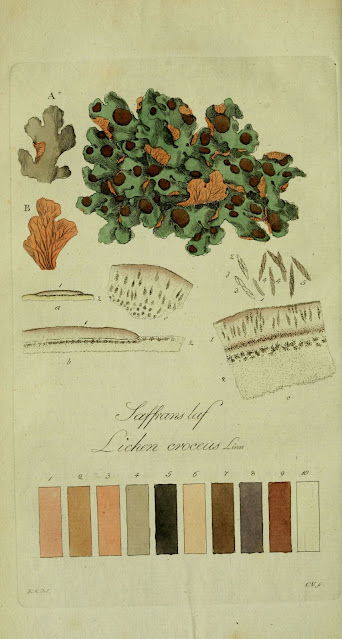
Some though, have long admired lichen, especially its extraordinary colour palette and variety of textures and forms. This is a selection of the colour charts based on lichen from the Svensk Lafvarnas Farghistoria by Johan Peter Westring. Printed in 1805-09. Via the Biodiversity Heritage Library archive. 

Svenska lafvarnas färghistoria Stockholm :Tryckt hos C. Delén,1805-[1809]


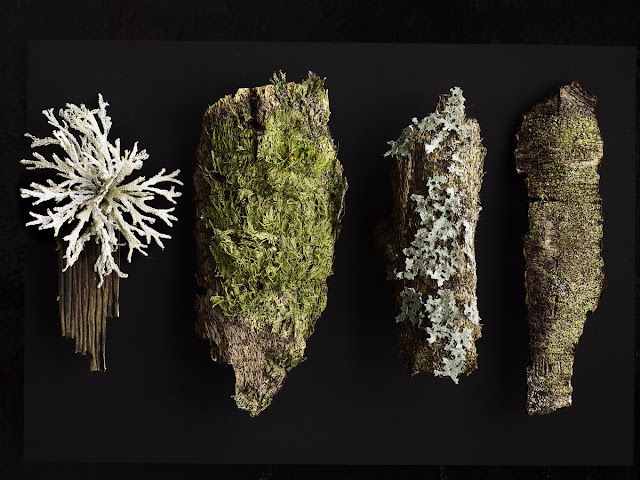
One of my favourite lichen artists is Dr. Immy Smith (website, Etsy, Patreon). They make a wide variety of artwork, much of it about natural history, or drawing on their background in neuroscience, but clearly they love lichen and have observed it very closely.
'Lichen makes the landscape' - Immy Smith with Herbarium RNG curators

They collaborated on the 'Symbiosis' project as part of the part of the Imagining Science Polymathic Art & Science Collaborative, with fellow member Scott Mantooth and other artists, scientists and the University of Reading Herbarium and EM Lab (Centre for Advanced Microscopy). Other drawings illustrate scanning electron microscope images of lichen. You can read more here.

'Reading campus twig' - Immy Smith with Herbarium RNG curators


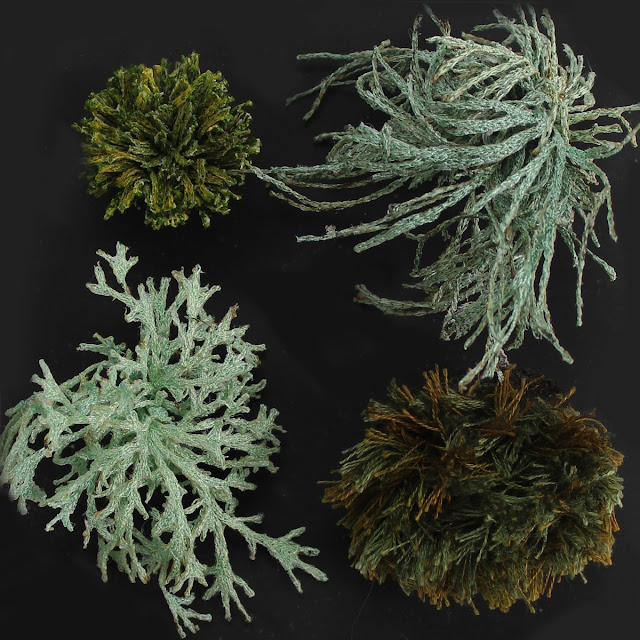
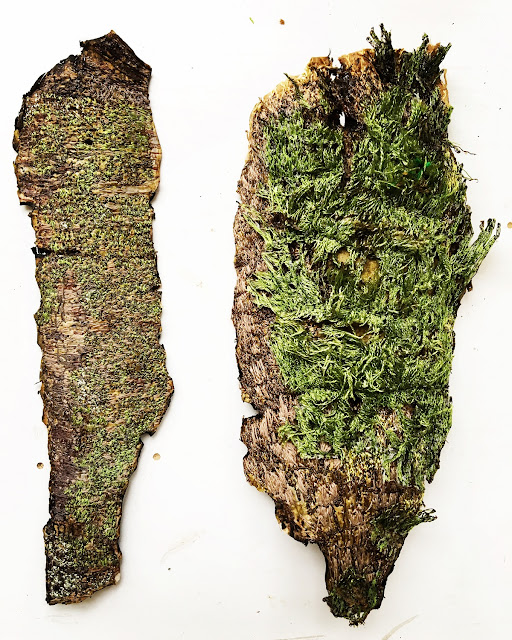
UK textile artist Amanda Cobett makes papier maché and machine embroidered sculptures, often fungi and extraordinarily life-like lichen.

Amanda Corbett lichen

Amanda : Moss and Lichen TQ 085 439, 2018, Built up layers of free machine embroidery (Photo credit, Fraser James)

Amanda Cobbett: Moss, bark and Lichen detail TQ 085 44, 2018, Built up layers of free machine embroidery, materials used; paper, silk, thread, dye, backing cloth, (Photo credit, Fraser James)


Artist and researcher Sarah Hearn makes artworks inspired by biology. She has made several lichen-inspired series of artworks. 

Sarah Hearn, Artificial Lichen Colony #8

10" x 15" cut photographs and watercolor, 2015


Sarah Hearn, Artificial Lichen Colony Collage #5

42" x 24" cut photographs, watercolor and graphite, 2016 (private commission)


Sarah Hearn, Artificial Lichen Colony #6

15" x 10" cut photographs and watercolor, 2016


There are whole worlds to contemplate in these extraordinary things if only we stop to look.


Thursday, June 3, 2021

Owl, Pussycat, Scientific Illustration and Other Nonsense by Edward Lear


owl illustration by Edward Lear


Edward Lear's illustration of a cat, Private collection promised to the Ashmolean Museum


The Owl and the Pussy-cat went to sea 

In a beautiful pea-green boat, 

They took some honey, and plenty of money, 

Wrapped up in a five-pound note. 

The Owl looked up to the stars above, 

And sang to a small guitar, 

‘O lovely Pussy! O Pussy, my love, 

What a beautiful Pussy you are, 

You are, 

You are! 

What a beautiful Pussy you are!’

The Owl and the Pussycat by Edward Lear

illustration of a lioness by Edward Lear


Poet Edward Lear (1812–1888), remembered affectionately for his delightful nonsense poems like 'The Owl and the Pussycat' or 'The Jumblies' is less well remembered for his exceptional, carefully observed scientific illustration but he was a talented and sought-after natural historian and illustrator. He believed in working from life, if not in the field, at least observing animals in zoos and menageries, rather than basing drawings of flora and fauna on museum collections of dead animals. He wrote “I am never pleased with a drawing unless I make it from life,” in 1831. He befriended zookepers to gain access and make measurements of animals; his work was praised by Charles Darwin and John James Audubon. He apprenticed with scientist Prideaux Selby, gaining confidence in his bird illustraions. His work shows a real understanding of how animals move and their 'personalities'which can be missing from work produced from drawing dead specimen. His first publication was a book about parrots, Illustrations of the Family Psittacidae or Parrots, published when he was only 19. It was the first book published about a family of birds. Then he worked for scientific illustrators John and Elizabeth Gould, helping him illustrate the birds of Europe and her illustrate birds for Darwin’s Zoology of the Voyage of H.M.S. Beagle, as well as producing illustrations for William Buckland, Thomas Bell, and William Jardine. His careful observation and illustrations lead Lear to identify several new species and several are named after him like Lear's macaw (Anodorhynchus leari), a large blue Brazilian parrot.

Culminated Toucan, Ramphastos culminatus (mid 1830s).
Plate 1 in Lear's Monograph of the Family of Toucans.

 
A Stanley parakeet, one of 42 plates in Edward Lear's Illustrations of the Family of Psittacidae, or Parrots. Biodiversity Heritage Library/CC BY 2.0

His nonsense poems came after, and in a sense, out of his scientific illustration. He was commissioned to illustrate the collection of parots in the menagerie of naturalist Edward Smith-Stanley, the 13th Earl of Derby at his home Knowsley Hall near Liverpool. He was treated like the help, and ate with the servants in the basement, but became a great hit with Lord Derby's grandchildren and began entertaining them with cartoons and limericks and this was how he began creating work for children. The Earl began inviting him to eat upstairs with guests and other nobles. He meanwhile gained a real reputation for his painting and even became the personal drawing instructor to Queen Victoria. So when he first began published Book of Nonsense, in 1846, he used a pen name to avoid tarnishing his reputation as a serious painter and scientific illustrator. He revealed his name only after his poems became a great success, a great surprise to him. This was a great boon to him as his ailing health and eyesight meant he could no longer work as a zoological draughtsman, and this new success came when he really needed it.

His scientific illustration and nonsense come together delightfully in his “Nonsense Botany” series, like this Piggiwiggia Pyramidalis! (Image courtesy of Houghton Library, Harvard University. MS Eng 797.1 [20])

Edward Lear's Cockatooca Superba from the Nonsense Botany series

Edward Lear's Crabbia Horrida from the Nonsense Botany series


References

Beth Marie Mole, Poetry and Pictures, circa 1830, The Scientist, November 2012.

GrrlScientist, Edward Lear featured at the Royal Society, The Guardian blog site, 2016 

Donna Ferguson, How Edward Lear's artistic genius led to the Owl and the Pussycat, The Guardian, Sunday, 31 January, 2021. 

Anna Lena Phillips, Serious Nonsense, American Scientist,.com

'Edward Lear', illusrtaion History resource from the Norman Rockwell Museum


Art, Nonsense and Science, The Biologist 64(6) p24-27

Friday, May 12, 2017

WUNDERKAMMER: The Cabinet of Curiosity Show


I'm very excited to have curated the Toronto Etsy Street Team Gallery's first group art show, WUNDERKAMMER: The Cabinet of Curiosities from May 11 to 28. This art - or science art - show, is inspired by the Wunderkammer or Cabinet of Curiosity, the immense, eccentric, encyclopedic natural history collections gathered by collectors since the Renaissance. Cabinets of Curiosities featured treasured zoological, botanical, anatomical, fossil and gem specimen, collected by early citizen scientists. WUNDERKAMMER features original sculptures, drawings, hand-bound books, prints, paintings, printmaking, ceramics, jewellery, generative and multimedia specimen of natural and unnatural history on all scales, from the microscopic to the macroscopic. We are featuring the work of local artists (myself included):


István Aggott Hönsch

Erin Candela
Gavin Canning

Andrée Chénier
Carolyn Eady

Leslie Fruman
Monika Millar

Heather Ibbott
Colleen Manestar

Peggy Muddles
Teodora Opris

Christine Strait-Gardner
Tosca Teran

Rovena Tey
Lauren Vartanian

Ele Willoughby


Explore our curiousity cabinet of wildlife biology, mathematics, chemistry, mycology, micro and cellular biology, marine biology, entomology, botany, and fantastical lifeforms through the lens of art.

Join us Saturday, May 13, 6:00 pm to 10:00 for our Opening! FOLLOW THE LINK TO RSVP

Saturday, January 31, 2015

Taking Inspiration from Animal Architecture

Beaver architecture - artwork by Jan Sovaki
There are some extraordinary architects amongst the animal kingdom. Our fellow mammals include many a burrow-digger or nest builder. The beaver is somewhat notorious for his ability to shape an entire landscape, redirect rivers, create lakes with dams and harvest and employ large numbers of trees. The beaver lodge is also extraordinary; a dry and cozy space with only underwater entrances.

The birds, of course, are the nest-builders par excellence, from little round, mud swallow's nests to giant flat eagle's aeries. One of the most handsome and amazing sort of nest are those woven by the weaver birds. For instance, in southest asia the Baya weaver's hanging woven nests, which are can be individual or in large colonies, are suspended often from thorny palm or acacias to make them inaccessible to predators. Southern Africa's sociable weaver builds huge, communal, multigenerational complexes. My favorite is the bowerbird; the males build bowers to attract the females and decorate them with coloured objects they find or pilfer. I was introduced to the bowerbird by David Attenborough's wonderful description.

Baya weaver photo by Ramnath Bhat
Sociable weaver nest photo by Linda De Volder
Vogelkop gardener bowerbird bower, photographed by Ingo Arndt for his recent book 'Animal Architecture', with text by Jürgen Tautz


Porky Hefer and one of his nest woven with kubu cane (via the NYT)
Such beautiful, organic nests have inspired human copycats to make some very whimsical achitectural spaces, with little more than the branches and vegetation employed by animals. Consider the high-end nests built by South African advertising-creative-director-turned-nest-maker Porky Hefer, who is inspired by weaver birds. Biomimickery in tree houses and even additions to homes!
You can get Porky Hefer's firm Animal Farm
to build you an extention on your home!
(image © Animal Farm)


Jason Fann builds nests for people as extensions on homes, and even the Treebones Resort, where you can spend a night one of his nests.
Jason Fann builds nests from tree branches from mainly eucalyptus trees in forests local to him in Big Sur, California. He weaves them together (with some counter-sunk screws to hold the structure) and builds spaces large enough for say, eight people to sit, or a couple to sleep - including in the Treebones Resort, a sort of treehouse nest hotel.


Philip Dougherty makes sculptural works directly from living trees. They allude to nests and other examples of animal architecture, as well as human activities like basketmaking. He too weaves branches and twigs together.

Philip Dougherty works directly with living trees to make works of architectural sculpture (via webecoist)

The Great Swallow by Benjamin Verdonck
The Great Swallow, a 2008 Rotterdam performance piece and sculptural human-sized swallow's nest by Benjamin Verdonck, takes biomimickery of nests to astounding and perhaps absurb heights.


LinkWithin

Related Posts with Thumbnails