Showing posts with label fibre art. Show all posts

Tuesday, June 25, 2013

Fibre Art Specimens

Sometimes the artifacts of science are beautiful in and of themselves. This is of course true of most biological specimens, as lifeforms themselves are beautiful. Thus you do see them recreated in various media. Today I bring you textile art specimens. Be sure to also see previous magpie & whiskeyjack posts Naturalia & Mirabilia on the art of Lyndie Dourthe, Barnacles which includes crocheted marine creatures like the Hyperbolic Crochet Coral Reef, Felt & Food Geology about the photos of Eszter Burghardt, and Doily Science on Lisa Solomon's anatomical and chemical doilies.

Laura Splan's microbial doilies "explores the 'domestication' of microbial and biomedical imagery. Many recent events, epidemics, and commercial products have brought this imagery into our living rooms, kitchens, and bathrooms," by employing this old-fashioned, domestic medium.


all by Laura Splan, 2004
freestanding computerized machine embroidered lace mounted on velvet
16.75H x 16.75W inches each (framed dimensions)
(via she walks softly)

Her 2002 'Vigilant' show also featured hand latch-hooked yarn on stretched latch-hook canvas images of petri dishes of various microbes.


Laura Splan, Vigilant, 2002, hand latch-hooked yarn on stretched latch-hook canvas, 120H x 204W inches (installation dimensions variable)

I've mentioned Australian artist Helle Jorgensen previously (for her crocheted Barnacles) but her plastic crochet sea creatures are worth exploring again.

Helle Jorgensen, 'Diploria'

Helle Jorgensen, 'Medusa'

Helle Jorgensen, 'The Retail Reef'

Laura Katherine McMillan's fibre art Petri dishes are quite lovely.

Laura Katherine McMillan, Cell series

Jessica Polka has made some wonderful fibre art specimens, from sea creatures to mushrooms (and she sells crochet patterns through her Etsy shop, which she describes as a wunderkammer, much to my delight).


Jessica Polka, chiton anatomy

Jessica Polka, mollusk anatomy

Jessica Polka, scaphopod anatomy

(you should also check out her laser-cut Turing patterns and her blog in general!)

Aubrey Longley-Cook's embroidered animals include their skeletons. See more on his blog spool spectrum.

Aubrey Longley-Cook

Amongst other work, Andrea V. Uravitch has made small insects and bugs from embroidered and sewn fabric and wire.

Andrea V. Uravitch

Andrea V. Uravitch


Hiné Mizushima makes wonderful and whimsical needle felted sculptures, including a variety of biological specimen.
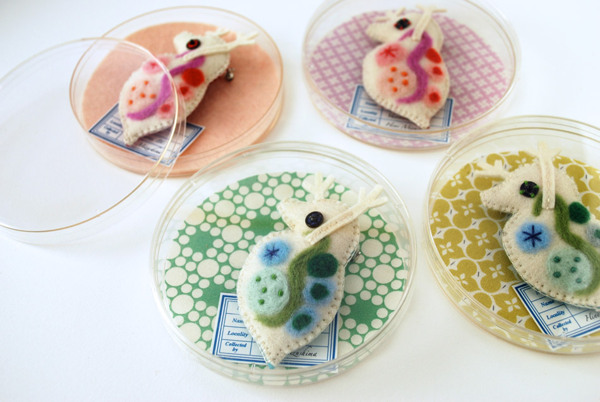

Hiné Mizushima, Giant Daphnia brooches

Hiné Mizushima


Friday, October 12, 2012

Butterflies are the new pirates

As a corollary to my insects in art posts, I note that an entire post could easily be devoted to butterflies and moths in art - even if I limit this to artists not mentioned in previous butterfly posts. I believe that butterflies are the new pirates. They've become as ubiquitous as other memes (pirates, zombies, vampires, even if far less bloody). I confess, I've been trying to start my own meme with the phrase, "butterflies are the new pirates" as a sort of experiment (and thus far, had no luck). It nonetheless amuses me, hence, the title. But, enough of that. On with the butterfly art!

Artist Louise Richardson often covers her fibre and sculptural art with moths and butterflies.

key of E flat
Key of E flat by Louise Richardson

spell bound
Spell bound by Louise Richardson

nettle
Nettle by Louise Richardson
( a billion taste and tunes)

Similarly, swarms of butterflies show up in the work of sculptor, painter, and animator, David Kracov.

Book of Life by David Kracov

Coca Cola Open Happiness by David Kracov

Indianapolis-based artist Tasha Lewis has made magnetized cyanotype butterflies - a brilliant solution for non-destructive, grafitti-like installations. She writes,
Each installation was spontaneously arranged on iron and steel structures in urban spaces. I find it important to insist that this project does not promote tampering with public sculpture. My butterflies are attached with very very small magnets and thus do not harm the metal of the found art. My goal is to create a very ephemeral public spectacle that toeing the line between subversive and lyrical.

There is much more art to be found in her portfolio.


 Magnetized Cyanotype Butterfly Installations by Tasha Lewis


 Magnetized Cyanotype Butterfly Installations by Tasha Lewis

 Magnetized Cyanotype Butterfly Installations by Tasha Lewis

( this is colossal)

Monday, April 11, 2011

Juxtaposition & Craftivism


german panther, 2007, Luftballon/Luft/Kleber (balloon/air/glou), 960 x370 x 300cm

A balloon tank by German-based Dutch artist Hans Hemmert (via Adapt)


Pink M.24 Chaffee
A tank wrapped in pink

Danish artist Marianne Jorgensen stitched together a pink cozy, knit and crocheted in a collection of three thousand 15 cm x 15 cm squares for a WWII tank as a protest against the involvement of Denmark (UK and US) in the war in Iraq, by volunteers in Europe and the US in 2006.


Barb Hunt
antipersonnel, 1998 and ongoing
approximately 50 knitted sculptures
Collection of the artist
©2001 Barb Hunt

Canadian artist Barb Hunt knit replicas of antipersonnel land mines in various shades of pink wool, inspired by protests againts land mines. While Marianne Jorgensen cites how knitting and pinkness allude to coziness and home, the antipathy of war, Barb Hunt relates knitting to caring for the body, bandages and hand-knit socks for soldiers abroad and thus to caring, recooperating and protection.


Barb Hunt
antipersonnel - detail landscape

I find Hunt's collection very moving; to ponder the sheer inventiveness of human evil in creating such an array of civilian-killing devices along with the irony of justaposition with the cuddly medium and feminine* pink colour.

The wikipedia entry for Craftivism includes instructions for knitting your own "purse grenade" from Political protest turns to the radical art of knitting by Charlotte Higgins published by The Guardian, Monday 31 January 2005.

*At least according to current colour-biases.

LinkWithin

Related Posts with Thumbnails