Thursday, February 19, 2015

De Revolutionibus - a portrait of Copernicus & his heliocentric solar system

DeRevolutionibus1
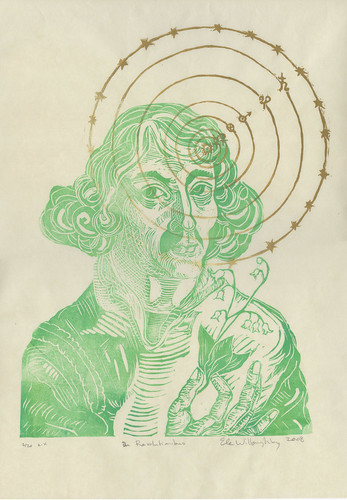
De Revolutionibus, linocut, 2008, Ele Willoughby

To celebrate his birthday, here is my portrait Copernicus (19 February 1473 – 24 May 1543) and his model of the celestial spheres, or as we would say, the solar system. Copernicus is shown in green with a lily of the valley, the standard Renaissance symbol to indicate a medical doctor, since like most proto-scientists, or 'philosophers' (doctors of philosophy) he learned his astronomy incidentally, since astrology was considered a vital diagnostic tool for medicine. His planetary model is shown as he conceived it in gold. Using the ancient Greek and Roman symbols, the heliocentric solar system has the following planets: Mercury (the fleet-footed messenger with his serpents and staff, the caduceus), Venus (goddess of beauty - the mirror, like an ankh), Earth (4 cardinal directions), Mars (spear and shield), Jupiter (thunderbolt) and Saturn (the scythe of Time). The outer planets had yet to be discovered. Beyond Saturn, he envisioned the sphere of the "fixed stars".

Copernicus' great work, "De revolutionibus orbium coelestium libri sex" (or "Six Books on the Revolutions of the Heavenly Spheres"), commonly known as "De Revolutionibus" (or "On the Revolutions") was finally approved for publication as he lay on his death bed. Was this due to perfectionism, fears, or religious belief and the concerns that displacing the Earth from the centre of the universe might conflict with literal interpretations of the Bible? Perhaps we will never know. But we do know that as a consequence of the publication of this provocative volume, the Western world experienced what is now known as the Copernican Revolution. This is a landmark in the history of science and culture.

The story of precisely how De Revolutionibus entered Western culture is told in Owen Gringrich's The Book Nobody Read (see sci & lit), which details the census he made of existing first and second editions of Copernicus' famous posthumous work, how he went about this and what he learned. There are at least 600 existing copies of the 1st and 2nd edition. There is plenty of evidence of enthusiastic readings, rapid transfer of information about interpretations, as well as negative reactions, amongst a Renaissance who's who. I learned several things from this book including a convincing argument that the "epicycles upon epicycles" story is a myth (one does not need circles upon circles to be added to the Ptolemaic geocentric planetary system model to predict "retrograde" motion) and contemporaries of Copernicus were often more excited about the details of the math and getting rid of the Ptolemaic equant than they were about the idea that we could live on a moving planet in a sun-centred solar system (bizarre to the modern reader)! Also interesting, is that Eames, of mid-century designer-chair fame (amongst other things), took many of the photographs in the book (The Book Nobody Read), having been hired to design IBM's display in honour of the 500 year anniversary of Copernicus' birth.

Monday, February 16, 2015

Ernst Haeckel & Artforms in Nature

Ernst Haeckel portrait
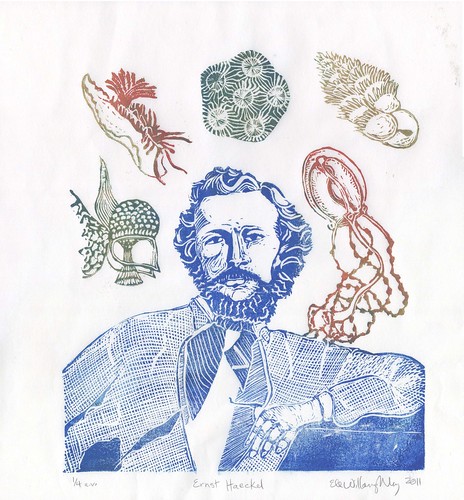
Ernst Haeckel, linocut on kozo, 30.5 cm by 30.5 cm, 2011, by Ele Willoughby


Ernst Haeckel's Artforms in Naure, 1904 can be viewed here
Biologist, naturalist, and scientific illustrator par excellence Ernst Heinrich Philipp August Haeckel (February 16, 1834 – August 9, 1919), and his beautiful and well-known Artforms in Nature can be credited for the fact that people who are not say, marine microbiologists or geostratigraphers or their colleagues, know and are inspired by the extraordinary forms of radiolarians (as I've written about before), or are familiar with any number of exotic marine invertebrates.  Here we have the man himself, surrounded by several of the creatures he depicted. Clockwise from the top we have: rugosa, a foraminifer (or foram), a tubularid hydroid, homo sapiens (Ernst Haeckel), a dinoflagelate, and a sea slug or nudibranch. His was a form of descriptive science, where his art, his depictions of lifeforms was science, or his science was art. As such, he can be seen as a sort of culmination of centuries of work of his predecessors, gathering their cabinets of curiosity, their wunderkammer of creatures, driven almost as much by aesthetics as by exploration of the biosphere. You can trace this sort of scientific collecting from luminaries of the scientific revolution like Robert Hooke who gathered microscopic wunderkammer, and many others throughout the age of exploration, who travelled the world gathering specimen through to the Victorians whose obsession with cabinets of curiosity has been explained as an indication in fact of a morbid fear of death (in Olalquiaga's The Artificial Kingdom: A Treasury Of The Kitsch Experience).

His particular presentation of life*, which highlights the inherent patterns and beauty, has long been an influence on artists (myself included). Consider the rococco jellyfish chandeliers of Timothy Horn, a hommage to Haeckel's drawings. Haeckel's influence can also be seen in the surreal and imaginary zoological and botanical style drawings of Katie Scott, or the entire otherworldly visual encyclopedia in an alien language Codex Seraphinianus by Luigi Serafini. You can compare his drawings with the glass sculptures of the near contemporary Blaschka father and son, who created fabulous menageries filled with marine invertebrates as well as other creatures and botanicals and whose work likewise straddles art and science and their fertile intersection. His work lead to the incorporation of forms from nature finding their way into everything from furniture to architecture, as well as the more obvious influence on fine art and scientific illustration.

*Sadly, his deep appreciation of life in its many forms did not translate into an enlightened view of his own species. While he did make contributions to evolutionary biology, and was a great popularizer of Darwin's work in Germany, he also used a confused hodgepodge of Darwinian and Lamarkian ideas and far more speculation than a we would consider reasonable in a modern scientific sense. Some of his discredited scientific ideas were in vogue during his lifetime, and his errors should be considered within context. Most disappointing however, were his wrong-headed and repugnant social Darwinist ideas about race and his evolutionary racism which have been linked to the rise of Fascism. I've long enjoyed his extraordinary art/science and was saddened to read that he harboured such ideas, but I think it's important to avoid lionizing people, for instance for their artistic or scientific ideas, and to acknowledge their failings as well as achievements. I can admire his scientific illustration and tireless zoological investigations but still repudiate his ideas about human evolution.

Saturday, February 14, 2015

Anatomical Valentines

My Heart Needs Your Breath - Isabelle Dalle, complete with lungs and heart
Happy Valentine's Day! As an antidote to the over-sweet sentiments of love we often see expressed in the name of St. Valentine (a matyred victim of torture, if he was one person, apparently), here are some more anatomically correct Valentines, or at least, Valentines and art inspired by anatomy and anatomical diagrams.

Collage artist Isabelle Dalle runs a virtual cabinet of curiosities, and creates anatomical collages which are also a sort of clever visual pun.


Heart and soul, by Isabelle Dalle

Collage artist Travis Bedel merges vintage anatomical drawing and other etchings from old science texts to create his exuborant works bursting with life. You can purchase prints of his work here. (via HonestlyWTF and Laughing Squid)


 Travis Bedel

 Travis Bedel

 Travis Bedel


Anatomical hearts come in other media too. From textiles,

Eat your heart out, crochet art by Kate Jenkins

le corps humain, (or "the human body") 15 cm x 15 cm embroideries by Cécile Dachary, 2011 
Hearts Crocheted satin cord, stainless steel 30x 30x 82 cm, by Sarah Maloney, 2000

to sculpture with beading,

Beaded heart by Jan Huling

to drawing

ai no toriko” (which means "slave for love") by Yuka Yamaguchi

to painting and pyrography, like the many hearts of Fay Helfer (via Street Anatomy).

Asparagus Heart pyrography, natural pigment and pastel on wood 10” x 22”, by Fay Helfer

Clover Heart pyrography, natural pigment and pastel on wood by Fay Helfer

Sea Fan Heart pyrography, natural pigment and pastel on wood 8” x 12” by Fay Helfer


Thursday, February 12, 2015

Riding on Galápagos: In Which Charles Darwin Sneaks Up on and Surfs Tortoises for Science

Darwin on Galapagos
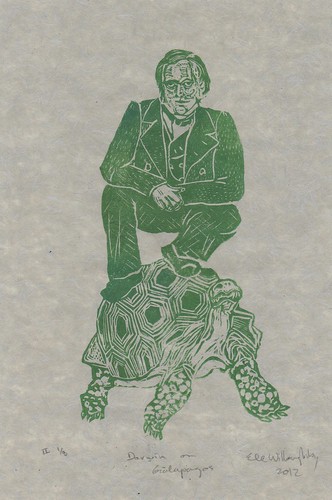
Darwin on Galapagos, linocut 17.8 cm x 26.7 cm, 2nd ed., 2012 by Ele Willoughby

"The inhabitants believe that these animals are absolutely deaf; certainly they do not overhear a person walking closely behind them. I was always amused, when overtaking one of these great monsters as it was quietly pacing along, to see how suddenly, the instant I passed, it would draw in its head and legs, and uttering a deep hiss fall to the ground with a heavy sound, as if struck dead. I frequently got on their backs, and then, upon giving a few raps on the hinder part of the shell, they would rise up and walk away; but I found it very difficult to keep my balance."

-Charles Darwin, 1835, Galápagos Islands

I initially carved this block to honour the 200th birthday of Charles Darwin. Today he would be celebrating his 206th. I depicted Darwin as a young man, during his famous voyage on the HMS Beagle and its stay in the Galápagos Islands. The giant tortoises which thrived on the islands, and the variations in species from island to island were instrumental to his thinking, when he later wrote "On the origin of species" which divulged his understanding of biological evolution. The cultural impact of "On the origin of species" is immense. Darwin built on the growing understanding that not only did life evolve, but that this could occur without some sort of supernatural control; he made the intellectual leap to argue that natural selection was all that was needed to explain the evolution of life on Earth. Yet somehow, Darwin failed to mention tortoise surfing in this great work.

Saturday, January 31, 2015

Taking Inspiration from Animal Architecture

Beaver architecture - artwork by Jan Sovaki
There are some extraordinary architects amongst the animal kingdom. Our fellow mammals include many a burrow-digger or nest builder. The beaver is somewhat notorious for his ability to shape an entire landscape, redirect rivers, create lakes with dams and harvest and employ large numbers of trees. The beaver lodge is also extraordinary; a dry and cozy space with only underwater entrances.

The birds, of course, are the nest-builders par excellence, from little round, mud swallow's nests to giant flat eagle's aeries. One of the most handsome and amazing sort of nest are those woven by the weaver birds. For instance, in southest asia the Baya weaver's hanging woven nests, which are can be individual or in large colonies, are suspended often from thorny palm or acacias to make them inaccessible to predators. Southern Africa's sociable weaver builds huge, communal, multigenerational complexes. My favorite is the bowerbird; the males build bowers to attract the females and decorate them with coloured objects they find or pilfer. I was introduced to the bowerbird by David Attenborough's wonderful description.

Baya weaver photo by Ramnath Bhat
Sociable weaver nest photo by Linda De Volder
Vogelkop gardener bowerbird bower, photographed by Ingo Arndt for his recent book 'Animal Architecture', with text by Jürgen Tautz


Porky Hefer and one of his nest woven with kubu cane (via the NYT)
Such beautiful, organic nests have inspired human copycats to make some very whimsical achitectural spaces, with little more than the branches and vegetation employed by animals. Consider the high-end nests built by South African advertising-creative-director-turned-nest-maker Porky Hefer, who is inspired by weaver birds. Biomimickery in tree houses and even additions to homes!
You can get Porky Hefer's firm Animal Farm
to build you an extention on your home!
(image © Animal Farm)


Jason Fann builds nests for people as extensions on homes, and even the Treebones Resort, where you can spend a night one of his nests.
Jason Fann builds nests from tree branches from mainly eucalyptus trees in forests local to him in Big Sur, California. He weaves them together (with some counter-sunk screws to hold the structure) and builds spaces large enough for say, eight people to sit, or a couple to sleep - including in the Treebones Resort, a sort of treehouse nest hotel.


Philip Dougherty makes sculptural works directly from living trees. They allude to nests and other examples of animal architecture, as well as human activities like basketmaking. He too weaves branches and twigs together.

Philip Dougherty works directly with living trees to make works of architectural sculpture (via webecoist)

The Great Swallow by Benjamin Verdonck
The Great Swallow, a 2008 Rotterdam performance piece and sculptural human-sized swallow's nest by Benjamin Verdonck, takes biomimickery of nests to astounding and perhaps absurb heights.


Wednesday, January 21, 2015

Making Invisible Fields Visible

Illustration showing movement of air through various rooms,
from Lectures on Ventilation (1869) by Lewis W. Leeds.
Image via Wikimedia Commons.
I used to teach physics to arts students and geophysics to environment science students. One of the mathematical concepts which was a challenge to convey was that of the field. In broad terms, it's rather simple really. A field is simply something which is defined at all points in space. A temperature field in a room is a scalar field; that means there is simply a value for temperature, a number you could measure, at any point (distance north from the corner, distance east from the corner and height off the floor) in the room. A vector field is the same thing, but at every point there is an amplitude and a direction. Add a fan or simply ventilation to the room and you can measure airflow at any point; this is a vector field. The illustration gives you an immediate sense of both the temperature and air flow field in a room - illustration as early data visualization.

Berenice Abbott (1898 - 1991) created brilliant
black and white science photographic illustrations like this one

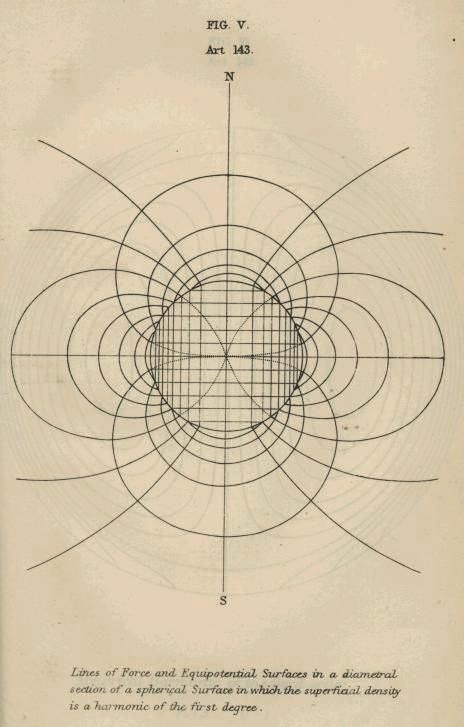
Scifi loves the idea of a force field; this is a vector field descripting a force, like for instance, gravity, at all points in space. You can't see these fields; they are invisible - but they are (hopefully) easy to imagine. You may remember seeing a simple demonstration of magnetic field lines: iron fillings around a bar magnet, tracing out loops from pole to pole. Such a simple experiment is shown - complete with extra electrically conductive metal key - in Berenice Abbott's photo.


Our own Earth has a magnetic field of course, and it is really not that different from that of a bar magnet. Certainly, to first order as physicists say, you can imagine our earth with magnetic field lines from pole to pole tracing loops similar to those in the photo in a full three dimensions. The main complication to this picture is the sun, and way the solar wind intereacts with the Earth's magnetic field.

"Lines of Force and Equipotential Surfaces in a diametral section of a spherical Surface in which the superficial density is a harmonic of the first degree" from A Treatise on Electricity an Magnetism, James Clerk Maxwell, 1873


Schematic diagram of how the Sun interacts with the Earth's magnetic
field (curtesy of the USGS). The solar wind distorts the field basically
compacting the field in on the sunward side creating a bowshock and 
blowing a long 'magnetotail' outward on the night side of the Earth.
Geophysicists use the way these fields interact to probe our planet. We
can all enjoy the beauty of the auroras caused by this interaction. Solar 
storms can also interfer with radio communications, damage GPS and 
other satellites, and even cause electrical blackouts. 

I love the creative, eerie and entrancing take of Semiconductor (the duo of Ruth Jarman and Joe Gerhardt) take in their short film 'Magnetic Movie'. They let NASA space scientists talk about magnetic field lines, and then animate the Space Science Laboratories at UC Berkeley employing very low frequency radio audio recordings (3 Hz to 30 kHz) as an input for their animated embellishments. They are taking poetic license with reality, but somehow expressing more than we might, if we could literally reveal these invisible fields.


Magnetic Movie from Semiconductor on Vimeo.

They write,
The secret lives of invisible magnetic fields are revealed as chaotic ever-changing geometries . All action takes place around NASA's Space Sciences Laboratories, UC Berkeley, to recordings of space scientists describing their discoveries. Actual VLF audio recordings control the evolution of the fields as they delve into our inaudible surroundings, revealing recurrent ‘whistlers' produced by fleeting electrons . Are we observing a series of scientific experiments, the universe in flux, or a documentary of a fictional world?


Perhaps a little more literal, is another artistic work by Semiconductor, which strives to make the invisible geomagnetic field visible. In '20 Hz' they employ data gathered by CARISMA (the Canadian Array for Realtime Investigations of Magnetic Activity, the magnetometer element of the Geospace Observatory Canada project, operated by U of Alberta) of a geomagnetic storm in the Earth's upper atmosphere - data recorded at the frequency of 20 Hertz (of course). They 'play' the data as the audio track and use the data to generate the visuals.


20 Hz from Semiconductor on Vimeo.

They write,

20 Hz observes a geo-magnetic storm occurring in the Earth's upper atmosphere. Working with data collected from the CARISMA radio array and interpreted as audio, we hear tweeting and rumbles caused by incoming solar wind, captured at the frequency of 20 Hertz. Generated directly by the sound, tangible and sculptural forms emerge suggestive of scientific visualisations. As different frequencies interact both visually and aurally, complex patterns emerge to create interference phenomena that probe the limits of our perception.

Thursday, January 15, 2015

Nihilist Girl: Great Russian Mathematician Sofia Kovalevski

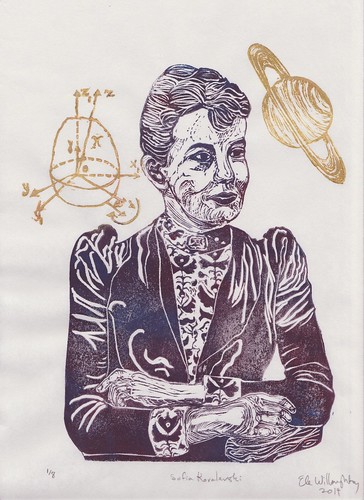
Sofia Kovalevski linocut
'Sofia Kovalevski', linocut 9.25" by 12.5" (23.5 cm by 32 cm), 2014 by Ele Willoughby
Today is the birthday of the great Russian mathematician and writer, Sofia Vasilyevna Kovalevski (1850-1891), in honour of which, I'm going to make the first of a series of posts about scientists I've portrayed.

Also known as Sofie or Sonya, her last name has been transliterated from the Cyrillic Со́фья Васи́льевна Ковале́вска in a variety of ways, including Kovalevskaya and Kowalevski. Sofia's contributions to analysis, differential equations and mechanics include the Cauchy-Kovalevski theorem and the famed Kovalevski top (well, famed in certain circles, no pun intended). She was the first woman appointed to a full professorship in Northern Europe or to serve as editor of a major scientific journal. She is also remembered for her contributions to Russian literature. All of this despite living when women were still barred from attending university. Her accomplishments were tremendous in her short but astonishing life.

Born Sofia Korvin-Krukovskaya, in Moscow, the second of three children, she attributed her early aptitude for calculus to a shortage of wallpaper, which lead her father to have the nursery papered with his old differential and integral analysis notes. Her parents nurtured her early interest in math, and hired her a tutor. The local priest's son introduced her to nihilism. So both her bent for revolutionary politics and passion for math were established early.

Unable to continue her education in Russia, like many of her fellow modern, young women including her sister, she sought a marriage of convenience. Women were both unable to study at university or leave the country without permission of their father or husband. Men sympathetic to their plight would participate in "fictitious marriages" to allow them an opportunity to seek further education abroad. She married the young paleontology student, Vladimir Kovalevsky, later famous for his collaboration with Charles Darwin. They emigrated in 1867, and by 1869 she enrolled in the German University of Heidelburg, where she could at least audit classes with the professors' permission. She studied with such luminaries as Helmholtz, Kirchhoff and Bunsen. She moved to Berlin and studied privately with Weierstrass, as women could not even audit classes there. In 1874, she present three papers, on partial differential equations, on the dynamics of Saturn's rings (as illustrated in my linocut) and on elliptic integrals as a doctoral dissertation at the University of of Göttingen. Weierstrass campaigned to allow her to defend her doctorate without usual required lectures and examinations, arguing that each of these papers warranted a doctorate, and she graduated summa cum laude - the first woman in Germany to do so.

She and her husband counted amongst their friends the great intellectuals of the day including Fyodor Dosteyevsky (who had been engaged to her sister Ann), Thomas Huxley, Charles Darwin, Herbert Spencer, and George Elliot. The sentence "In short, woman was a problem which, since Mr. Brooke's mind felt blank before it, could hardly be less complicated than the revolutions of an irregular solid." from Elliot's Middlemarch, is undoubtedly due to her friendship with Kovaleski. Sofia and Vladimir believed in ideas of utopian socialism and traveled to Paris to help those the injured from the Paris Commune and help rescue Sofia's brother-in-law, Ann's husband Victor Jaclard.

In the 1880s, Sofia and her husband had financial difficulties and a complex relationship. As a woman Sofia was prevented from lecturing in mathematics, even as a volunteer. Vladimir tried working in business and then house building, with Sofia's assistance, to remain solvent. They were unsuccessful and went bankrupt. They reestablished themselves when Vladimir secured a job. Sofia occupied herself helping her neighbours to electrify street lamps. They tried returning to Russia, where their political beliefs interfered with any chance to obtain professorships. They moved on to Germany, where Vladimir's mental health suffered and they were often separated. Then, for several years, they lived a real marriage, rather than one of convenience, and they conceived their daughter Sofia, called Fufa. When Fufa turned one, Sofia entrusted her to her sister so she could return to mathematics, leaving Vladimir behind. By 1883, he faced increasing mood swings and the threat of prosecution for his role in a stock swindle. He took his own life.

Mathematician Gösta Mittag-Leffler, a fellow student of Weierstrass, helped Sofia secure a position as a privat-docent at Stockholm University in Sweden. She developed an intimate "romantic friendship" with his sister, actress, novelist, and playwright Duchess Anne-Charlotte Edgren-Leffler, with whom she collaborated in works of literature, for the remainder of her too short life. In 1884 she was appointed "Professor Extraordinarius" (Professor without Chair) and became the editor of the journal Acta Mathematica. She won the Prix Bordin of the French Academy of Science, for her work on the rotation of irregular solids about a fixed point (as illustrated by the diagram in my linocut) including the discovery of the celebrated "Kovalevsky top". We now know there are only three fully integrable cases of rigid body motion and her solution ranks with those of mathematical luminaries Euler and Lagrange. In 1889, she was promoted to Professor Ordinarius (Professorial Chair holder) becoming the first woman to hold such a position at a northern European university. Though she never secured a Russian professorship, the Russian Academy of Sciences granted her a Chair, after much lobbying and rule-changing on her behalf.

Her writings include the memoir A Russian Childhood, plays written in collaboration with Edgren-Leffler, and the semi-autobiographical novel Nihilist Girl (1890).

Tragically, she died at 41, of influenza during the pandemic. Prizes, lectures and a moon crater have been named in her honour. She appears in film and fiction, including Nobel laureate Alice Munro's beautiful novella 'Too Much Happiness', a title taken from Sofia's own writing about her life.

LinkWithin

Related Posts with Thumbnails