Showing posts with label zoology. Show all posts

Monday, February 16, 2015

Ernst Haeckel & Artforms in Nature

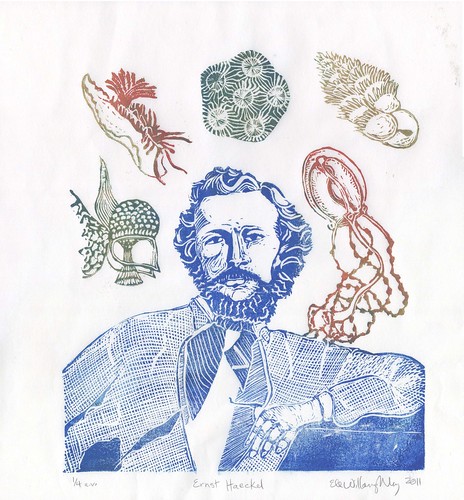
Ernst Haeckel portrait
Ernst Haeckel, linocut on kozo, 30.5 cm by 30.5 cm, 2011, by Ele Willoughby


Ernst Haeckel's Artforms in Naure, 1904 can be viewed here
Biologist, naturalist, and scientific illustrator par excellence Ernst Heinrich Philipp August Haeckel (February 16, 1834 – August 9, 1919), and his beautiful and well-known Artforms in Nature can be credited for the fact that people who are not say, marine microbiologists or geostratigraphers or their colleagues, know and are inspired by the extraordinary forms of radiolarians (as I've written about before), or are familiar with any number of exotic marine invertebrates.  Here we have the man himself, surrounded by several of the creatures he depicted. Clockwise from the top we have: rugosa, a foraminifer (or foram), a tubularid hydroid, homo sapiens (Ernst Haeckel), a dinoflagelate, and a sea slug or nudibranch. His was a form of descriptive science, where his art, his depictions of lifeforms was science, or his science was art. As such, he can be seen as a sort of culmination of centuries of work of his predecessors, gathering their cabinets of curiosity, their wunderkammer of creatures, driven almost as much by aesthetics as by exploration of the biosphere. You can trace this sort of scientific collecting from luminaries of the scientific revolution like Robert Hooke who gathered microscopic wunderkammer, and many others throughout the age of exploration, who travelled the world gathering specimen through to the Victorians whose obsession with cabinets of curiosity has been explained as an indication in fact of a morbid fear of death (in Olalquiaga's The Artificial Kingdom: A Treasury Of The Kitsch Experience).

His particular presentation of life*, which highlights the inherent patterns and beauty, has long been an influence on artists (myself included). Consider the rococco jellyfish chandeliers of Timothy Horn, a hommage to Haeckel's drawings. Haeckel's influence can also be seen in the surreal and imaginary zoological and botanical style drawings of Katie Scott, or the entire otherworldly visual encyclopedia in an alien language Codex Seraphinianus by Luigi Serafini. You can compare his drawings with the glass sculptures of the near contemporary Blaschka father and son, who created fabulous menageries filled with marine invertebrates as well as other creatures and botanicals and whose work likewise straddles art and science and their fertile intersection. His work lead to the incorporation of forms from nature finding their way into everything from furniture to architecture, as well as the more obvious influence on fine art and scientific illustration.

*Sadly, his deep appreciation of life in its many forms did not translate into an enlightened view of his own species. While he did make contributions to evolutionary biology, and was a great popularizer of Darwin's work in Germany, he also used a confused hodgepodge of Darwinian and Lamarkian ideas and far more speculation than a we would consider reasonable in a modern scientific sense. Some of his discredited scientific ideas were in vogue during his lifetime, and his errors should be considered within context. Most disappointing however, were his wrong-headed and repugnant social Darwinist ideas about race and his evolutionary racism which have been linked to the rise of Fascism. I've long enjoyed his extraordinary art/science and was saddened to read that he harboured such ideas, but I think it's important to avoid lionizing people, for instance for their artistic or scientific ideas, and to acknowledge their failings as well as achievements. I can admire his scientific illustration and tireless zoological investigations but still repudiate his ideas about human evolution.

Tuesday, June 3, 2014

Transparent Still Life

Physicist Arie van 't Riet specializes in radiation physics, and very low energy x-rays in particular. He began making artwork employing x-ray nature photographs, where radiography intersects fine art. His colourized x-ray photos of bioramas are a sort of see-through wunderkammer. He creates entire scenes in x-ray form. It makes me think of how the natural world might look if my eyes could see in x-ray wavelengths (or those back-of-the-comic-book x-ray specs really worked).

  Arie van 't Riet

Cameleon, begonia, Arie van 't Riet

Barn owl, Arie van 't Riet

Arie van 't Riet

frog, Arie van 't Riet

Arie van 't Riet
Arie & Hans van't Riet

 As a printmaker, I also appreciate how he's worked with Hans van 't Riet to produce Toboyo prints, or photo-polymer etchings, using UV light to transfer the x-rays to a plate which was inked and hand-printed. There's something poetic about using one non-visible wavelength to photograph right through lifeforms and show their structure, and then use another non-visible wavelength to bite an etching plate and print onto paper- combining the high tech with the centuries-old artistic medium.


Transparent flowers, revealing their skeletal structures, are also the subject of  architecture-student-turned-artist Macoto Murayama's work, but his is a very different medium. He uses computer graphics, 3dsMAX software usually employed in architecture (or animation), to model and then Photoshop and Illustrator depict the anatomy of flowers. It's like a specialized form of scientific illustration, as he bases his images on his own careful dissection of flowers
Chrysanthemum, Macoto Murayama
Rose, Macoto Murayama

Yoshino cherry, Macoto Murayama

Chrysanthemum, Macoto Murayama

Satsuki azalea, Macoto Murayama

(via the scientist)


Wednesday, July 31, 2013

The Blaschka Glass Menagerie Dynasty

The Natural History Museum (NHM)
German glass artists Leopold (1822-1895) and his son Rudolf (1857-1939) Blaschka produced wonderous glass anotomical models of organisms, including many marine invertebrates and flowers, which went on to populate the natural history museums of the world, universities and aquaria. These were creatures and plants they wished to display but which were difficult to preserve and often rarely observed. Previously, models were limited to drawings, pressed specimens, photos, paper and wax models. The famous Blaschka models not only provided views of anatomy in a full three dimensions, they were beautiful and quite accurate. There were other glass artists making zoological and botanical models, but the Blaschkas were known for their attention to detail - and for the perhaps unexpected way this very specialized career in scientific illustration (in glass) was passed from father to son and how this one family of scientific artisans produced so much of the world's collections of glass specimen models.

Octopus from the Cornell collection
Leopold even kept an aquarium in his home to study these creatures for his models.

Physalia arethusa (glass model of a Portuguese Man-of-War). There are about two hundred tentacles made of thin coloured glass, supported and attached by fine copper wires. (via National Museum Wales)  
 Despite its unexpected resemblance to the 'Golden Snitch' of Harry Potter and the imaginary game of Quidditch fame, the 'sea gooseberry' is a is a common genus of Ctenophora.
A 'sea gooseberry' or 'comb jellyfish' (Pleurobranchia rhododactyla).
Length: 205mm.

Charybdea periphyllum (glass model)
Pelagia cyanella (glass model).
Sea anenomies displaying a territorial dispute.
Here S. troglodytes fires stinging cells at A. mesembryanthemum who has ventured too close. This behaviour was observed first hand in the aquaria at the Blaschka's home.
Base: 180x110mm. Height: 80mm. (via National Museum Wales)
 
collection of 5 marine invertebrates in glass from the Aurelia aurita, Berenice euchroma, Physophora hydrostatica and Pelagia noctiluca species from the Fonazione Scienzia e Tecnia, Florence, Italy

Highly magnified model of single cell amoeba (Amoeba proteus).
Diameter: 120mm.
Life sized model of marine snail (Cerithium vulgatum) with glass body fitted in real shell.
Length: 90mm.
From the Harvard glass flower collection

Tuesday, January 29, 2013

Naturalia & Mirabilia

French textile artist Lyndie Dourthe creates what she calls 'Naturalia & Mirabilia' - both marvels and natural history in her miniature cabinet of curiosity. She describes how in her secret laboratory she creates jewelry, soft sculpture and installations with a hint of botany, voodoo, anatomy, and superstition. Like any naturalist, she sorts, labels and boxes her specimens and treasures. Her jewelry also serve as childlike talismans.

Lyndie Dourthe - Source: lyndiedourthe.monsite-orange.fr


Lyndie Dourthe - Source: lyndiedourthe.monsite-orange.fr via minouette


Lyndie Dourthe - Source: lyndiedourthe.monsite-orange.fr via minouette


Lyndie Dourthe - Source: lyndiedourthe.monsite-orange.fr via minouette


Lyndie Dourthe -Source: lyndiedourthe.monsite-orange.fr via minouette


Lyndie Dourthe -Source: lyndiedourthe.monsite-orange.fr via minouette


I've long admired her work and can't imagine why I haven't written about her before! Check out her portfolio, blog, and shop.

Tuesday, July 10, 2012

Sir David Attenborough

David Attenborough by Elda The


Sir David Attenborough is one of the most popular naturalists and popularizers of natural science, anywhere in the world. His enthusiasm is infectious. He is articulate, mesmerizing and unfailingly fascinating. It's no wonder he's inspired some art about his passion for the animal world.


Father Earth by
Always With Honor


David Attenborough by Damien Weighill


Wait for it... "this is a camera shutter;" it's worth the wait.

Sunday, January 29, 2012

Transparent Wunderkammer


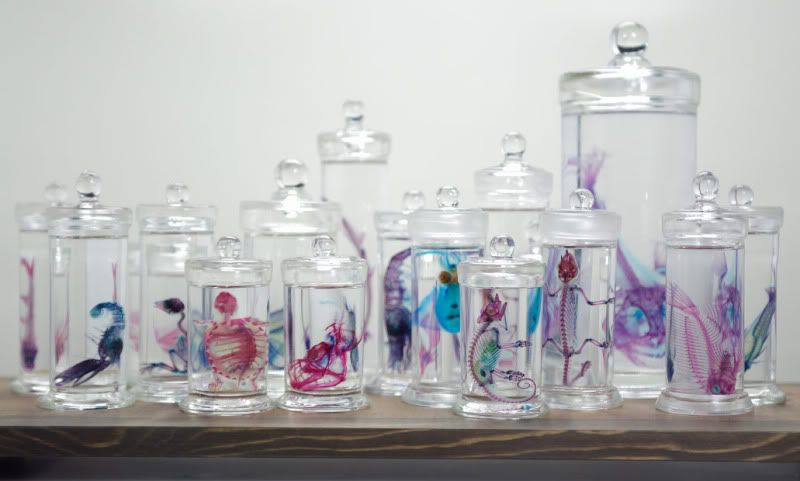
Iori Tomaki's “New World Transparent Specimens” began with established scientific tools for studying the skeletal systems of zoological specimens (using enzymes to turn the proteins transparent, dyeing the bones magenta and dyeing the cartilages blue), refined the colouration to make whole wunderkammers of fascinating "specimen" in glycerin for, as he explains, everything from academic purposes, to objects for artistic or philosophic contemplation. I love that he's taken his experience in fisheries and employed it to make art at the interface of art and science.


See more specimens here.
(via form is void)

Friday, April 23, 2010

The Anachronism

The Anachronism (Full Film) from Anachronism Pictures on Vimeo.


The entire, award-winning, steampunk short film The Anachronism by Matthew Gordon Long has been released on vimeo. It has intrepid Victorian, amateur-biologist children, printmaking specimens and discovering a ship-wrecked robotic squid submarine, which are pretty much a list of my favorite things, in a setting I recognized instantly as Canada's west coast, my former home. What little I caught of the Japanese was disconcerting. The story telling is perfect, right down to the things left untold.

From the film's website


On a sun dappled summer day a science expedition propels two children toward an enigmatic encounter at the edge of their known world. Arriving on an isolated beach, they stumble upon the shipwreck of a robotic squid submarine. The secret it holds within changes their lives forever.

The Anachronism is a Steampunk science-fiction short set in the late nineteenth century. Unfolding with the simplicity of a children's storybook, this lush journey through the landscapes of Canada's West Coast draws inspiration from a whimsical juxtaposition of Pacific Rim cultural references to elaborate an elegant meditation on the courage of curiosity and the haunting effect of childhood trauma. In 2009 the film won six Leo Awards including Best Short Drama.


(via bioephemera)

LinkWithin

Related Posts with Thumbnails