Tuesday, January 29, 2013

Naturalia & Mirabilia

French textile artist Lyndie Dourthe creates what she calls 'Naturalia & Mirabilia' - both marvels and natural history in her miniature cabinet of curiosity. She describes how in her secret laboratory she creates jewelry, soft sculpture and installations with a hint of botany, voodoo, anatomy, and superstition. Like any naturalist, she sorts, labels and boxes her specimens and treasures. Her jewelry also serve as childlike talismans.

Lyndie Dourthe - Source: lyndiedourthe.monsite-orange.fr


Lyndie Dourthe - Source: lyndiedourthe.monsite-orange.fr via minouette


Lyndie Dourthe - Source: lyndiedourthe.monsite-orange.fr via minouette


Lyndie Dourthe - Source: lyndiedourthe.monsite-orange.fr via minouette


Lyndie Dourthe -Source: lyndiedourthe.monsite-orange.fr via minouette


Lyndie Dourthe -Source: lyndiedourthe.monsite-orange.fr via minouette


I've long admired her work and can't imagine why I haven't written about her before! Check out her portfolio, blog, and shop.

Wednesday, January 23, 2013

Illustrating Explorers

I'm enjoying the illustrations of Bristol-based illustrator Joe Todd Staunton. This cross-section of the oceanic water column with all its flora and fauna (and fishers) and their measurements and appropriate depths, first captured my attention:


via his blog where he wrote that he was considering adding sea birds above! It reminds me of working at sea with ROVs and watching the video feed as they descend or ascend from the depths.

Several other illustrations touch on scientists, academics and explorers, or draw on scientific illustration with their diagrammatic qualities, which is right up my alley.


for an editorial "Cambridge professors to set tough new maths A-levels".


"Newest image from a project that is looking at explorers who died on there journeys. This one is about the astronaut Vladimir Komarov who died coming back to earth due to parachute failure."


for an editorial "Why bright lads are being picked on".

Check out his portfolio and blog for more!

Tuesday, January 15, 2013

Exploring Alternate Evolutionary Paths in Clay


This isn't the first time I've written about ceramic artists playing with variations on flora and fauna as we know it; it is something which definitely appeals to me, and fits squarely in that wondrous creative region where art and science intersect. Chicago-based artist Chris Garofalo took inspiration from her garden when she began to make hybrid creatures or plants in clay. I particularly like how her site describes this as imagining a different evolutionary path for life:

By blurring the distinction between lang, sea and air, the plant and animal kingdoms- by examing the state between the waving arms of a sea anemome and unfurling tendril of a fern- a kind of hybridization or exogamy of all biological lifeforms takes place. The results are an exploration into what might have occurred with slight changes in early evolutionary events.


The 'Basidiomycete Florid Hoveren' above alludes to the Basidiomycota a phylum which contains 37% of the true fungi, including mushrooms and yeasts. "Florid", of course, means flowery, and "Hoveren" is apparently Old English (frequentative of hoven) from which we get words like hover. So perahps it describes itself as a flowery, hovering, mushroom. the 'Siphonophore Royale' below is more transparent; a siphonophore is any of various transparent marine hydrozoans, of the order Siphonophora, that float or swim as colonies of polyps, the sort of colony of creatures we sloppily think of as 'jellyfish'. The 'Corallia Bractea' below literally can mean a 'gold leaf' coral, but it is also reminescent of the bracteate flower, where a group or cluster of flowers arranged on a stem that is composed of a main branch or a complicated arrangement of branches (or bracts). The sculpture below, 'Blastomycetes' actually refers to a real organism; Any of various yeastlike, budding fungi of the genus Blastomyces that cause diseases in humans and animals. 'Redocumaize Porifera' is a bit mysterious. We know that porifera are the sponges, and maize the corn family. We can see how she is imagining alternate pathways for polyps, mushrooms, corals, flowers, grasses and sponges, or growing a garden of ceramic evolutionary might-have-beens.


Be sure to peruse the rest of her portfolio!

Friday, January 4, 2013

Transparent Animals


(Photo by Heidi and Hans-Jurgen Koch) Source: oddee.com via minouette on Pinterest


A few years ago, I made a post about a couple of transparent sea creatures: an octopus and one deep sea fish. Transparency, or translucency is something we might expect in say, jellyfish, or insect wings, or in microbiology but I've stumbled upon a whole collection of different animals who are more or less see-through.


The aptly named Glass frogs (frogs of the amphibian family Centrolenidae) of South and Central America may be mostly lime green, many have translucent abdominal skin through which internal viscera, including the heart, liver, and gastrointestinal tract are visible.


This translucent shrimp is sometimes called a "ghost shrimp".


(Photo by David Shale) Source: oddee.com via minouette on Pinterest


This North Atlantic animal called Phronima, uses transparency as a survival strategy and a means to be invisible.


Photo by Peter Batson) Source: oddee.com via minouette on Pinterest

The southern oceans' Glass Squid (Teuthowenia pellucida) "has light organs on its eyes and possesses the ability to roll into a ball, like an aquatic hedgehog."


Flatfish can be transparent in their early planktonic stage.

(Photo by Uwe Kils) Source: oddee.com via minouette on Pinterest


Even the blood of the crocodile icefish (Channichthyidae) is transparent, lacking hemoglobin and/or only defunct erythrocytes. Because they live in the very cold southern oceans, around Antarctica, which contain more oxygen it's believed they can absorb sufficient oxygen directly through their skin.


This is a transparent pelagic octopus.


We're familiar with translucent wings on flies and bees, but the lovely Glasswinged butterfly (Greta Oto) also has translucent wings.


Friday, December 21, 2012

Winter Solstice

Happy winter solstice! Here in the Northern Hemisphere, I've always felt that the winter solstice and the coming lengthening of days is worth celebrating. As winter begins here, this will be the shortest day, and while it will be cold in the coming months, there will be more light.

Tyrrhenian Sea and Solstice Sky Credit & Copyright: Danilo Pivato, Source: apod.nasa.gov via minouette on Pinterest


The length of days varies little at the equator, and in the high arctic and antarctic we have the midnight sun in summer and no sun over the horizon in winter. Surprisingly, we can use a Ptolemaic idea to explain this. In Ancient Greece, they imagined that the objects observed in the sky were placed on a series of concentric spheres around the Earth. While we no longer imagine celestial bodies pinned to spheres of quitessence, the idea of the celestial sphere is still useful for mapping the apparent paths of any astronomical body in the sky. From our perspective on the surface of our planet, the sun traces a arc path across the sky, like that in the photo above. On any day this path is of course due to the rotation of the Earth around its axis. Over the course of the year, because of the tilt of the axis, the position of the arc varies as the earth completes its rotation along its elliptical path around the sun. At the equator, the the path of the sun in the sky makes an untilted arc to the north or south of the celestial equator (the imaginary line cutting the imaginary sky sphere in half). As we move away from the equator, the relative path of the sun appears more and more tilted (directly proportional to latitude). This tilt means the paths of the sun at the extremes of the yearly orbit, the two solstices, are quite different lengths. Away from the equator, the apparent path of the sun is quite long (maximal, in fact) at the summer solstice and quite short at the winter solstice. The image below shows the extemes of the paths of the sun on the celestial sphere above a point at mid-latitudes. If you go to higher latitudes this tilt of the two extreme paths of the sun become more and more tilted until the winter path is entirely below the horizon.
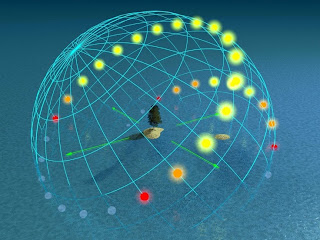


There are other astronomical cycles which affect our Earth, but which are not easy for individuals to observe, because they are much longer than human lifespans. These are known as the Milankovitch cycles and include things like procession of the Earth's axis (which moves like the children's toy, a spinning top or gyroscope) over a cycle of roughly 26,000 years.


Different cultures have developped different calendars, often, if not exclusively, based on their astronomical observations. In ancient Mesoamerica, the Long Count calendar broke time into a variety of units, as we do (days, weeks, months, years, centuries, millenia, eons). They had K'in (one day), Winal (20 days), 1 Tun = 18 Winal (360 days, almost 1 year), 1 K'atun = 20 Tun (7200 days, almost 20 years), B'ak'tun = 20 K'atun (144,000 days or almost 394 years), Piktun = 20 B'ak'tun (2,880,000 days or roughly 7,885 years), Kalabtun = 20 Piktun (57,600,000 days or roughly 157,704 years), K'inchiltun = 20 Kalabtun (1,152,000,000 days or roughly 3,154,071 years), Alautun = 20 K'inchiltun (23,040,000,000 days or roughly 63,081,429 years). Today happens to be the end of a B'ak'tun, which while nifty, it is not the end of the Mayan calendar. In the Mayan notation this day would be 13.0.0.0.0 which would have last occurred at the mythical creation day of this the fourth world, Monday, Aug 11, 3114 BCE (which is no more accurate, of course, than Bishop Usher's date, since of course, our planet is roughly 4.2 billion years old). The image at left shows the east side of stela C, Quirigua with mythical creation date in 13 (or 0) baktun, 0 katun, 0 tun, 0 uinal, 0 kin, 4 Ahau and 8 Cumku and corresponds to August 11, 3114 BCE in the Gregorian calendar (via wikipedia). Now previous worlds in the Mayan mythology only lasted 13 B'ak'tun, but there are inscriptions which refer to the end of the Piktun, which will not occur until 13 October 4772, so it's clear they assumed the world would be around a lot longer than this one solstice. So, if you would like to celebrate, celebrate the lengthening of days (at least here in the Northern Hemisphere), or go ahead and celebrate the end of the Mayan B'ak'tun as a notable date to a fascinating culture, or with tongue planted firmly in cheek, the bizarre variation on millennial pop culture myths of the end of days. Strange eschatological misconceptions seem like as good an excuse for a party as any. It'll be a while until we have the next prediction of an apocalypse.

(x-posted to minouette)

Saturday, December 8, 2012

Sound (Visual) Art


Source: asci.org via minouette on Pinterest


"Bowhead," a picture of a sound made by a Bowhead whale, 2003 by Mark Fischer (using wavelet analysis of recorded hydrophone sound data)

Artist Mark Fischer was interested in whalesong and found that in the literature you could find information on the range of frequencies employed, or fourier transforms of recorded sound (so you could see it plotted as a function of frequency, or moreorless which 'notes' were used, if whales happened to use discrete notes like most human music). He decided to use a method common in my field - marine geophysics. He employed wavelet analysis. (If you're interested, this is something seismologists typically use. They take time series data, which means they measure the amplitudes of vibrations, which is often equivalent to measuring the intensity of sound, periodically, so they get a series of measurements in time. They convolve the time series with a wavelet, a specific function. The result is a matrix of numbers which can be displayed as a 2D image if you simply map numbers onto colours.) It suffices to understand that there are a series of numbers (equivalent to the whalesong) to which he applies a mathematical procedure to produce an image. As he writes,
The procedure I have developed to pursue this exploration is, to me, a form of photography- with mathematics as the lens and a computer as a camera. What results is something I call 'the shape of the sound'.

More recently he's produced wavelet images of birdsong and insect noises and what he calls 'AguaSonic' videos of various species, so you can hear the animals too.


Source: asci.org via minouette on Pinterest


Pseudorca Pontinha by Mark Fischer, 2009 17.75" x 23.75" archival digital print on Crane's Museo Max paper

Sound as visual art can also be of sounds closer to the human experience (and not only those which require hydrophones to record). Epic Frequency makes prints of famous audio clips. This one is Martin Luther King, Jr. beginning, "I Have A Dream" On August 28, 1963.


Or, here is a way in which natural sounds combine with sculptural art. 'Hear Heres' is a set of four giant ear trumpet sculptures designed to highlight the sounds of nature, by London architecture firm Studio Weave.


Hear Heres


Hear Heres


Hear Heres

Friday, November 16, 2012

Music about Radioactivity: Radioactive Orchestra


adafruit industries blog

Using models from collaborating nuclear physicists, on how specific isotopes emit gamma radiation, media artist Kristofer Hagbard created an algorithm to translate this to music, and Axel Boman created songs based on melodies and sounds from the software Via the project webste:

The musical and artistic ambitions is about exploring a world that is not available to our senses and finding musically interesting pattens and to render them in a way that both resonates with popular culture while staying close to the subject matter.

The pedagogical aspect aims to inspire young people to learn about the natural sciences by making one of its most hidden phenomenas available in a new way and exposing complexity and beauty in the strange world of the atomic nuclei – using music.

I love the idea of making the ever-present though always changing ambient radiation audible and something we can sense. The physicists make the point that the general public tends to think ionizing radiation, these strong photons emitted, are unnatural, or something only associated with nuclear technology, when in fact, radiation is everywhere. Our Earth is filled with radioactivity and even our own bodies emit some radiation. By translating the frequencies of photos emitted by any given isotope to cascades of musical frequencies (or pitches) not only are they providing a means to think about this unsensed presence, but something lovely to listen to as well.

You can play with the software too, creating music from you favorite isotopes! It even allows you to export the music you create.

LinkWithin

Related Posts with Thumbnails