Friday, June 22, 2012

Alan Turing Centenary


'Alan Turing'
Artist: Stephen Kettle
Title: Alan Turing
Material: stacked slate
photo: Leo Reynolds
Bletchley Park National Codes Centre
Bletchley Park, Milton Keynes, Buckinghamshire, England, UK

Alan Mathison Turing, OBE, FRS (23 June 1912 – 7 June 1954), mathematician, cryptanalyst, computer scientist, prophet and hero, would have been 100 today. He is someone I would like to portray, but I have been stumped. My scientists are shown with images of something quintessential to their science, or the reason they are famous (or should be), but Turing had so many accomplishments, it isn't obvious what to portray or how. You might recall his portrayal in Neal Stephenson's Cryptonomicon. I was introduced to him many year ago by Douglas Hofstadter's  Gödel, Escher, Bach (which I can't recommend highly enough... go read it now). You may be familiar with the Turing Test or at least its portrayal in Blade Runner. Turing foresaw not only that machines might quite likely develop the capacity to think (after all, our brains are only made of matter, and complex systems of neurons, which either fire or not, much like an electronic switch), but that we needed an objective, double-blind test to determine whether something/someone was able to think, as early as 1950, when most people were only dimly aware of the existence of any sort of computer. But Turing quite literally defined what we now mean by computation itself (with his concept of Turing Machines) back in 1936. During the WWII he worked as a codebreaker and invented the device which was finally able to crack the notorious German crypotographic Enigma machine! His work undoubtedly saved many lives, and today we recognize him as a genius and a hero. During his all too short life, he also made important contributions to mathematical biology and explaining morphogenesis (the biological process that causes an organism to develop its shape) and the existence of Fibonacci numbers in biology. 

Tragically, he lived in a time even more biased and bigoted than our own. Rather than recognizing the magnitude of his contributions to society during his lifetime, he was prosecuted for his homosexuality (still illegal in Britain in 1952) and forced to undergo chemical castration. He died two years later, after eating a cyanide-poisoned apple (determined by the coroner to be a suicide). It is truly abominable they way he was treated; while we can't address the past injustice we can remember, recognize and celebrate his remarkable achievements today.

Check out this Turing Machine built from LEGO, in honour of the 2012 Turing Year!


(via Brain Pickings, which also has an interesting article about Turing) 

This beautiful paper Turing Machine, by The Real M Davey employs a microcontroller and some electronics, but it is really the paper itself which is the computer (as the "tape" is described in Turing's original paper:


My goal in building this project was to create a machine that embodied the classic look and feel of the machine presented in Turing’s paper. I wanted to build a machine that would be immediately recognizable as a Turing machine to someone familiar with Turing’s work. Although this Turing machine is controlled by a Parallax Propeller microcontroller, its operation while running is based only on a set of state transformations loaded from an SD card and what is written to and read from the tape. While it may seem as if the tape is merely the input and output of the machine, it is not! Nor is the tape just the memory of the machine. In a way the tape is the computer. As the symbols on the tape are manipulated by simple rules, the computing happens. The output is really more of an artifact of the machine using the tape as the computer.
( Adafruit blog)

You can also learn how to make a papercraft Enigma machine on MAKE.

Wednesday, June 13, 2012

Ceramic Might-Have-Beens

British ceramicist Sophie Woodrow knows that the Victorian fascination with nature (though it was firmly defined as 'other' than human), collecting and romanticizing nature in a way which was ultimately kitsch is a great place to seek ideas and inspiration. Though most Victorian science was of the 'descriptive' sort, I know I find their romantic and sometimes heroic collecting an inspiration myself; it is definitely a class of activity at the fertile intersection of art and science, like the building of wunderkammers (Cabinets of Curiosity), gathering everything from rocks, to ferns, to fossils, to exotic animal species from around the world. I love how she describes the Victorian "enormous misinterpretations of geological evidence" (particularly of biological evolution) as "a game of Chinese whispers1 played over millennia". She's been inspired by natural history, and our changing ideas about evolution, to create a growing collection of ceramic "might-have-beens". This makes me think of the Rhinogrades, the wonderous "might-have-evolved" creatures of Harald Stümpke [Gerolf Steiner]. Her imaginary-animal pots are likewise truly wonderful.

 
Bear (41 cm height)


Totem (39 cm height)

 
 Little Owl


 Crowd Scene

Here she speaks about her process:
 

 Be sure to check out both her recent work and archive!

Lou Lou & Oscar

 1 "Chinese whispers" is the British name for what North Americans call the game of "broken telephone" where a message passed by whispers from person to person, mutating as it travels along.

Wednesday, May 30, 2012

Measuring the Universe, Animated

This is a lovely, very graphic animation, with simple lines and sparing use of colour, gives one of the most straightforward, yet rather thorough explanations I've heard of the sheer scale of our Universe and how we measure astronomical distances. It is directed by Richard Hogg, animated by Robert Milne,Ross Philips, and Kwok Fung Lam and narrated by astrophysicist Olivia Johnson.


Brain Pickings

I particularly liked her efficient explanation of 'standard candles', which is something I've tried to put as simply and plainly as possible, when I describe the importance of Henrietta Swan Leavitt's discovery of the relationship between luminosity, or brightness, of a certain type of star, the Cepheid variable stars. Thanks to her discovery, we now know there is a simple relationship between period and luminosity for these stars - something which radically changed the theory of modern astronomy, an accomplishment for which she received almost no recognition during her lifetime.

Cepheid variables are a class of pulsating star. They are named for the star Delta Cephei in the Cepheus constellation. The relationship between a Cepheid variable's luminosity and pulsation period is quite precise, securing Cepheids as viable standard candles and the foundation of the Extragalactic Distance Scale.

Henrietta Swan Leavitt


My portrait of Swan Leavitt, shows Henrietta, related constellations, and a plot of her period-luminosity relation. This is a first edition lino block print in lavender-silver and gold ink on Japanese kozo paper (10" by 12.5" or 25.4 cm by 31.8 cm). The first edition is a run of 6 prints.

Tuesday, May 22, 2012

Art about (or from) Chemistry


I find it amusing how this 'True Colours Miniatures' project is billed "a framework in which nature can express itself and maintain beauty" as if it were in anyway surprising that a natural process (or a chemical process) would create something beautiful and colourful. This artistic, design project is quite literally a chemistry experiment (with typographical flair); Dutch designer Lex Pott (for Found By James) took 6 panels of brass (an alloy of copper Cu and zinc Zn), aluminium (Al), steel (an alloy which is mainly iron Fe) and copper (Cu) and then incited various oxidation reactions everywhere on the plate, except for text recording the materials used and produced.


  Bloesem

He has used oxidation previously in his work, including a series of mirrors of differing tints, and various furniture, and has more in the 'True Colours' series on his site.

Monday, May 21, 2012

Canadiana for May two-four - Happy Victoria Day!

Typography meets contemporary Canadiana in Vancouver design firm 10fourdesign's Canada icon font:


If you can identify and understand the cultural significance of each (or most) of these icons you may be Canadian, or deserve honourary Canadian status. So, happy Victoria Day! Take the day off, declare it summer, relax with friends (and two-four) and watch some fireworks.

Confused? Just ask, eh.

Sunday, May 20, 2012

Singing about Isostsy, with Stop-Motion and the Baltic Sea


(Colossal)

This lovely short stop-motion paper craft video is directed by Vincent Pianina and Lorenzo Papace (May 2012) for Papace's band Ödland, for the song Østersøen on the album Sankta Lucia (October 2011). The music was also written, composed and recorded by Lorenzo Papace. The song tells the story, in French, of dreaming of traveling in bed, moving about a room, aboard a train, which in turn is aboard a ship, which is sailing the Baltic Sea, trying to avoid dangerous islands.


There is a verse about isostacy, which has got to be the most only artistic interpretation of the geophysical concept I've ever seen. It's quite pertinent to the Baltic, due to the post-glacial rebound (or isotatic rebound) of Fennoscandia1 to the north and east of the sea; basically, the nature and size of the sea depends on its relative height. Imagine all the continents floating on the Earth's mantle (also shown in the video), much like icebergs float in the sea, with a certain proportion above water and the remainder below. Everything will find its equilibrium position. If you drop an ice cube in your glass of water, it may sink initially then float to the surface; isostasy (or with fluids, buoyancy) will push the less dense up so that it can be in gravitational equilibrium. In the case of icebergs, which are only slightly less dense than water, there is 90% below the sea and only 10% above. It is isostasy which determines these proportions, as the song says (the islands like icebergs find the sea surface through the process of isostasy). Thus mountains have 'roots' just like icebergs hide much below the waterline. If you put a large weight on the Earth, it will deform to accommodate this weight like a trampoline. Consider for instance huge glacial ice sheets during ice ages. These pushed the crust downward. Since the removal of that weight and the retreat of the icesheets, the Earth has been rebounding upward to find its new icesheet-less equilibrium. (The Earth, like SillyPutty, is viscoelastic, so it does not respond instantaneously to the removal of the icesheet's mass, but on a longer time scale governed by the nature of the mantle - specifically its viscosity. It's also important to remember that if we think in geological time, units of thousands to hundreds of thousands of years are not that long). Thus vast regions of the Earth near the poles, like Fennoscandia, or Canada's Hudson's Bay are in fact moving and have been moving upward, away from the centre of the planet, since the retreat of the glaciers and the end of the last ice age. In the song, which describes a dream, the process is vastly sped up, and "dangerous islands" pop up through isostasy in a matter of seconds, so the boat must take a circumambulating path to navigate its changing seascape.

Consider the series of shapes needed to show the rise of a single island!


The video uses the plates of Ernst Haeckel2 to great effect. I love the spatial context; the bed upon the train upon the ship upon the sea, complete with the multifarious sea life; the sea in turn is shown in context of Northern Europe and earth and the solar system. In the process they built a wonderful orrery (solar system model). How I love orreries. The train furthermore travels an amazing roller coaster-like track, which I'm astounded to learn they built and filmed in only 4 months. It's really quite marvellous.
You can find more about the music, the video, art and process on the blog Le Petit Écho Malade. You can even buy the sheet music. I'm so charmed by this quixotic, anachronistic endeavour. Check it out.

1 Ok, I just wanted to use the word 'Fennoscandia'. It is the geological province which encompasses the entire Scandinavian peninsula and Finnland.

2 You know how I am a raving fan of the wunderkammer collections of nature illustration by Ernst Haeckel.

Wednesday, May 16, 2012

Riding the tortoise

'Tortoise Ride' by Meg Hunt
Virginia Frances Sterrett, illustration for Old French Fairy Tales (1920) by the Contesse de Segur (via 50watts). The story illustrated is that of Blondine, a princess lost in a forest due to the actions of her wicked step-mother, where amongst other adventures, she meets a great tortoise who offers her protection and to lead her out of the woods so long as she will sit on her back silently, without asking a single question, for six months. Another French fairytale has a princess who rides a tortoise- Babiole, but only when she has been cursed and turned into a (well-educated) monkey.
'A Monkey Riding on a Tortoise' (1821) by Katsushika Hokusai

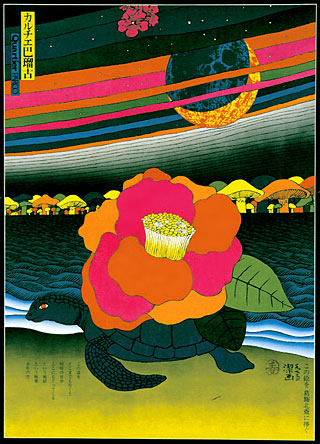
Which makes me think of Monkey, Sun Wukong riding the giant tortoise during his epic Journey to the West, and then I am reminded that I promised you more of Awazu's turtles, some time ago. Here are but a few:
'QUARTIER PARCO -A' (1973), Advertizing Poster, Silk-screen by Kiyoshi Awazu
(1978) Public postet, offset, by Kiyoshi Awazu
(1980) Public postet, offset, by Kiyoshi Awazu
(1975) by Kiyoshi Awazu

LinkWithin

Related Posts with Thumbnails