Showing posts with label embroidery. Show all posts

Friday, January 7, 2022

Insects in Textiles

 Insects have been used as adornment and recreated in textiles for centuries. I'm sharing a smattering here of some beautiful contemporary textile art of insects.

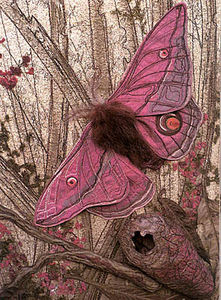
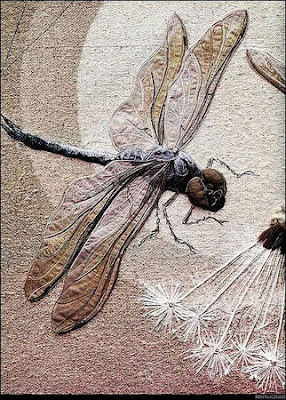
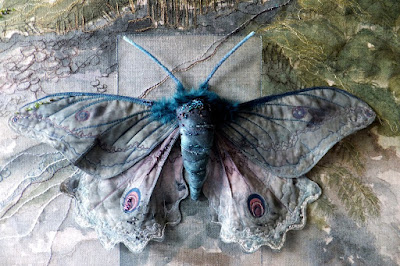
Check out the sensitive textile nature art of Dutch-born Australian artist Annemieke Mein here. She works in various media including textiles, and the textile art includes these beautiful insects:


Butterfly textile art by Annemieke Mein

Dragonfly textile art by Annemieke Mein

Butterfly textile art by Annemieke Mein
Textile insects by Annemieke Mein


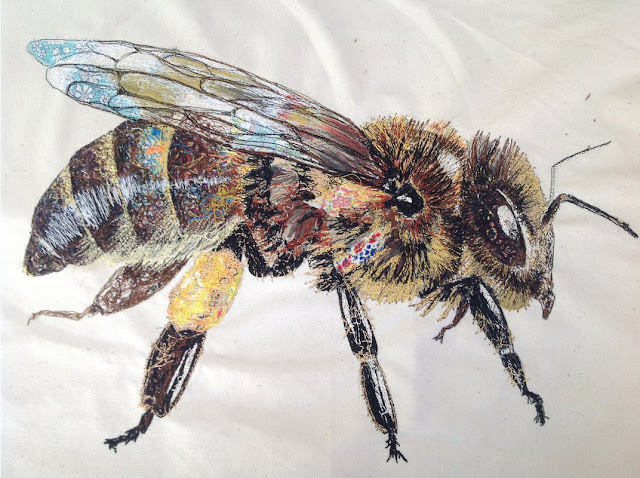
Born in England and based in Kenya, artist Sophie Standing uses textile art to portray the wildlife she sees. I absolutely love this bee:

Sophie Standing Bee
Bee textile art by Sophie Standing

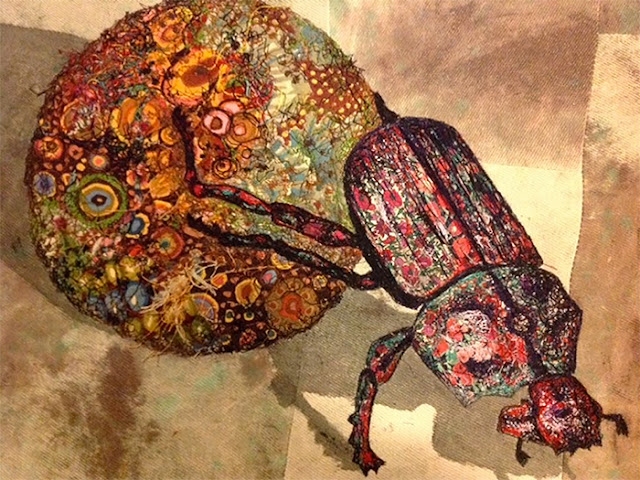
She does a lot of the African megafauna, but this dung beetle is charming:

Dung Beetle textile art by Sophie Standing

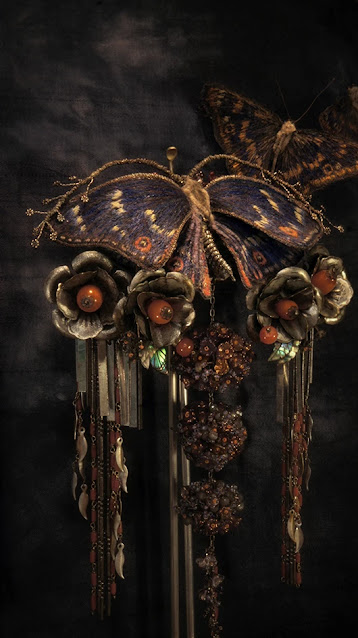
Michele Carragher is a London costume embroidery for film and TV who has done extraordinary work (for shows like Game of Thrones). Some of her insect-themed work: 

The Head Artefact, Hairpin
The Head Artfact, Hairpin, (c) MCE 2021

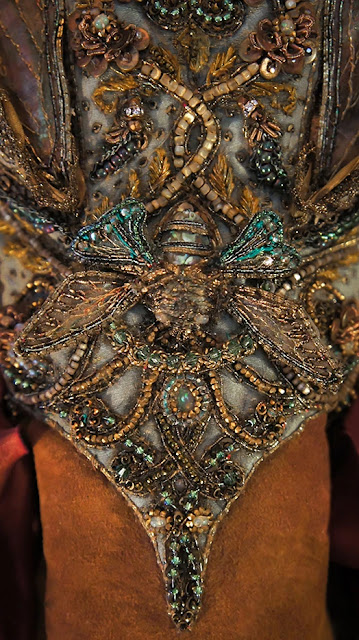
The Hand Artefact, Gauntlet
The Hand Artefact, Gauntlet detail cicada motif, (c) MCE 2021


Cicada detail from Game of Thrones costume embroidery by MCE
Detail of Game of Thrones costume embroidery by Michele Carragher

You can find the delightful work of UK embroiderer Humayrah Bint Altaf on instagram and Etsy as The Olde Sewing Room. 

The Olde Sewing Room butterfly
She wished for wings, Papilio Demoleous Swallowtail Butterfly with Goldwork Embroidery


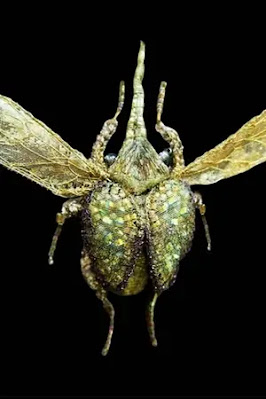
Goldwork scarab beetle by The Olde Sewing Shop
Goldwork scarab beetle with crystals and antique wires


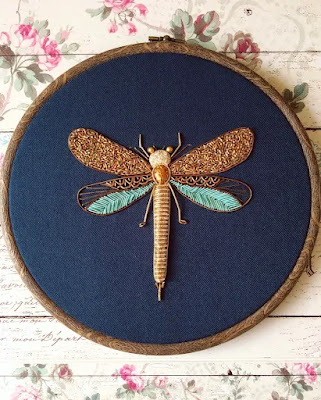
Goldwork dragonfly by The Olde Sewing Shop
Madelaine (n.), something that triggers memories or nostalgia - gold work dragonfly embroidery

Wednesday, August 7, 2013

Textile Anatomy

Where textile art meets human anatomy!

Shannell Papp, Lab (skeleton), detail
Shannell Papp, Lab (skeleton)


Canadian artist Shannell Papp created Lab (skeleton), a complete, full-scale crocheted model of the human skeleton and organs. She writes, "I was pretty serious about making a very exacting replica of the human body. There are parts of the work that nobody sees–the brain has gray and white matter, the bones have marrow, the stomach has half digested food in it. I made it to understand my body better and I think this is why people like it," in  this interview. She has also made other textile works, whether crochet or embroidered, about human anatomy.

Shannell Papp, Bonebook (detail)

Shannel Papp, Bonebook and Blood Pools
Another Canadian artist was working on knitted and embroidered works about human anatomy in the late 90s. Sarah Maloney made these beautiful embroideries and knitted sculptural and multimedia works.


Sarah Maloney,
Knitted Arms, Shoe Forms, Gloves, 1997,
variable dimensions, multimedia, Photo: Ned Pratt
Sarah Maloney, Brain, Knitted cotton, stainless steel armature
35.6 x 35.6 x 152.4 cm
1988-1989, Photo: Paul Litherland

Sarah Maloney, Skeletal System,
Embroidered cotton on silk
305 x 112cm
1998-99, Photo: Geoffrey Gammon
Sarah Maloney,
Vertebrae, Sacrum, Coccyx,
Knitted cotton, stainless steel armature
36x 36 x 189 cm,
1998-99, Photo: Geoffrey Gammon
Sarah Maloney,
Circulatory System
Embroidered cotton on silk
305 x 112cm,
1998-99, Photo: Geoffrey Gammon
Similarly, LA-based artist Ben Cuevas has produced a knit skeleton and various organs and blood vessels.
Ben Cuevas, knit skeleton


Ben Cuevas,
Knit Veins: Fiber of Our Being
Some fibre artists are creating anatomical works about anatomy on an entirely different scale. Consider the 'macro' work of New Mexico-based artist Betty Busby. (Do, check out her portfolio. I'm in love with her dinosaur skull quilts).

Betty Busby, Neurotic 36x42

Betty Busby, Purkinje 37x44"


Betty Busby, Retia 60x45
 
 The neurons might be something most can identify in 'Neurotic'. Likewise, Purkinje refers to a class of neurons located in the cerebellum. 'Retia mirabilia' are a complex of arteries and veins lying very close to each other, found in some vertebrates. Purkin

Sunday, June 30, 2013

Textile Maps

Map art is one of my favorite things. I'm always gathering examples. I define it broadly to include any art map with maps, or of maps, artistic cartography, and the art of what is mappable. Today, I'm sharing a subset of what I've found: the maps made with textiles (especially map quilts and embroidery).

Haptic Lab, Great Lakes quilt

Haptic Lab, Paris quilt
Haptic Lab makea variety of wonderful quilt maps and kits so you can make your own. I think of the Great Lakes as home (though as a Canadian, I think they are missing the boat by only annotating the American side).

They've also made some lovely city map quilts and kits, including the ones for Paris and Boston, shown.


Former urban planner, Kathryn Clark made a series of 'foreclosure quilts' depicting bird's eye views of neighbourhoods with the foreclosed properties marked. She writes, "It was important to me to present the whole story in a way that would captivate people’s attention and make a memorable statement. Making map quilts seemed an ironic solution. Quilts act as a functional memory, an historical record of difficult times.  It is during times of hardship that people have traditionally made quilts, often resorting to scraps of cloth when so poor they could not afford to waste a single thread of fabric."

Kathryn Clark, Detroit Foreclosure Quilt, 22" x 44" Cheesecloth, linen, cotton and quilting thread.
Kathryn Clark, Cleveland Foreclosure Quilt, 2011. 25" x 60" Cotton, linen, recycled denim and embroidery thread. 

Kahryn Clark, Chicago Foreclosure Quilt, 2013. 31" x 42" Linen, cotton and embroidery thread.

Leah Evans uses appliqué, reverse appliqué, piecing, natural and synthetic dyeing, needle-felting, hand printing, and a variety of embroidery stitches to make her quilts, based on aerial photography, maps, and satellite imagery, though they may not be consciously based on specific places. The results are organic and beautiful.

Leah Evans, Estuary

Leah Evans, Development

Leah Evans, Isthmus Nocturn

Leah Evans, Tundra

See also Ian Hundley and his fabric map quilts.

Ian Hundley and his fabric map quilts

As described previously, Steele and Tomczak created Street of Heaven, a stitched, embroidered map of Toronto and specifically, Yonge STreet for STITCHES.

yonge_st 
Steele and Tomczak, Street of Heaven 

Other amazing examples I've found of embroidered maps include:


IÑIY SANCHEZ’S SUSTAINABLE EARTH SWEATER

Nicola Searle, Memory map of a route in my hometown, St. Albans.

Heidi Weiss
Flood Map (October 19-23, 2009), cotton thread on linen. 7" x 11"

Embroidered Buenos Aires map for travel guide cover. By Rita Smirna.

Friday, March 2, 2012

Embroidering STITCHES

STITCHES cloud brocade & IMBLANKY
IMBLANKY by RAD on the left and Cloud Brocade by Philip Beesley on the right

I did not have an opportunity to post last month, but there were a number of interesting exhibits in Toronto, thanks to TODO the Toronto Design Offsite festival (part of the IDS). The premise of ‘STITCHES: Suzhou Fast Forward’ fascinated me. The show was at the Toronto experimental design centre and gallery, WORKshop, below ground and adjacent to Bay subway station. It promised to use the exquisite traditional craftsmanship of silk embroidery from China, as a sort of jumping off point for contemporary Canadian designers, architects, inventors and artists to riff on theme of embroidery. The show included seven hand-crafted embroidery pieces from the Zhou XueQing Embroidery Art Center in Guangdong, China, depicting luminous natural scenes with birds, flowers and landscapes in subtle, iridescent silk threads, some as fine as hair. They even provided magnifying glasses to really see the incredible detail.

minouette 026
minouette 025
suzhou-leaf

The contemporary response played on the idea of embroidery. Eric Boyd from Hack Lab combined machine embroidery with a pretty (yes, pretty!) open source microcontroller called LilyPad Arduino, which was designed for ‘wearable’ applications, sewed to fabric employing electrically conductive thread. This allowed him to have changing patterns of flashing LED sequins. The Responsive Architecture at Daniels RAD team showed IMBLANKY, which appeared to be a green taffeta blanket with a modern, stylized pattern of bronze flowers. On closer inspection, each ‘flower’ is a tilt sensor made of conductive fabric, with the pattern of ‘stems’ actually acting as a circuit. Projected onto the wall was a demonstration of the blanket’s ‘sense’ of its own position: a short film showed a person moving the blanket and the simultaneous computer model produced from its data of its own 3D shape. Suspended from the ceiling was architect Philip Beesley’s Cloud Brocade, a ‘geotextile’. This is a strange and beautiful sculpture, like those of his you may have seen at Luminata or Nuit Blanche. A delicate net of airy, white, plastic flowers, hide hypodermic needles, through which they might inhale useful chemicals from the environment and collect them in tiny bulbs. He imagines a future where microprocessors and sensors embedded in art and architecture can play a role interactively in our environment – without ever forgetting aesthetics and design. Specific Objects Inc. and Steele and Tomczak each employed digital machine embroidery to mimic the detail of the Suzhou pieces in portraying the glacial formation of Moraine and all 58 km of Yonge St. in Street of Heaven, respectively. Williamson Chong Architects decided to add further dimensions to embroidery, presenting 3D printed art objects and a holographic projection, along with 2D prints.

cct
Circuit Stitching (front and back) by Eric Boyd, Hack Lab

morraine
Moraine by Specific Objects Inc.

yonge_st
yonge_st2
Street of Heaven by Steele and Tomczak

printed3d
Stitches: Interstices by Williamson Chong Architects

I’ve always had great respect for needlework and the Chinese pieces are truly exquisite. I love how broadly the theme has been interpreted by those working in contemporary and perhaps even futuristic media. Imagine how both the ancient and the boundary-pushing, interactive contemporary designs could play in our own homes!

Wednesday, October 19, 2011

Art on Science

I like to blog about the intersection and cross-breeding of art and science. Today I bring you some beautiful objects which are really more just art on top of scientific ephemera - but they are lovely.

Philadelphia- based multi-media artist Matthew Cox embroiders x-ray photographs. He writes about the contrast between the labour-intensive needle work and the rapid technological image making, the decorative and artisanal versus the x-ray images "devoid of aesthetic intention", the stereotypically feminine art of embroidery versus the stereotypically male technological output.


Laughing Skeleton


Waterproof Watches


Feet


Wading Knees
(via Honestly WTF)

You know I love a wunderkammer and adore scientific collections re-imagined. CoriKindred, one of my Etsy favorites, has done something of such beautiful simplity. She's created rock collections of beautiful minerals, and labelled them whimsically, with unexpected, conceptual names. It's easier to look at than to describe, but it's like she's managed to illustrate things as ephemeral or intangible as anticipation incarnate as a rock, simply by adding typewritten labels.


Legend Rock Collection


Bohemian Rock Collection


Dress-up Rock Collection

LinkWithin

Related Posts with Thumbnails