Showing posts with label Martin Krzywinski. Show all posts

Tuesday, March 14, 2017

Pi in the sky


Today we celebrate π day, because (non-metric) Americans write the date 3/14, like the first three digits of the digital expansion of the ratio of the circumference of a circle to its diameter. Enjoy with some mathy Kate Bush and yet another incredible math-art work about pi by Martin Krzywinski. This year he's translated the 12,000,000 digits of Pi into star charts (by taking blocks of 12 digits and using them as latitude, longitude and azimuth). Then he's selected 80 constellations from these imagined stars and named them after extinct plants and animals. Find more here!

Martin Krzywinski's 2017 Pi Day Star Chart Carree Projection


Saturday, March 14, 2015

Pi Art for Pi Day

If you like numbers, you cannot help but like one as famous as the ratio of the circumference of a circle to its diameter, π. Likewise, what's not to like about π day? I confess, I like to write the date in the metric fashion (day, month, year), but if you represent it numerically the way we say it in English, March 14, '15 looks like the first several digits of this famed irrational: 3.1415 (and this post is scheduled for 9:26 to continue with the fun). 


http://mkweb.bcgsc.ca/pi/art/
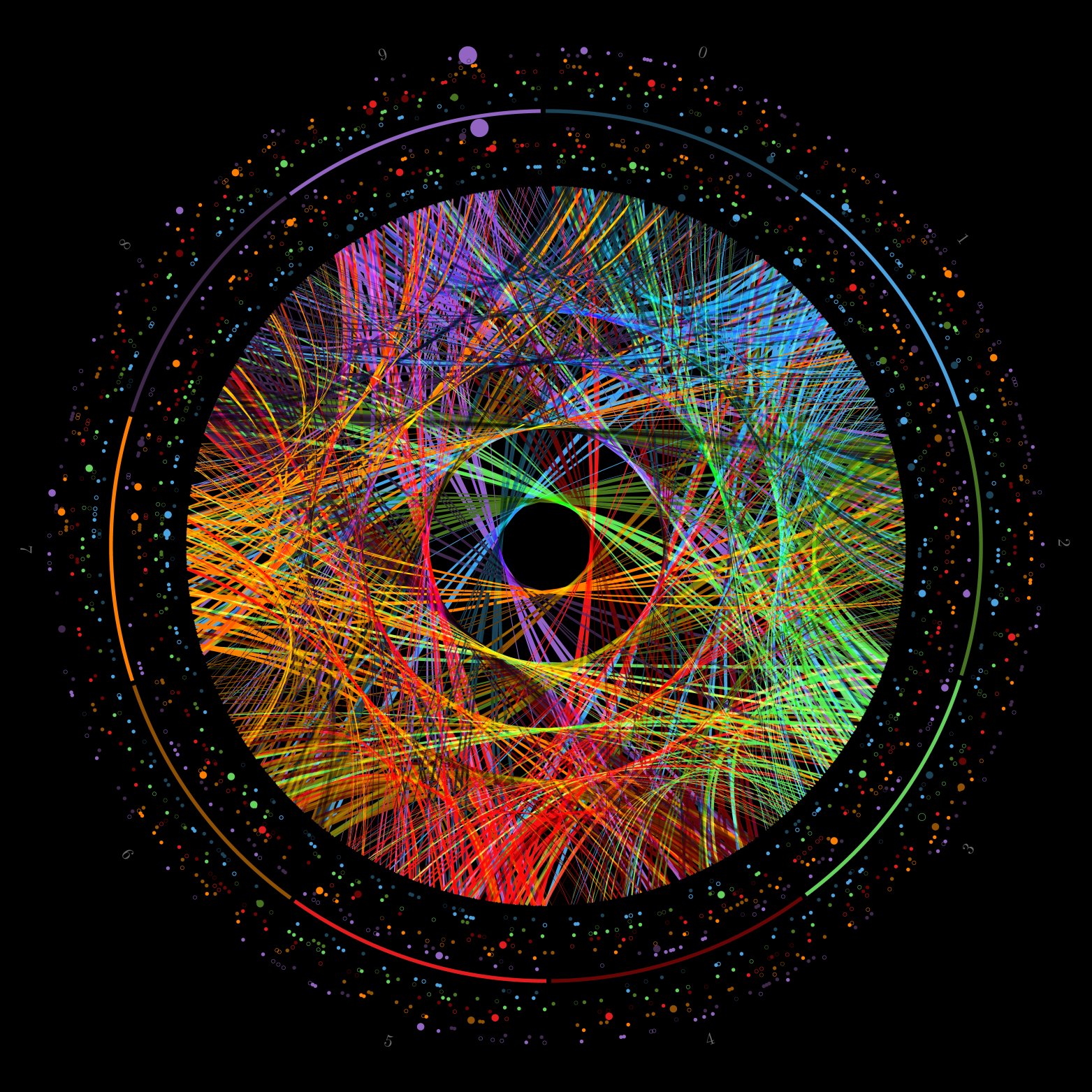
path connecting segments traces out the digits
of π. Here the transition for the 6 digits is
is shown. Concept by Cristian Ilies Vasile.
Created with Circos.
Martin Krzywinski, bioinformatics researcher and artist, has created a number of artistic representations of π (and other mathematical concepts) at that place where scientific visualizations meet art. He created Circos, a software package for visualizing data and information in a circular layout; he writes, "Cristian Ilies Vasile had the idea of representing the digits of π as a path traced by links between successive digits".

He found that they could weave  a mandala by continuing this process. Then he proceeded to add more employing concentric circles of dots to indicate the number of transitions between any two figures. The colour of the dot indicates which figure (0 through 9) was visited next and the size is proportional to frequency of a given transition.

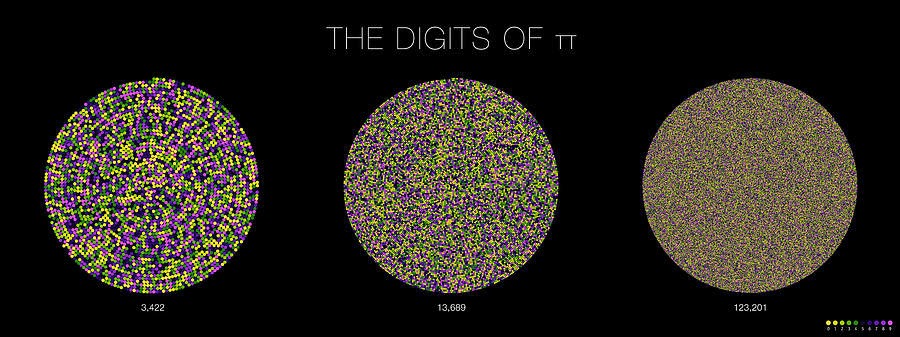
Check out his other lovely and fascinating projects (including how he mapped π on an Archimedean spiral, as above) on his site.


Martin Krzywinski, Progression and transition for the first 1,000 digits of π. Created with Circos. (PNG, BUY ARTWORK)

LinkWithin

Related Posts with Thumbnails